
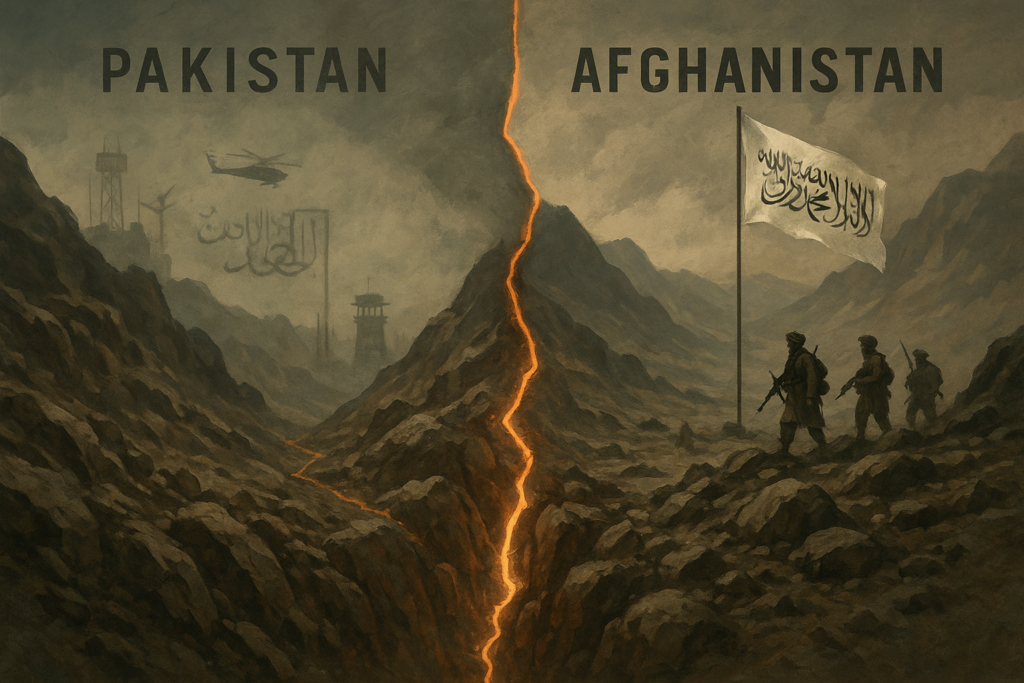
- The ongoing conflict signifies not only a deterioration of bilateral relations between the two Muslim nations but also the collapse of Pakistan’s longstanding strategy of backing Islamist groups in Afghanistan.
- Pakistan anticipated that its approach of ‘pan-Islamism’ would diminish the fervour of Pashtun nationalism and render the issue of the Durand Line insignificant, as Islam does not endorse territorial nationalism.
- The recent conflicts are the result of the inadequately formulated foreign policy of Islamism of Pakistan, which failed to acknowledge that ideology cannot override the national interest.
- A nation cannot compromise its fundamental interests in pursuit of religious dogma (Islamism), as shown by all of these conflicts and the Afghan Taliban’s reaction to them.
On November 25th, 2025, cross-border airstrikes occurred in Afghanistan, resulting in civilian casualties. Afghan Taliban spokesperson Zaibullah Mujahid stated that these air strikes were conducted by the Pakistan Air Force, resulting in the deaths of nine children and one woman. The Taliban has pledged to deliver an appropriate response to Pakistan’s aerial strike. Pakistan did not issue any statement over the incident; however, this aerial strike on Afghanistan followed the terrorist attack on the Pakistan Paramilitary Federal Constabulary headquarters in Peshawar, which resulted in the deaths of three officers and injuries to eleven individuals. Pakistan attributed responsibility to Tehrik-e-Taliban Pakistan (TTP), which utilised Afghan territory to execute this act of terrorism.
What has transpired between the two countries since August 15, 2021? The answer is complicated. Two primary factors underpin this conflict.
First, the Afghan Taliban dispelled the perception of being merely a client of Islamabad in Afghanistan. Since 2022, the TTP has carried out terror attacks resulting in the deaths of over 1,000 military personnel. Afghanistan is home to the TTP’s major military sanctuaries. Pakistan has accused the Afghan Taliban of permitting the TTP to operate from Afghan territory against Pakistan. Initially, Pakistan urged the Afghan Taliban to eradicate the TTP’s sanctuaries within Afghanistan. The terrorist attacks carried out by the TTP against Pakistan, however, did not decrease.
Second, the present character and severity of the conflict differ from those of previous disputes between the two nations. As the ongoing conflict becomes more intense, it involves extensive artillery exchanges, aerial assaults, suspension of commercial relations, and the repatriation of Afghan refugees from Pakistan.
The ongoing conflict signifies not only a deterioration of bilateral relations between the two Muslim nations but also the collapse of Pakistan’s longstanding strategy of backing Islamist groups in Afghanistan. This approach is designated as the foreign policy of Islamism. The foreign policy of Islamism seeks to advance the universal unity of Muslims irrespective of ethnicity. This policy of Islamism has historically been a fundamental component of Pakistan’s foreign policy before the nation’s independence. As Liaquat Ali Khan, Pakistan’s first Prime Minister, asserted that Pakistan would turn the ‘Muslim Brotherhood’ into a reality.
The significance of the Muslim Brotherhood increased in the context of Afghanistan, not merely because it’s a Muslim-majority nation but also because of the strategic challenges Islamabad encountered from Kabul. There were two primary contentions between the two nations: the Durand Line, which serves as the border between Pakistan and Afghanistan. First, the British Empire arbitrarily established the Durand Line in 1893, which Afghans found unacceptable. Therefore, in 1947, Kabul declined to acknowledge it as the international frontier between the two nations and opposed Pakistan’s membership in the United Nations. Secondly, Pashtun nationalism was founded on the idea of uniting Pashtun regions located in both Pakistan and Afghanistan. Both posed a security threat to Pakistan, which perceived it as an adversarial effort to encircle the country from multiple directions.
To address these two challenges posed by Afghanistan, Pakistan adopted a foreign policy centred on pan-Islamism. Pakistan anticipated that this approach would diminish the fervour of Pashtun nationalism and render the issue of the Durand Line insignificant, as Islam does not endorse territorial nationalism. Pakistan adopted the foreign policy of Islamism towards Afghanistan since the early 1970s, based upon two elements: first, installing a pro-Pakistani regime in Kabul, which would give a geostrategic depth to Islamabad against India. Secondly, Pakistan has favoured Islamists over Communists and Pashtun nationalists within the country. Islamabad supported Gulbuddin Hekmatyar’s Hizb-e-Islami in opposition to all other factions during the Afghan civil conflict. However, the most significant shift in Pakistan’s policy occurred with the Taliban’s assumption of control in 1996. Pakistan altered its support for the Afghan Taliban due to their rapid military success and their Islamic identity. The significant alteration to this policy occurred when Pakistan decided to participate in the United States’ military efforts against terrorism in Afghanistan. However, Pakistan did not cease supporting the Taliban over the new Republic government in Kabul. This decision became the primary factor for the worsening of Pakistan’s relations with Washington.
The return of the Taliban to rule on 15th August 2021 was regarded as a victory for Islamabad. At that time, Prime Minister Imran Khan contended that Pakistan had broken free from the chains of servitude. However, this initial optimism diminished as disagreements between the two nations arose. These events occurred due to the inadequately formulated foreign policy of Islamism, which failed to acknowledge that ideology cannot override the national interest. Ideology functions solely as a tool to achieve political objectives.
First, the Durand Line was not recognised as the legitimate border between the two countries by the Taliban in the past. The Taliban negatively perceived Pakistan’s construction of the Durand Line fence to secure its border. They perceived it as a unilateral effort to formalise the disputed border. Secondly, the Taliban’s triumph over Western forces established it as the sole guardian of Afghanistan’s sovereignty and territorial integrity. Such unilateral measures involving border fencing and unilateral Pakistani military operations did not go well with Kabul. Third, throughout history, Pashtuns have harboured considerable suspicion towards Punjabis for various reasons. They remain highly distrustful of the Punjabi-dominated Pakistani establishment. After September 11, under U.S. pressure, Pakistan swiftly abandoned the Taliban, reinforcing this suspicion.
Finally, TTP remains a significant source of tension between the two nations. For Pakistan, TTP poses a significant threat to national security due to its involvement in key terrorist attacks within the country. Pakistan urges the Afghan Taliban to eliminate these sanctuaries from Afghan territory. However, Afghanistan exhibits reluctance due to two primary factors: firstly, the ideological, ethnic, and emotive ties between the Afghan Taliban and TTP. Both primarily belong to the Pashtun ethnicity and adhere to the Deobandi Islamic school of thought. The Pakistani Taliban was the primary organisation that supported the Afghan Taliban by offering safe havens and fighters against Western forces during the War on Terror. The Afghan Taliban also did not consider taking action against TTP, as militants from this group would align with ISIS (Khorasan). This latter group presents a security hazard to the Afghan Taliban’s authority within Afghanistan. All of these factors prevent the Afghan Taliban from undertaking aggressive military operations against TTP.
A nation cannot compromise its fundamental interests in pursuit of religious dogma, as shown by all of these conflicts and the Afghan Taliban’s reaction to them. The Islamic concept of Ummah, even in its broadest interpretation, has proven insufficient to reconcile national differences and resolve ethnic and territorial disputes between Pakistan and Afghanistan. As a result, Islamism as a policy in Afghanistan by Pakistan has failed.

Mohmmad Rizwan is a PhD scholar in Political Science at Jamia Millia Islamia and is currently awaiting his final defence. His doctoral research examines Pakistan’s relations with key global powers. Views expressed are the author’s own.
 Archita Gaur
  Parag Gilada
  Anusreeta Dutta