
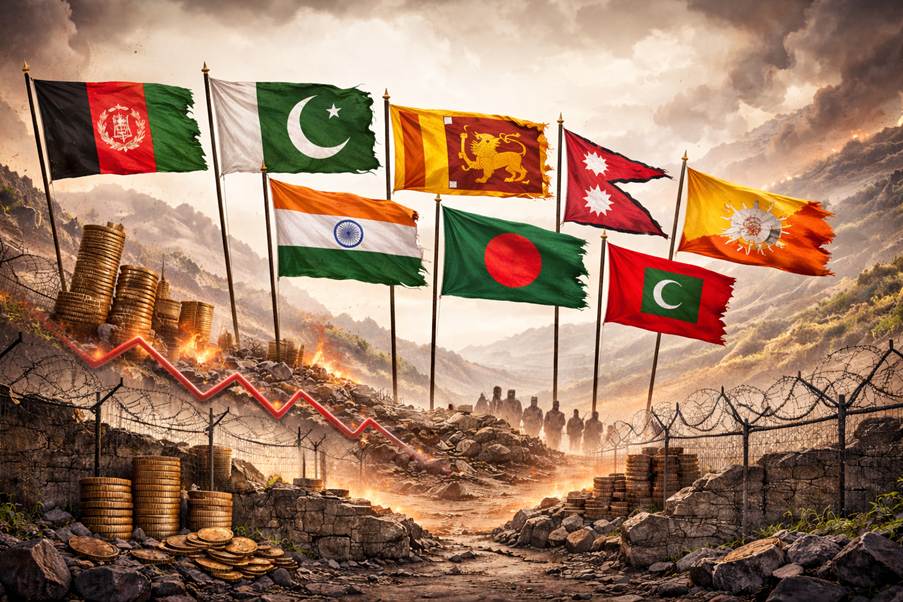
- The security of the region is now less about traditional inter-state rivalry and more about intersecting economic vulnerabilities, contested borders, and the increased salience of non-state actors.
- Security is no longer the preserve of inter-state competition; it is the outcome of non-state actors, porous borders, and weak state formations.
- Understanding the transition from bipolar rivalry to a fragmented security architecture might thus be the first step in analysing, and perhaps managing, the region’s emerging strategic challenges.
For several years, the entire Indian subcontinent was seen through a monolithic lens, the protracted India-Pakistan rivalry. The framework, though still applicable, does not adequately capture the region’s current turbulence. Recent tensions on the border between Pakistan and Afghanistan, sustained economic crises in Sri Lanka and Pakistan, political realignments in Bangladesh, and Afghanistan’s post-2021 limbo are symptomatic of a potentially much broader structural transformation. The security of the region is now less about traditional inter-state rivalry and more about intersecting economic vulnerabilities, contested borders, and the increased salience of non-state actors. The region appears to be evolving from a bipolar security order to a fractured strategic terrain marked by multiple layers, with economic vulnerability and domestic instability playing an increasing role in shaping geopolitical outcomes.
The 2021 return to power of the Taliban was supposed to be a recalibration of regional strategic calculations. Yet what followed between Pakistan and Afghanistan showed that even ideological convergence did not guarantee strategic control. Meanwhile, at least some subcontinental states are experiencing fiscal strain that has constrained state capacity, exacerbating domestic pressures and intensifying challenges to security. Combined with the great power competition between China and India interacting with these domestic contradictions, the subcontinent will enter a stage characterised less by decisive confrontation and more by sustained instability. To understand this metamorphosis, we need to go beyond traditional rivalries and instead focus on the systemic forces that are restructuring regional security.
The Erosion of the Old Security Architecture
For years, the region’s security architecture was built around the India-Pakistan rivalry in the subcontinent. The nuclearisation of the two states in 1998 also brought a form of deterrence stability which, although interrupted by several crises, prevented all-out conventional war. Even when things were heating up, excitement was confined to a known repertoire of signalling, retaliation and diplomatic cooling off. This bilateral contest was to dominate regional geopolitics, affording expressions to alliances, defence planning and the foreign policies of the great powers.[1]
However, recent trends suggest that the bipolar model is inadequate. The U.S. withdrawal from Afghanistan, leading to the return of the Taliban to power in 2021, was first seen in Islamabad as a strategic win, in line with its long-standing quest for “strategic depth.” Yet tensions between Pakistan and the Taliban-led government have rapidly escalated, especially over cross-border militancy and the Durand Line dispute. The continuation of Tehrik-i-Taliban Pakistan (TTP) bombings within Pakistan highlights not only the failure of the logic of proxy warfare but also the blowback of the security doctrines that were previously employed.[2]
Meanwhile, internal political instability across the region has started to converge with external security challenges. The civil-military tensions in Pakistan, the governance difficulties in Afghanistan, and changing domestic priorities elsewhere in the subcontinent make traditional deterrence thinking increasingly difficult. Security is no longer the preserve of inter-state competition; it is the outcome of non-state actors, porous borders, and weak state formations. The older structure, founded on a relatively stable India–Pakistan equation, now coexists with multiple, overlapping fault lines that are not easily pinned down to strategic categories.
Economic Fragility as a Security Multiplier
Economic fragility throughout the Indian subcontinent has intersected with and been intensified by regional security concerns. Fiscal tensions in Pakistan, extended debt restructuring in Sri Lanka, sanctions-driven economic paralysis in Afghanistan, and export dependence in Bangladesh paint a broader picture of fragile and vulnerable economic foundations across the region. These fragilities constrain state capacity, decrease fiscal space for governance and development, and increase dependence on external financial support. With rising interest rates and economic challenges piling up, there is domestic political tension, which can lead to security issues that spill over into other countries.[3]
Economic volatility further exacerbates underlying structural vulnerabilities such as the expansion of informality and cross-border economic dependencies. Poor labour markets, inflation, and cuts to social programmes can lead to social unrest and political instability, which in many cases serve as prime recruiting grounds for militants and help establish organised smuggling networks across porous borders. Border regions have long been sustained by informal trade and shadow economies, especially between Pakistan and Afghanistan, creating a distinct “border economy” where economic survival and security risk are intertwined. In this regard, when economic crises strike, they no longer just impact fiscal numbers, but instead act as force multipliers that increase regional instability and strain the security infrastructure of already fragile states.
External Power Competition and Strategic Realignments
The security architecture in the subcontinent is also being shaped by the participation of outside powers, especially the China–India strategic rivalry. Beijing’s economic and infrastructure engagement in the region, most prominently through the China–Pakistan Economic Corridor (CPEC) in Pakistan and earlier investments in Sri Lanka, has also placed the subcontinent at the centre of wider geopolitical contestations. At the same time, China’s tentative diplomatic approach to the Taliban-led regime in Afghanistan signals Beijing’s stake in regional stability, not least because of fears that the country might become a source of security threats linked to Xinjiang.[4]
At the same time, India has tried to increase its regional and global diplomatic visibility through development partnerships, humanitarian aid, and more involvement in an Indo-Pacific strategic framework. This double dynamic – China’s economic presence and India’s strategic outreach – has brought a new element of competition to an already volatile regional order. Yet instead of solidifying rigid alliance blocs, states in the Indian subcontinent now engage in pragmatic and transactional relations with external powers, balancing economic needs and strategic autonomy. The end result is a regional environment that is more fluid but also more uncertain.
From Bipolar Rivalry to Fragmented Regional Security:
In the latter decades of the twentieth century, the strategic context in the subcontinent could be analysed in terms of the stable India-Pakistan bipolar rivalry. Nuclear deterrence, notwithstanding intermittent crises, capped escalation and provided a framework within which regional security could take shape. Although there were tensions, the importance of the dyad implied that the vast majority of strategic thinking – whether by regional players or extra-regional powers – was geared towards managing or stabilising this rivalry.
Today, however, the region has come to display a more fragmented pattern of security concerns. Violence along the Pakistan–Afghanistan border, economic crises in several states, and the increasing prominence of non-state actors have added new dimensions of uncertainty that cannot be accounted for by the India–Pakistan subsystem alone. Security issues are not just a matter of traditional military confrontation; they encompass internal instability, cross-border militancy, and economic weaknesses, all of which interact in complex ways.
Such fragmentation does not mean the dissipation of traditional rivalries, but rather that the regional security environment has become more fragmented and multidimensional. The Indian Sub-continent is facing converging challenges such as domestic political instability, economic fragility, and changing external alignments, which are causing the lines between internal governance challenges and regional strategic competition to become blurred. The upshot is that the region is moving toward an environment of insecurity that is less determined by a single overriding rivalry and more shaped by multiple sources of turbulence.[5]
The security dynamics in the subcontinent cannot be fully understood through the prism of the traditional India–Pakistan rivalry that until recently monopolised the region’s strategic imagination. Although this continues to be significant, new challenges, including Pakistan–Afghanistan tensions and cross-border militancy, and widespread economic fragility, have reshaped the region’s security landscape. Domestic political instability, weak economic conditions, and porous borders are intersecting with interstate competition to create a more multifaceted and unpredictable regional system.
As these trends deepen, the Indian subcontinent seems set to enter a period shaped more by cumulative, overlapping vulnerabilities than by single crisis points. In this context, stability will require more than military deterrence; it will also require economic resilience, institutional capacity, and ongoing regional engagement. Understanding the transition from bipolar rivalry to a fragmented security architecture might thus be the first step in analysing, and perhaps managing, the region’s emerging strategic challenges.
References:
- [1] Kapur, S. Paul. (2005). India and Pakistan’s unstable peace: Why nuclear South Asia is not like Cold War Europe. International Security, 30(2), 127–152.
- [2] Staniland, Paul. (2017). Militant politics and Pakistan’s security policy. International Security, 42(3), 9–47.
- [3] Brück, Tilman, Naudé, Wim, & Verwimp, Philip. (2011). Small business, entrepreneurship, and violent conflict in developing countries. Journal of Conflict Resolution, 57(3), 397–421.
- [4] Rolland, Nadège. (2019). China’s Belt and Road Initiative: Underwhelming or game changer? The Washington Quarterly, 42(1), 127–142.
- [5] Acharya, Amitav. (2014). Global international relations (IR) and regional worlds: A new agenda for international studies. International Studies Quarterly, 58(4), 647,–659.

Archita Gaur is a postgraduate student at the School of International Studies, JNU. She specialises in the World Economy and has a strong interest in public policy, economic research, and governance. The views expressed are the author’s own.
 Amit Dasgupta & Uma Sudhindra
  Aayush Pal
  Divyanka Tandon