
|
Getting your Trinity Audio player ready...
|
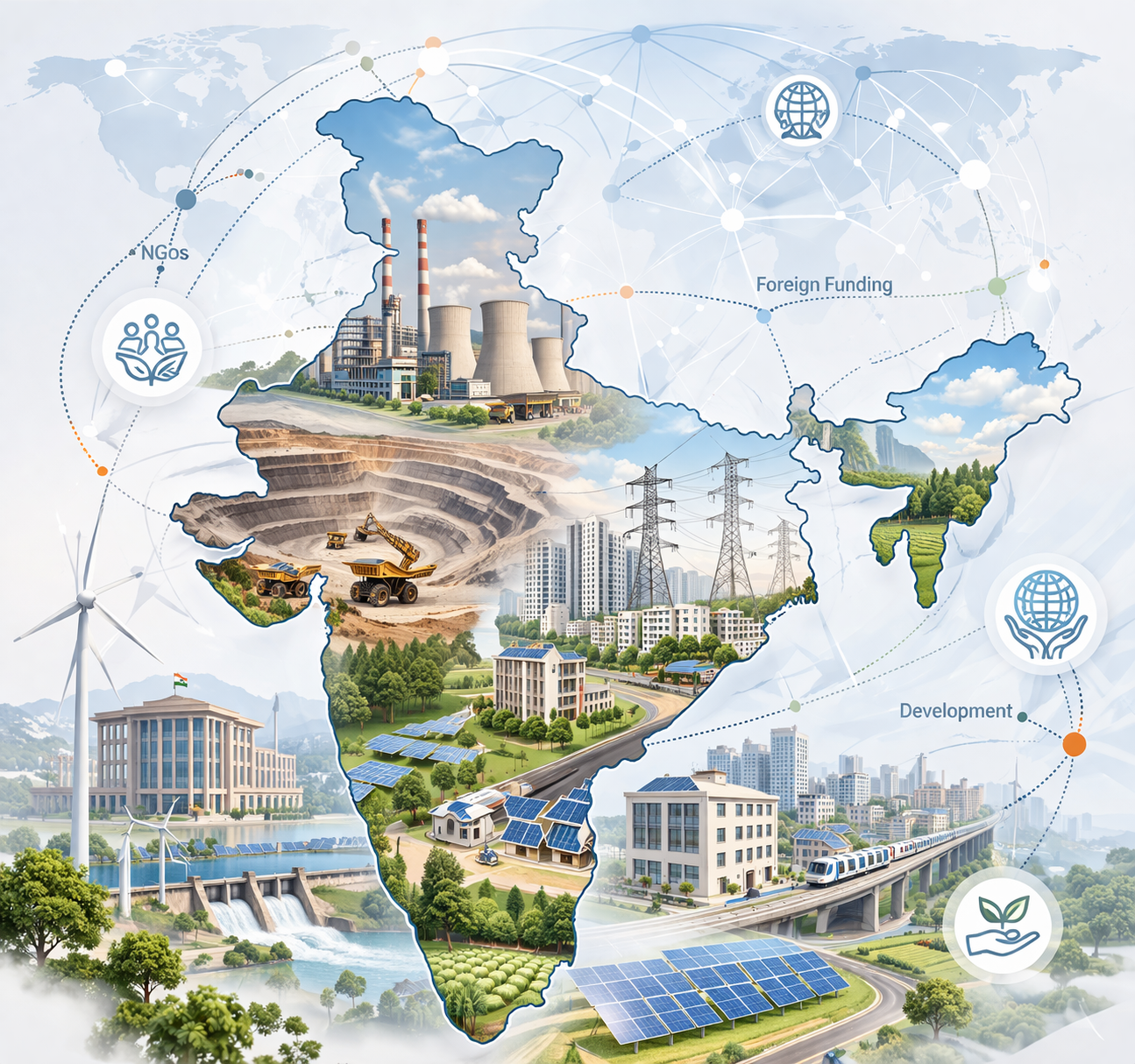
- There is a stealthy battle being waged against India’s rise, not with missiles or armies, but with clipboards, court filings, and cleverly worded “civil society” initiatives.
- The weapon is what can only be described as organised developmental obstruction, which is financed from abroad, carried out locally, and disguised in the language of environmentalism and human rights.
- In an economy straining to lift hundreds of millions out of poverty, a foreign-orchestrated drag of 2–3% GDP is not activism but is economic warfare.
- India is rising. The invisible hand trying to hold it back grows more visible by the day.
There is a stealthy battle being waged against India’s rise, not with missiles or armies, but with clipboards, court filings, and cleverly worded “civil society” initiatives. The battlefield is not a border; it is India’s coalfields, nuclear plants, ports, and mining sites. The weapon is what can only be described as organised developmental obstruction, which is financed from abroad, carried out locally, and disguised in the language of environmentalism and human rights.
India’s Intelligence Bureau (IB) left little to the imagination in a classified 2014 report titled “Concerted efforts by select foreign-funded NGOs to ‘take down’ Indian developmental projects.”
The investigation identified seven agitations as key “anti-developmental activities,” including those involving nuclear facilities, coal-fired power plants, GMOs, POSCO in Odisha, Vedanta in Odisha, the Narmada Bachao Andolan, and protests against extractive industries in the Northeast.[1] Especially, the IB accused these NGOs of “serving as tools for foreign policy interests of Western governments” by supporting agitations against nuclear and coal-fired power plants and assessed the detrimental impact on India’s GDP development at 2-3%.[2] This figure deserves to be absorbed. In an economy straining to lift hundreds of millions out of poverty, a foreign-orchestrated drag of 2–3% GDP is not activism but is economic warfare.
The Western Hand in India’s Backyard
A considerable number of Indian NGOs financed by donors located in the US, UK, Germany, and the Netherlands have been spotted leveraging people-centric concerns to create an environment conducive to stalling development programs, the report stated.[3] According to the article, Greenpeace has spearheaded a “massive effort to take down India’s coal-fired power plant and coal mining activity.” These were not spontaneous demonstrations of grassroots concern.[4]
They were carefully coordinated through pan-national networks, international seminars, and a purposeful strategy of internationalising local issues to put pressure on Indian politicians and investors.[5]
This is hybrid warfare under a different name. Rather than deploying armies, adversaries use funding. The footprint is small, the deniability high, and the harm structural. The goal is delaying India’s energy independence, constraining its resource development, and stunting its industrial rise, as strategic as any military objective.
The comparison to broader Western foreign assistance trends is noteworthy. USAID was founded in 1961 to counter the Soviet Union’s influence during the Cold War using soft power.[6] Its replacement apparatus, a network of Western-backed foundations, multinational NGOs, and “democracy promotion” funds, has carried on the heritage, but now focuses on controlling growing countries that refuse to accept Western-defined frameworks for development, governance, and energy choices. Even within the United States, this has sparked criticism: Secretary of State Marco Rubio said that USAID had “created a globe-spanning NGO industrial complex at taxpayer expense” and that development goals were “rarely met.”[7]
If Washington now admits that foreign aid was weaponised for geopolitical purposes, India’s fears are not paranoid; they are justified.
A Pattern, Not an Incident
What makes this concerning is not a single event, but a proven pattern. The Central Bureau of Investigation (CBI) accused organisations such as LIFE of using foreign donations to “target and stall coal projects.”[8] Other environmental and tribal organisations, including Greenpeace, Oxfam, and Citizens for Justice and Peace, have also been barred from using the Foreign Contribution (Regulation) Act (FCRA) provisions. According to the government’s FCRA dashboard, more than 20,000 NGOs have been removed from the list.[9]
The Centre for Policy Research, acclaimed to be one of India’s most prestigious think tanks, lost its FCRA license after it was discovered to have diverted funds to protests and produced documents that government officials claimed could harm India’s economic interests, including analyses of air pollution policy.[10] The Environics Trust’s licence was suspended for allegedly supporting rallies against steel and coal facilities.[11]
One must offer a pointed query here. Do Western environmental foundations support efforts opposing coal plants in China with the same zeal? Do they fund rallies against fracking in Texas or the Rhine Valley’s lignite mining in Germany? The answer, naturally, is no. India’s developmental decisions are selectively targeted, while donor nations freely utilise the same resources, revealing strategic hypocrisy rather than environmental care.
Genuine environmental concerns merit recognition and serious domestic resolution. Displacement is real. Pollution is real. Forest destruction is real. India’s constitutional framework and Supreme Court jurisprudence give mechanisms for redressing these issues. What is unlawful is the selective amplification of local concerns by foreign-funded groups, whose interventions are measured not by the severity of ecological damage, but by the strategic value of the project under consideration. A coal mine in Chhattisgarh faces a foreign-backed legal challenge,[12] whereas a strip mine in Wyoming does not have the same worldwide solidarity network.[13] The asymmetry is instructive.
The Red Corridor and the Thorium Opportunity
Here, the analysis reaches its most consequential dimension.
India holds the world’s fifth-largest thorium reserves, estimated at 846,000 tonnes, which are predominantly concentrated in the monazite sands of Odisha, Jharkhand, Andhra Pradesh, and Kerala.[14] Thorium isn’t only a mineral curiosity. It serves as the foundation for India’s three-stage nuclear programme, which was envisioned by Homi Bhabha in the 1950s as a long-term path to energy independence.[15] Stage three of that programme, thorium-fueled reactors with a closed fuel cycle, would provide India with a nearly limitless indigenous energy source, eliminating reliance on imported uranium and significantly lowering sensitivity to fossil fuel price shocks.
The topography of India’s thorium and other vital mineral assets almost perfectly fits with the Naxal-affected “Red Corridor” — the arc of central and eastern states that has been under Maoist insurgency since the 1960s. This overlap has never received the strategic attention it merits. Naxalism arose from genuine complaints, such as land dispossession, caste exploitation, and state neglect of tribal communities. These causes are real and should not be ignored. However, insurgencies, no matter how genuine their origins, can become strategically useful for external players who profit from the disruption they cause. The IB investigation and following FCRA enforcement actions demonstrate a pattern in which foreign-funded organisations utilised tribal and environmental framing to build legal and political resistance to mining operations in certain locations.[16]
The question is not whether tribal rights are important—they are—but if the worldwide attention and financial backing pouring into anti-mining campaigns in the Red Corridor has any bearing on the thorium and mineral map beneath it.
Coal India, NALCO, and other public-sector entities have experienced years of project delays in mineral-rich tribal areas, which are frequently fueled by foreign-funded campaigns.[17]
The strategic stakes for thorium are particularly significant. A nation that successfully develops thorium-based nuclear technology on a large scale would not only attain energy independence but would also become a global exporter of nuclear technology, lowering the leverage of uranium-supplying states and establishing a new axis of energy geopolitics. Sustained instability in the Red Corridor, whatever its reasons, acted as a barrier to this future.
The Moment India Is In
The operational collapse of Naxalism, aided by prolonged security operations, improved local government in tribal districts, and the Maoist movement’s own organisational disintegration, is more than just a counter-insurgency success story.[18] This is a strategic opening. As the threat diminishes, the logistical and legal room for developing the crucial mineral belt grows. India’s National Critical Minerals Mission, which began in 2023, and the Department of Atomic Energy’s reinvigorated drive for thorium research provide the policy foundation for grasping this opportunity.[19]
The objective is to ensure that the regulatory framework, particularly FCRA enforcement and environmental clearance processes, does not allow for a repeat of the old obstruction model with new vehicles. Domestic environmental adjudication must be enhanced, not to quell dissent, but to ensure that foreign-funded opposition aligned with foreign strategic objectives does not have the same standing as legitimate domestic stakeholders.
India’s civilisation has always recognised that artha — material wealth and statecraft- is inextricably linked to dharma. A nation that cannot defend its resource base, govern its development routes, or safeguard its energy future from external manipulation is not really sovereign, regardless of its diplomatic statements. The thorium question, which has been long delayed, is strategically important and geographically complex. It will test India’s ability to translate its declared commitment to Atmanirbhar Bharat into the arduous, unglamorous labour of safeguarding what lies beneath its own soil. India’s strategic autonomy—its refusal to identify with either Washington or Beijing—requires civil society to be as disciplined.
The FCRA amendments are not an assault on civil society, but rather a defence of sovereignty—the bedrock of any true civic space. Activists entrenched in Indian communities have nothing to fear from transparency; only those serving outsider agendas should.
India is rising. The invisible hand trying to hold it back grows more visible by the day.
References:
- [1]The Intelligence Bureau Report On NGOs And What It Says
- [2] Foreign-funded NGOs stalling development: IB report [India]
- [3] Foreign-aided NGOs are actively stalling development, IB tells PMO in a report
- [4] Intelligence Bureau says Greenpeace endangers economic security
- [5] IB report says Greenpeace a threat to national economic security; GP says report to muzzle civil society voices
- [6] Foreign Aid or Strategic Influence? Examining USAID’s Operations in India
- [7] Making Foreign Aid Great Again
- [8] CBI registers case against environmental lawyer Ritwick Dutta and LIFE for FCRA violation
- [9] Govt cancels more FCRA licences of NGOs over ‘violations’, second time in a month
- [10] Disproportionate act: CPR on FCRA licence cancellation
- [11] CBI registers FIR against NGO Environics Trust, its directors for ‘funding’ agitations in Odisha
- [12] Coal India accused of bulldozing human rights amid production boom
- [13] Court Defends Climate Overturns Massive Coal Mining in Wyoming
- [14] India Sits on the World’s Largest Untapped Energy Reserve. Why Aren’t We Burning It?
- [15] https://x.com/SadaaShree/status/2041340324384301326?s=20
- [16] https://x.com/sougat18/status/2041225903532040664?s=46
- [17] NALCO’s overseas projects delayed due to policy issues
- [18] After March 31, Where does India stand in its fight against Naxalism?
- [19] India Steps Up Exploration, Mining and Value Addition of Rare-Earth Minerals

Pranav S is a Project Assistant at the Energy Department, Government of Karnataka with an MA in Public Policy. Views expressed are the author’s own.
 Ajith Shetty Heranje
  Atri Patel
  Anusreeta Dutta