
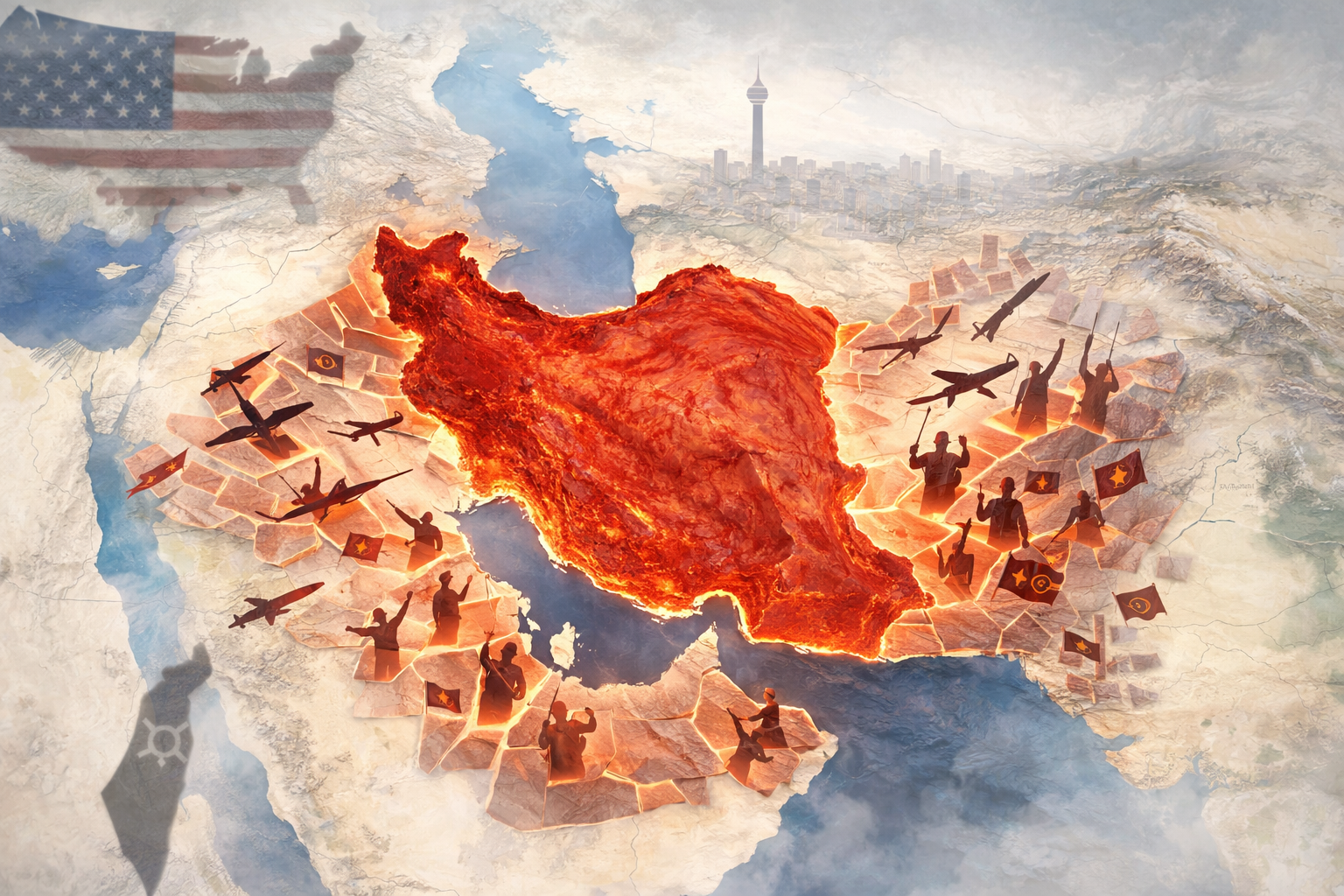
- Iran’s cultural isolation in its immediate neighbourhood is an important factor influencing Iran’s anxiety about its national security.
- For Khomeini, the goal and achievement of the revolution was to restore Iran’s independence after two centuries of external domination, and Islam was a vehicle for achieving such independence.
- Through its ‘forward Defence doctrine’, Iran has supported regional proxies such as Hezbollah, Hamas, Houthis and militias in Iraq and Syria so that the US and Israel were kept preoccupied enough to prevent them from initiating direct conflict with Iran.
- Iran’s Grand Strategy, with its overemphasis on increasing the Islamic regime’s regional influence, has failed to address the economic and political aspirations of Iran’s population.
The Concept of Grand Strategy
The concept of grand strategy was initially used in the military to define the requirements for a successful military force in both wartime and peacetime. During peacetime, grand strategy continues to be important – namely, how the state can retain peace through deterrence and coercion. Other components of grand strategy include alliance-building, diplomacy, economic policies, intelligence, and propaganda.
Grand Strategy is an expansion of traditional strategy in three key ways:
- Inclusion of non-military means, including diplomatic, economic, and informational means,
- Examination of the necessary internal policy, such as military conscription
- Considerations for peacetime as well as wartime
In sum, once a state identifies its goals, from a policy perspective, everything the state does to achieve them should be oriented toward meeting those goals. Every policy the state enacts should be part of and in service to the grand strategy.
Iran’s Grand Strategy: An Overview
The following factors have influenced the Grand Strategy of the Islamic Republic of Iran.
Cultural Isolation: Iran’s grand strategy has been greatly influenced by its history. Iran sees itself as a grand civilisation. But it is a lonely civilisation as many Muslim Sunni-dominated states surround its mainly Muslim Shia population. Modern Iran was created by the Safavid dynasty in the 16th century, which adopted Shia Islam to distinguish itself from the Ottoman Empire.
Iran is also home to Persian-language speakers in a region dominated by Arabic- or Turkic-speaking populations. Iran’s cultural isolation in its immediate neighbourhood is an important factor influencing Iran’s anxiety about its national security.
Fear of Foreign Interference in domestic affairs: During the 19th century, Iran was brutalised by European imperialism, losing territory to Russia and Britain. Its economy was also deeply influenced by external powers’ interventions.
Natural resources, particularly oil, have influenced Iran’s role in regional and global geopolitics since the 19th century. Iran remained under the influence of Britain and Russia until the Second World War.
In 1953, Iran’s Prime Minister, Mohammad Mosaddegh, was overthrown in a British and US-supported coup to protect British and American oil interests following the nationalisation of the country’s oil industry. The 1953 coup brought Iran under the influence of the United States. It enabled Iran’s ruler, Shah Mohammad Reza Pahlavi, to maintain his rule with American support until the 1979 Islamic Revolution.
Iran under Shah Mohammad Reza Pahlavi from the early 1950’s until 1979 maintained a quiet, pragmatic partnership with Israel rooted in shared strategic interests. Iran supplied up to 60 per cent of Israel’s oil through a discreet pipeline. Israeli El Al flights connected Tel Aviv and Tehran. Israeli experts aided Iranian agriculture, while Iranian students studied in Israeli universities.
Israel’s Mossad intelligence agency, along with the US Central Intelligence Agency (CIA), helped train the Shah’s secret police, SAVAK. During this period, both Iran and Israel saw themselves as non- Arab powers in a hostile region, fostering alignment based on mutual security concerns.
The Shah was ousted in 1979 in the Iranian revolution, led by Ayatollah Ruhollah Khomeini, an Islamist cleric. For Khomeini, the goal and achievement of the revolution was to restore Iran’s independence after two centuries of external domination, and Islam was a vehicle for achieving such independence.
Anti-US and Anti-Israel foreign policy stance: In November 1979, Iranian students stormed and closed the US embassy in Tehran, taking 66 Americans hostage. Khomeini approved this because he was convinced that if there were a US embassy in Iran, there would be an attempted repeat of the 1953 coup. Ayatollah Khomeini’s new Islamic regime also cut off diplomatic ties with Israel, declared it an enemy, and openly shifted political and ideological support towards the Palestinian cause. This shift towards greater support for the Palestinian cause was an attempt by Iran’s Islamic regime to gain greater support among the majority Sunni Muslims across the world.
This also marked the beginning of Iran’s hostile relations with both the United States and Israel, with Iran’s clerical leadership labelling the United States “The Great Satan” and Israel as “The Small Satan”.
Lessons of the Iran-Iraq war: A defining event in shaping Iran’s grand strategy was the eight-year-long Iran-Iraq war, which began with the Iraqi invasion of Iran in September 1980. This war left Iran with the feeling that the whole world was against it, as the wider international community, which included the Arab countries, the United States, Western European countries and the United Nations, supported Iraq. So, the lessons of the Iran-Iraq war that Iran is alone and must be independent and self-reliant became ingrained in Iran’s Islamic regime, as well as in the leadership of Iran’s Islamic Revolutionary Guard Corps (IRGC).
Leveraging Iran’s nuclear program to engage the West and ease the burden of economic sanctions: In the 1970’s, the then US Secretary of State Henry Kissinger played a significant role in supporting Iran’s civil nuclear program under the Shah by authorising plans to sell billions of dollars in nuclear equipment to Iran, intending to help the country transition away from oil reliance. However, following the 1979 revolution, the US and Israel have become concerned that Iran has been using its civil nuclear infrastructure to develop nuclear weapons. This has led Iran to engage with allies of the US, particularly the countries of the European Union, to reach some sort of diplomatic agreement on the nuclear issue, which in turn could lead to the West, including the US, lifting economic sanctions against Iran.
Thus, Iran’s interest in the 2015 Iran nuclear deal or Joint Comprehensive Plan of Action ( JCPOA ) was a de facto means of opening to the West, without the fanfare of establishing diplomatic relations.
However, US President Donald Trump’s withdrawal from the JCPOA in 2018 and the bombing of Iran’s nuclear facilities in 2025, as well as the current joint US -Israel bombing campaign against Iran, indicate that this aspect of Iran’s grand strategy has been a failure.
Forward Defence Doctrine: Through its ‘forward Defence doctrine’, Iran has supported regional proxies such as Hezbollah, Hamas, Houthis and militias in Iraq and Syria so that the US and Israel were kept preoccupied enough to prevent them from initiating direct conflict with Iran. But the outbreak of the Gaza war in October 2023 proved to be a big turning point with Israel’s successful degradation of these groups. Iran’s ‘forward Defence doctrine’ has also received a further setback with the fall of the Iran-friendly Assad regime in Syria.
Iran’s Mosaic Defence and the current escalating conflict in West Asia
The current joint US – Israel military campaign against Iran has been successful in killing several Iranian political and military leaders. In response, Iran has devised a military strategy known as Mosaic Defence, which emphasises that Iran should keep on fighting even if its leaders are killed.
Rather than a single central command, Iran divides its military into 31 semi-independent units. Like tiles in a mosaic, each piece can fight on its own, even if the centre collapses. Iran’s Mosaic Defence consists of the following three elements:
- Strategic Depth
- Asymmetric Deterrence
- Decentralised Command
Command and Control is moved away from the “Vulnerable Centre” ( Tehran ) into the “Resilient Periphery”, hence no single strike by the US and Israel can end the war. Iran observed that centralised regimes collapse the moment their “Head ” is removed.
Iran’s Foreign Minister Abbas Araghchi said, “We have had two decades to study defeats of the US military to our immediate east and west. We‘ve incorporated lessons accordingly. Bombings in our capital have no impact on our ability to conduct the war. The Decentralised Mosaic Defence enables us to decide when- and how – the war will end”.
Modern Warfare often targets leaders, command centres and communication systems. Iran’s response has been to make leadership replaceable and irrelevant. The Mosaic Defence System is designed to function, even if top leadership is eliminated.
Under Iran’s Mosaic Defence, each regional unit has its own weapons, intelligence, and command system. In effect, each unit is a mini-army with decentralised decision-making. Thus, even after senior leadership losses, Iran continues to launch missiles, drones and regional operations.
The risks associated with Iran’s Mosaic Defence include poor coordination, fragmented decisions and unintended escalation. For example, Iran’s strike on Oman was attributed to an autonomous unit.
Conclusion
Iran’s Grand Strategy has had a high cost in terms of Iran’s isolation in the international system. The Islamic regime’s aim to export its brand of Shia political Islam, known as Khomeinism, has resulted in suspicion and hostility of Iran’s largely Sunni Gulf Arab neighbours and has made them willing hosts to US military bases on their territories. The presence of US military bases in Iran’s immediate neighbourhood only further increases its insecurity.
Since the outbreak of the Gaza war and the start of the current conflict in February 2026, Iran’s forward defences have been virtually demolished. Iran’s Mosaic Defence also risks dragging the country into a never-ending cycle of conflict in the absence of adequate security guarantees from the international community.
Iran’s Grand Strategy, with its overemphasis on increasing the Islamic regime’s regional influence, has failed to address the economic and political aspirations of Iran’s population, which has resulted in civil unrest against the country’s Islamic regime. However, rapid change in Iran is difficult because its politics is riddled with factions, from hardliners to reformers, as well as minority ethnic groups such as the Kurds, Arabs, Baloch, and Azeris, who are demanding greater political, economic, and cultural autonomy vis-à-vis Iran’s majority Persian ethnic group.
However, the recent joint US – Israel military campaign against Iran, with the stated goal of regime change, could result in temporarily uniting Iran’s population behind the Islamic regime in the cause of resisting foreign aggression and foreign interference. This indicates an often overlooked and important aspect of the Islamic Republic of Iran’s Grand Strategy, which is to mobilise Iran’s diverse population against perceived external threats by using Iranian nationalism and not just political Islamic Shia ideology.
References
- Nasr, V (2025). Iran’s Grand Strategy: A Political History. Princeton University Press
- Notre Dame International Security Centre (2022). The History and Importance of Grand Strategy in IR. Retrieved from https://ondisc.nd.edu/news-media/news/the-history-and-importance-of-grand-strategy-in-ir/
- Roushan, V ; Sharma, N ; & Kaushiki, N ( 2023 ). Tracing the Structures and Factors Influencing Iranian Foreign Policy. Retrieved from file:///C:/Dhruv/2%20nd%20Scopus%20publication%20%20reading%20%20materials/Iran’s%20foreign%20policy.pdf
- Samriddhi Vij ( 2026 ). Iran’s Mosaic Defence strategy. Retrieved from https://www.instagram.com/p/DWJjC7qD3Tm/?igsh=MTNheWZnNHVxenp4OQ==
- The Soufan Centre (2026). Iran’s ‘Mosaic Defence’ Strategy: Decentralisation as Resilience Factor. Retrieved from https://thesoufancenter.org/intelbrief-2026-march-9a/
- West, J (2026). Iran’s Grand Strategy. Retrieved from https://www.realcleardefense.com/articles/2026/03/16/irans_grand_strategy_1170579.html

Dhruv Ashok is a PhD research scholar from Christ (Deemed to be University), Bangalore. He writes on current affairs and international politics. His areas of interest include conflict resolution and historical narratives. Views expressed are the author’s own.
 Pranav S
  Ajith Shetty Heranje
  Atri Patel