
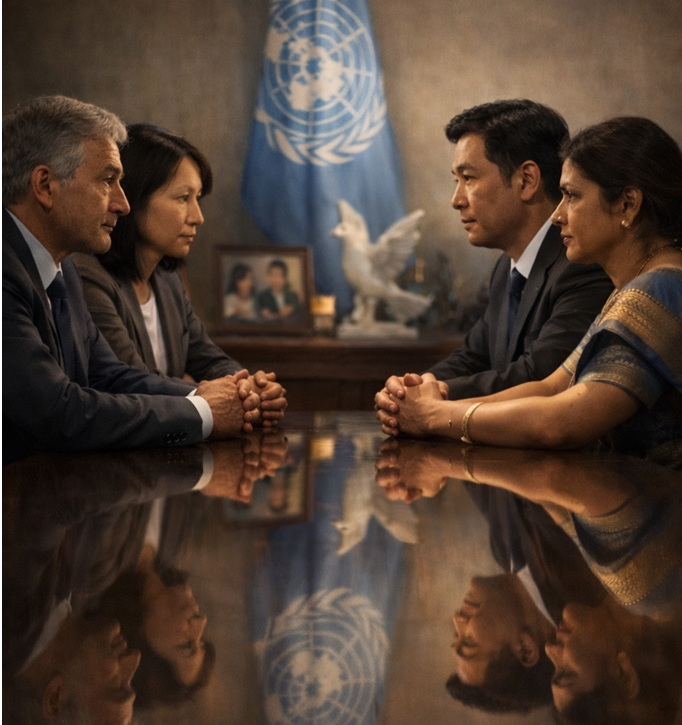
- Collaboration is a key element, as negotiations are not a one-way communication but rather a dialogical process.
- If either side feels they are losing face because of recalcitrance on the part of the other side to accommodate a differing point of view, negotiations will break down and often, irreparable damage can ensue.
- In the Mahabharat, the Kurukshetra war became a necessity because of Duryodhana’s ego and his arrogant refusal to concede to any requests for an amicable solution.
- Successful negotiators know that the most crucial aspect of negotiation is preparation, or the pre-negotiation phase.
We are constantly negotiating, either with our spouse, our parents, our children, our friends, work colleagues, or our boss, to name a few. The list is endless. With all this practice and exposure, each of us ought to have mastered the art of negotiation. Yet, many of us fall woefully short, though it would be fair to say that some negotiate better than others. It is, however, possible to improve and enhance our negotiation skills provided we are clear on why we are negotiating in the first place, who we are negotiating with, what we hope to achieve in the end, and how we propose to negotiate to best advantage collaboratively. Collaboration is a key element here, as negotiations are not a one-way communication but rather a dialogical process.
Negotiation is not a contest to be won; it is a conversation to be sustained.
Negotiation is not, in other words, a static process. It is the active art of recognising that the process of negotiation is constantly evolving and that we need to be mindful of this dynamic movement. Consequently, the so-called red lines also need to be in harmony to adapt and accommodate changing circumstances without compromising on key interests.
Simply put, negotiation is the process through which two parties, with differing points of view, jointly agree. There can also be situations we suddenly find ourselves in, in which we need to negotiate, such as an angry customer, for instance, or a road accident, or an unexpected job loss, or the diagnosis of a terminal illness. How we handle or manage such a situation is also a form of negotiation, and often, a challenging one, as we not only need to navigate the sudden development as best as we can but also dialogue with family and others, who would be equally impacted by the development.
As Stephen Cohen wonderfully put it, how we see a problem is often the problem. Crucial to our negotiating strategy is our attitude and approach. This applies equally to negotiating a situation as it does to negotiating with other people. A negative mindset is half the battle lost even before you sit down to negotiate. This often happens in the work environment where management adopts a confrontationist approach with union representatives seeking better working conditions. It also happens in a family environment between spouses, where refusal to even hear an alternative point of view is brusquely rejected.
A popular misconception is to see negotiations as deal-making. While you certainly want to arrive at the best possible outcome, negotiations are as much about ‘taking’ as they are about ‘giving’, or put differently, successful negotiations are the best possible win-win under prevailing circumstances. This means that both sides are willing to lose or sacrifice something (shifting their red lines) while keeping the bigger outcome in mind.
Negotiations, therefore, cannot and should not be entirely adversarial in nature and demand, even though it may well be a negotiation-initiation ploy when the two sides sit across from each other. Both sides enunciate their individual Lakshman rekhas to start with. In a negotiation, these red lines are flexible and not set in stone. It is understood at the outset that concessions and some degree of backtracking would take place. Without this, the negotiation would collapse. The most consequential negotiations today succeed not through coercion or clever tactics alone, but through a dialogical approach – continuous engagement, adaptive dialogue, and emotional intelligence. This is not idealism. It is a hard-nosed strategy.
Successful negotiations are the best possible win-win under prevailing circumstances.
If either side feels they are losing face because of recalcitrance on the part of the other side to accommodate a differing point of view, negotiations will break down and often, irreparable damage can ensue. Trust is lost, and restarting the negotiation process can be far from easy. The challenges in trying to end the Russia-Ukraine conflict, for instance, through a negotiated and brokered settlement, are a good example. Russia feels genuinely threatened by NATO’s expansion and by the combative European approach, while Ukraine fears loss of territory and its sovereignty. Hardline positions make negotiations impossible and are challenging roadblocks to navigate.
Crucial to negotiations is the communication strategy. A confrontationist and talking-down approach can result in one side walking away from the negotiation table because it feels undermined and humiliated, and further, it believes that the other side has not come with good faith and intent to find a workable, acceptable, and sustainable solution to the situation at hand. In the Indian epic, the Mahabharat, for instance, the Kurukshetra war became a necessity because of Duryodhana’s ego and his arrogant refusal to concede to any requests for an amicable solution. Deeply disappointed, Krishna told the Pandavas that there was no choice but to fight the Kauravas, as it was their bounden duty to uphold dharma (righteousness).
Who one negotiates with determines how one negotiates, including what our best communication strategy ought to be. We don’t negotiate with our children on the need for polite behaviour or the benefits of eating vegetables, for instance, in the same way as we would with a terror group on the release of hostages, or when we are negotiating a property purchase. Negotiation strategies, consequently, shift and vary depending on the situation, circumstances, and our counterpart negotiator.
Successful negotiators know that the most crucial aspect of negotiation is preparation, or the pre-negotiation phase. You need the following as completely as possible:
- An understanding of the scenario (What has brought you to the negotiating table? Why, in other words, are you negotiating?)
- Everything possible about the person or persons you are negotiating with (How does the other person think/behave? Is he authorised to negotiate or does he have a boss, who is the real negotiator?)
- What are your red lines? (What can you not give in to, what you need to achieve, what is a desirable outcome? What will the other side find non-negotiable?)
Effective negotiation begins long before the table. Meticulous preparation, internal brainstorming, and multi-source inputs ensure that clarity, not confusion, shapes engagement, especially when the other side arrives equally prepared.
Successful negotiators know that they should never underestimate the other side. They constantly focus on reading their mood and body language. Non-verbal communication is as important as what is loudly spoken. Indeed, it is often more important. The best counter to threats, outbursts, and anger is a calm response. Many of us are aware of how family misunderstandings get messy because an outburst by one is met with a louder outburst from the other. Both sides are scoring points, and nothing is achieved. In unfortunate cases, even physical violence occurs. Strong negotiators know that their strength lies in calm behaviour. It helps them think better. It also helps them understand what the constraints of the other side are. This is critical to success.
While it is part of strategy to play good-cop/bad-cop, you need to know when to shift from playing Dr Jekyll to becoming Mr Hyde, and vice versa, but more importantly, whether such a shift in strategy is warranted by the circumstances at hand. The best negotiation is done when we can separate the person from the issue. Terrorism, for instance, does not negotiate, whereas terrorists do. The person sitting across the table is not as important as the issues at stake. He is only the acting spokesperson for the side he represents. Like you, he is smaller than the issue that lies at the heart of the negotiation. Stay focused on the issue. If you are negotiating a property purchase, the fact that the property is put up for sale is a clear demonstration that the seller is open to negotiating the best possible price and is usually open to concluding the deal early.
Remember, negotiation is both an art and a science.
This applies equally to all negotiation scenarios, whether it is a multilateral trade negotiation, a business deal, a hostage negotiation, or a family dispute. This is because negotiations are interest-driven and not position-driven. Consider the Hamas attack of October 7th, 2023, on Israel. In addition to murdering several men, women, and children, which was one of their key objectives (kill as many Israelis as possible), Hamas took 250 hostages, knowing that Tel Aviv would want to get their citizens back and that the government would be under enormous pressure from family members of the hostages to do so at the earliest. This was their second objective, as taking hostages was a ploy to open negotiations and to seek the release of Hamas operatives and sympathisers, who were in Israeli jails, in exchange for the hostages.
Following brokered negotiations, Israel released more than a thousand prisoners that Hamas identified, in exchange for the Israelis taken hostage. If Hamas did not wish to negotiate, it would have summarily executed all the hostages or not taken any hostages at all. Their sole objective in taking hostages was to secure the release of their cadre-mates in exchange. Negotiation means that the other side is open to talking and would, consequently, bargain for the best deal.
This is unlike the July 1976 Entebbe raid that was carried out by the Israeli Defence Forces to rescue Jewish hostages, who were among 250 passengers on board an Air France flight that was hijacked by armed terrorists. The Israeli government initiated negotiations through French authorities for the release and safe passage of the hostages, but the hijackers continued to stall and push the deadline. Fearing that continued attempts at negotiating with an unresponsive group might be unproductive and lead to a tragic outcome for the hostages, the Israeli government authorised an anti-terror operation, while making a public show of continuing negotiations to deceive the terrorists. Israeli commandos successfully carried out the assault, storming the aircraft, killing all the hijackers, and rescuing the hostages.
This departure from the negotiation process was made after a carefully calculated assessment that the negotiations were not likely to succeed and would, in fact, encourage other terror groups to target Israelis through similar terror operations. Walking away from negotiations and seeking an alternative route to achieving the primary objective of rescuing the hostages was driven by strategic assessments of whether negotiations would yield results and, thereafter, the conclusion that strategic compulsion necessitated an anti-terror operation as the best alternative. Such decisions are not taken lightly and require detailed planning and meticulous execution, as failure would certainly have resulted in loss of life for both the hostages and the commandos. It is pertinent to recall that the detailed planning was not restricted to the assault on the aircraft but also on the safe evacuation of hostages from Entebbe airport, which was under the control of an unfriendly government.
This kind of situation is, however, rare and unique, and not likely to be the sort of situation most of us would find ourselves in. However, it demonstrates the importance of assessing if the negotiations are heading in the direction of a mutually agreed outcome, or if it is best to adopt an alternative methodology to achieve the required objective. If the situation is a direct threat to your core interests or, as in this case, the national interest, protecting your interests justifies the means adopted. Before taking such a decision, it is critical to understand how the other side thinks, what its motives are, and to make a candid assessment of risk and next steps.
Negotiations are interest-driven and not position-driven.
William Ury, Director of Harvard’s Program on Negotiation, highlights listening as the cornerstone of effective negotiation — listen, listen, listen. Without deep listening, dialogue collapses into monologue. True listening extends beyond words to the unspoken, requiring mindfulness to detect concerns, motivations, and possible concessions from the other side. This skill allows negotiators to recalibrate their strategy in real time and align communication with the other side.
Ury’s second insight challenges the assumption that negotiations are binary. We frame them as management versus unions, government versus opposition, parent versus child, when the operative word should be and, not versus. A versus mindset breeds confrontation, and a mindset enables dialogue. More importantly, Ury reminds us that every negotiation has three sides: the two at the table and the wider circle of influencers – colleagues, families, communities, stakeholders – all of whom are affected by the outcome. Ignoring this third side weakens both strategy and sustainability of any agreement.
The Oscar-winning film Kramer vs. Kramer captures this dynamic vividly. While the conflict appears to be between husband and wife, the true third side is their child, emotionally torn and deeply affected by the outcome. The same pattern recurs across contexts: in management – union disputes, workers’ families bear the consequences; in hostage negotiations, families of captives are profoundly impacted by every decision. Recognising this third side is critical, for it imposes a heightened responsibility on negotiators to consider the broader human impact of their approach.
The Ten Commandments for successful negotiation can be summarised as follows:
- How we approach negotiations would determine how the negotiations proceed. An us-versus-them combative approach usually leads to failure.
- Never humiliate or undermine your counterpart negotiator. A disagreement with your spouse is understandable, but to talk down to and rubbish your spouse will certainly cause irreparable damage to the relationship.
- Before an important negotiation, preparation is the key.
- Learn to listen. Be mindful of what is being said and conscious of what is unsaid. Usually, it is the unsaid that is more relevant. Empathy is the key.
- Stay focused on what you would like to achieve. Negotiations are not about debating and proving points. It is about understanding and collectively finding a sustainable and amicable solution. The process needs to be dialogical.
- Don’t be in a hurry to find a solution. Take your time and, more importantly, give the other side time to find comfort. Unless there is a win-win, a long-term solution would be elusive.
- Negotiation is not a static process but needs to shift and alter as it absorbs what the other side is saying. Have flexible red lines, but do not compromise on the core ask.
- Avoid precipitating a walking-away-from-negotiation situation. You lose trust, and getting back to the negotiating table is difficult and time-consuming. Do not clutter the menu with new demands and developments, making the negotiation more challenging.
- Constantly assess how the negotiations are proceeding, so that tactics can change, if required.
- Negotiations are a team effort, and no negotiator should believe they can fly solo. Consult, brainstorm, reassess, re-evaluate. Failed negotiations impact the third side. Stay mindful of the consequences of failure.
Remember, negotiation is both an art and a science. Success lies not just in strategy, leverage, or economic calculus but in dialogue that respects emotional currents and adapts to ever-changing signals.

Amit Dasgupta is a former Indian diplomat with an interest in management studies. Uma Sudhindra is a strategy consultant and a member of the Advisory Board at Strategic Research & Growth Foundation & Centre for National Security Studies. Views expressed are the author’s own.
 Divyanka Tandon
  Faareha Usmani
  Archita Gaur