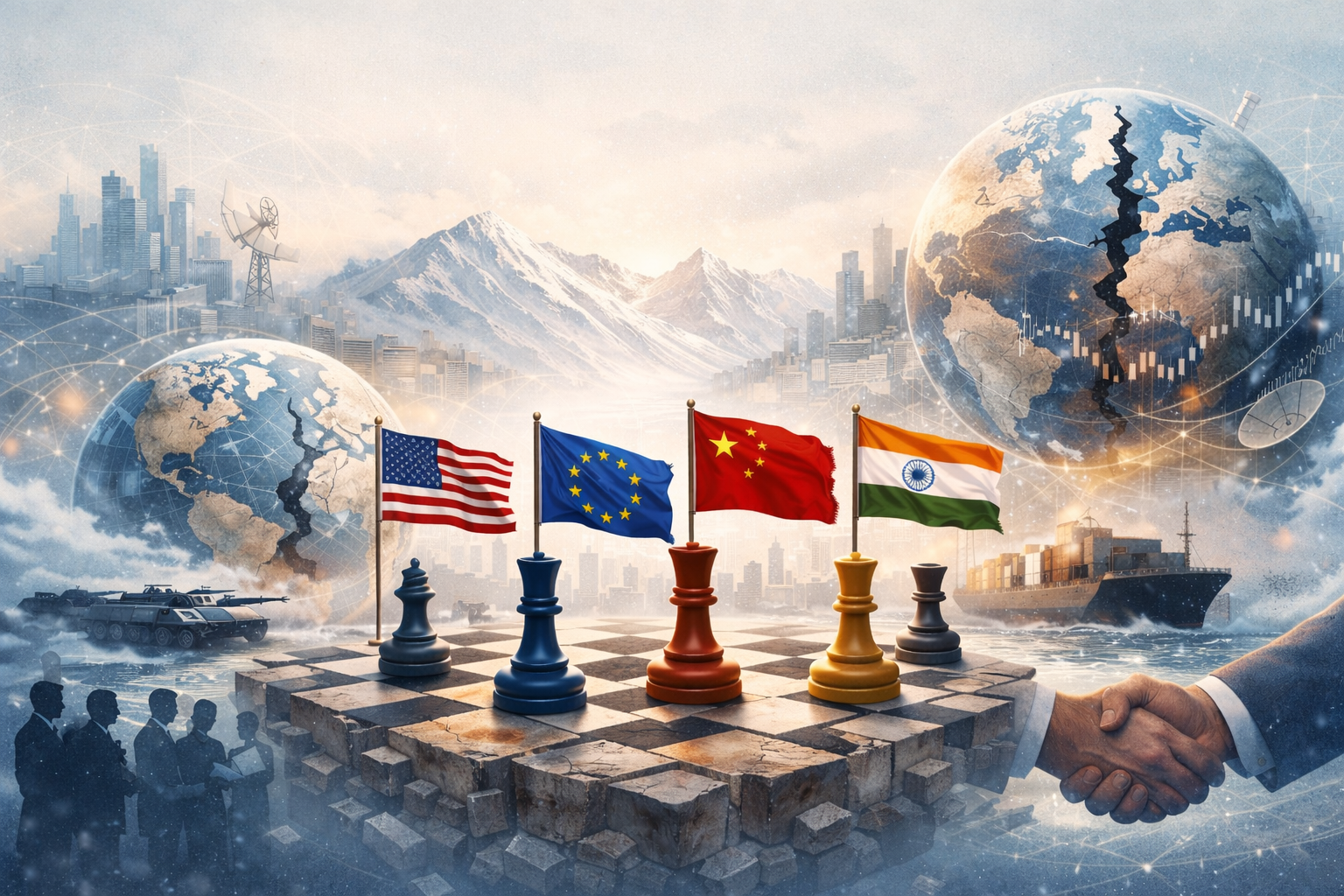
- What emerged most clearly was not simply a debate about trade policy or diplomacy, but a deeper fear, among America’s closest partners, that Washington is no longer a predictable guarantor of stability.
- According to Carney, the world has reached a moment where “middle powers are not powerless” but must build a new order that embodies shared values like human rights, economic stability, and sovereignty.
- EU and Canadian leaders sounded a warning: the old order is breaking, and the most destabilising force may no longer be distant adversaries, but the unpredictability of power within the Western alliance itself.
- For India, these developments are a strategic opportunity: to deepen partnerships, shape emerging norms, and help define the new era of global cooperation.
At the World Economic Forum in Davos 2026, the Western leadership confronted a reality that is reshaping international politics and economics. Particularly, the EU and Canadian leaders articulated that the post-Cold War global order that served their interests and was sustained by stable alliances, predictable norms, and collective institutions is no longer adequate to address rising competition and fracturing trust between major powers. Their speeches at the WEF reflected deep concern about strategic competition, economic coercion, and systemic fragmentation.
The West’s leadership outlined their strategy grounded in autonomy, diversified partnerships, and renewed multilateral engagement. What emerged most clearly was not simply a debate about trade policy or diplomacy, but a deeper fear, among America’s closest partners, that Washington is no longer a predictable guarantor of stability. For European capitals and Ottawa, the threat is not only adversaries abroad, but instability within the Western alliance itself.
A World in Flux: Leaders’ Shared Fear of the Change in ‘Self-serving Order’
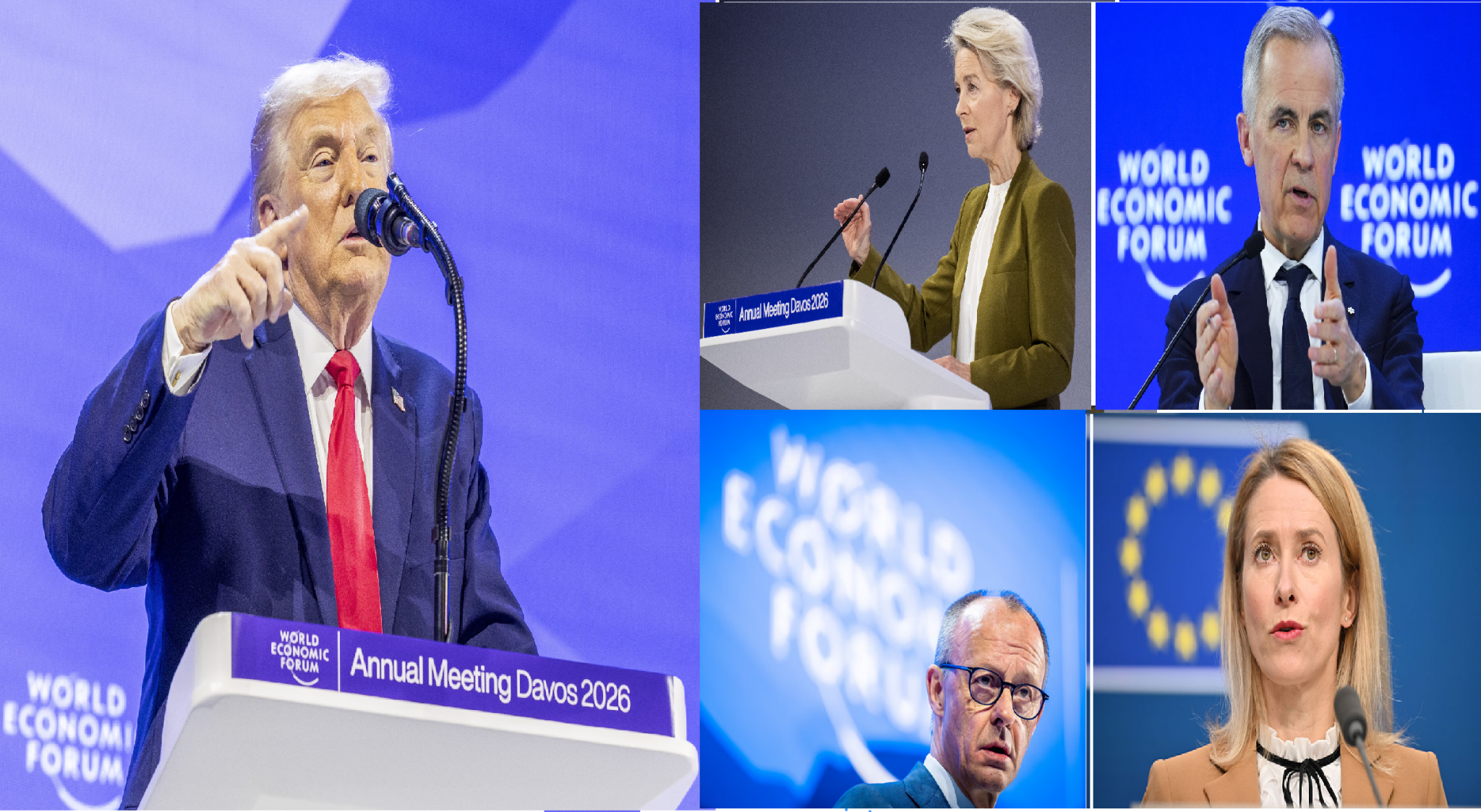
Canada’s Prime Minister, Mark Carney, was among the most direct in articulating how leaders perceive the transformation of the global order. In his address at Davos, Carney described a decisive break from the past, saying that the “rules-based international order”, that which was infact a self-serving order, that many nations have relied on to underpin cooperation, is fading. He characterised the current era as one driven by great power rivalry and acknowledged that multilateral norms and institutions no longer function with the authority they once did. According to Carney, the world has reached a moment where “middle powers are not powerless” but must build a new order that embodies shared values like human rights, economic stability, and sovereignty. Carney’s subtext was unmistakable: in a world where major powers increasingly act unilaterally, middle powers risk becoming collateral damage, caught between economic coercion, security uncertainty, and fragile institutions that no longer deter disruption.
That anxiety was echoed sharply from within the European Union’s foreign policy establishment. EU foreign policy chief Kaja Kallas acknowledged that transatlantic relations had taken a “big blow”, and that Europe was being forced to confront a “new reality” in its relationship with the United States, driven by unpredictability, pressure tactics, and an increasingly transactional approach to alliance management. Kallas’ assessment was significant because it reflected that strategic dependence on Washington is now a vulnerability that can no longer be ignored.
This fear was shared, in different words, by Ursula von der Leyen, President of the European Commission. Speaking at the forum, von der Leyen emphasised that Europe must adapt to “a new form of European independence,” amid ongoing geopolitical shifts, including trade tensions and the broader implications of unilateral actions by powerful states like the United States. She stated, “Europe will always choose the world, and the world is ready to choose Europe,” signalling a commitment to remain globally engaged while pursuing strategic resilience. This highlighted that Europe is preparing for a reality where access to markets, technology, and even political sovereignty could increasingly be subject to external pressure, even from allies.
Underlying their remarks was a common recognition that the world order, alliances, normative frameworks, and collective institutions that served them well are no longer reliable. Whether in trade, defence, or diplomatic frameworks, Europe sees global politics now as shaped by strategic competition and the need for self-reinforcement without abandoning cooperation.
The EU and Canadian leaders sounded a warning: the old order is breaking, and the most destabilising force may no longer be distant adversaries, but the unpredictability of power within the Western alliance itself.
Drivers of Disorder: How Power Politics Replaced the Old Consensus
At WEF 2026, several factors emerged repeatedly as drivers behind the shift in global order. The increasing assertiveness and unpredictability of major powers have strained shared norms. Trade and economic policy have become instruments of statecraft rather than neutral mechanisms for prosperity. U.S. President Donald Trump’s speech at the forum clearly highlighted this trend. Trump highlighted his administration’s economic achievements and reiterated support for using tariff authority as a negotiation tool. He asserted that the United States is “the economic engine on the planet” and defended his approach to tariffs and trade policy as central to ensuring American prosperity. Such rhetoric signals a departure from earlier eras where economic integration was principally justified on shared mutual benefit. For the EU and Canada, the anxiety is that economic interdependence, once seen as mutual advantage, has now become a vulnerability that can be activated overnight through tariffs, policy shocks, and transactional bargaining.
The Greenland controversy crystallised broader anxieties about territorial sovereignty, alliance cohesion, and the rules governing international relations. The episode was disturbing not merely because it raised territorial questions, but because it suggested that even within alliances, sovereignty itself could become negotiable under pressure. European leaders, in their address, emphasised the importance of respecting the sovereignty of nations and their territories, with von der Leyen reaffirming that the sovereignty of Denmark and Greenland was non-negotiable.
Erosion, Coercion, Rivalry: The New Triggers of Western Instability
Across speeches by EU leaders, several threats to Western stability were repeatedly cited. Erosion of norms and predictability emerged as a central concern, with leaders expressing that the norms that served them are being challenged, unilateral actions are becoming more frequent, and multilateral institutions are facing diminished authority. Economic coercion was highlighted as another major risk, as trade and economic tools are increasingly used to extract political concessions; Trump’s assertive tariff posture was presented as a clear example of this trend and a cause for concern among EU leaders.
Strategic rivalry was repeatedly emphasised, with great power competition particularly between the U.S., China, and Russia cited as a central dynamic reshaping global alignments; Carney’s framing of the world as entering an “era of great power rivalry” signalled this shift. German Chancellor Friedrich Merz reinforced this anxiety in unusually stark terms. Speaking at Davos, Merz warned that the old order is unravelling at a “breathtaking pace” as the world enters an era of “great power politics.” He described a system increasingly built on “power… strength… and when it comes to it, on force,” adding bluntly: “It is not a cosy place.” Importantly, Merz did not frame this as a distant geopolitical trend driven only by Russia and China—he explicitly pointed to the “radical reshaping of US foreign and security policy under Donald Trump” as a force accelerating Europe’s strategic insecurity.
The strain in the alliance was further illustrated through the Greenland episode, which highlighted how even longstanding alliances can become contested, with differing priorities raising questions about cohesion and mutual obligations. The underlying fear was simple: if the Western alliance cannot guarantee predictability, then no institution truly can.
EU and Canadian leaders signalled anxiety that tariffs are no longer economic tools but political weapons, used to extract concessions, reshape alliances, and impose obedience without firing a shot.
Autonomy Without Isolation: Europe and Canada’s Response to Coercion
European leaders and Canada’s prime minister outlined a set of strategic priorities aimed at mitigating these threats. None advocated retreat from global engagement; rather, they emphasised adaptation with resilience. Yet resilience, as framed at Davos, is no longer a development agenda: it is a security agenda. Diversification, autonomy, and industrial capacity are being treated as shields against coercion.
Carney encouraged middle powers to pursue cooperative strategies based on shared values and diversified partnerships, rather than relying solely on dominant powers. Von der Leyen and other EU leaders emphasised diversifying economic relationships, strengthening industrial and technological capabilities, and reinforcing Europe’s diplomatic engagement across regions and issues. Their approach combines autonomy and multilateral cooperation to reduce vulnerabilities while fostering collective influence.
Trump’s strategy, by contrast, prioritised American economic leadership and unilateral strength. His speech focused on U.S. economic performance, energy production, and the use of tariffs and national leverage in negotiations, presenting this as the foundation for global influence.
The Greenland episode crystallised a disturbing reality: even among allies, borders and territorial integrity can become bargaining chips, turning security guarantees into transactional deals.
Where Does India Stand as the West Falters?
For India, the faultlines in the West-dominated world order exposed at WEF 2026 present both strategic opportunities and complex choices.
On the economic front, Europe’s emphasis on diversified trade and resilient supply chains aligns with India’s own priorities. India’s large market, growing manufacturing base, and growing role in technology services position it as an appealing partner for European nations seeking alternatives to over-dependence on single markets. Enhanced trade with the EU could drive investment, technology transfer, and integration into high-value global value chains.
Strategically, India’s doctrine of strategic autonomy resonates with the EU’s emerging posture of cooperation without automatic alignment. This shared orientation opens potential for deeper collaboration in areas such as clean energy, critical minerals, defence technology, and digital governance. The anxiety in Europe and Canada also creates openings for India. As partners search for ‘safer’ economic and strategic alignments, India becomes not just relevant—but necessary. India could also play a more active role in the emerging networks of like-minded middle powers that Carney emphasised, contributing not merely as a beneficiary but as a co-architect of new cooperative frameworks.
However, India must also navigate the evolving dynamics between the United States and its partners. Trump’s assertive use of economic tools and transactional approach to alliances signals a world where states must balance relationships carefully, avoiding overdependence on any single power while managing geopolitical risks.
WEF 2026 revealed a global order in transition, one where old assumptions no longer hold, and new forms of cooperation must be forged. It highlighted the need for resilience, diversified partnerships, and principled engagement over unilateral strength and economic leverage. For India, these developments are a strategic opportunity: to deepen partnerships, shape emerging norms, and help define the new era of global cooperation.

Tejashree P V holds a Master’s degree in English Literature from IGNOU and a Bachelor’s degree in Journalism, English, and History from Vivekananda Degree College. A UPSC aspirant, she has a keen interest in international affairs, geopolitics, and policy.
 Sughosh Joshi
  Mohmmad Rizwan
  Anjali Singh