- Instead of retreating, Indian policymakers, led by Prime Minister Narendra Modi, turned constraints into strategic leverage.
- The tariff rollback is therefore not merely a trade adjustment but an acknowledgement that India is no longer a passive rule-taker.
- India’s ability to secure a historic EU agreement and then pivot back to Washington for a complementary deal demonstrates diplomatic dexterity in an era defined by crisis and rupture.
- What these developments reveal is a nuanced negotiation of interests, with India neither capitulating to external pressure nor sacrificing its energy autonomy.
In international politics, one nation’s setback often turns into another’s strategic opening. The adage holds as true today as it did in earlier eras of shifting blocs and realigned interests. The unfolding arc of India’s external economic engagements over the last few months — most notably the long-pending India–European Union Free Trade Agreement dubbed the “mother of all deals” and the surprising rekindling of U.S.–India economic ties under President Donald Trump- illustrates this dynamic with remarkable clarity.
At first glance, the landscape was inhospitable for New Delhi. Western capitals had been publicly critical of India’s energy choices. In 2025, the United States repeatedly pressed India over its imports of discounted Russian oil, arguing such purchases indirectly sustained Moscow’s war effort against Ukraine. That criticism came with teeth. New tariffs were imposed, including an additional punitive levy of as much as 25 per cent on Indian imports, compounding trade costs and squeezing exporters already navigating post-pandemic supply challenges. The Trump administration’s stance was blunt and transactional: India must align its energy sourcing if it wanted tariff relief and deeper commercial engagement. Critics in Washington accused New Delhi of “profiteering” by refining Russian crude at a time when much of the world sought to isolate Moscow economically. It was in this moment of external pressure that all four corners of India’s diplomatic strategy came alive. Instead of retreating, Indian policymakers, led by Prime Minister Narendra Modi, turned constraints into strategic leverage.
Two key facets stand out in how India played its cards: timing and triangulation. The turnaround on 2 February 2026 captures the essence of how deftly India has played its cards. After months of criticism and tariff pressure, President Donald Trump publicly praised India, calling it a “strong partner” and announcing a reduction of tariffs on Indian goods from 25 per cent to 18 per cent, while adding that a broader trade deal with India would be signed “very soon.” This was not an act of generosity; it was recognition of India’s strategic weight. New Delhi neither reacted defensively nor rushed into concessions. Instead, by advancing the India–EU trade deal and demonstrating that it had credible alternatives, India altered Washington’s cost–benefit calculation. Trump’s shift reflects a hard reality of power politics: pressure works only when the other side has no options. India had options, and it signalled them clearly. The tariff rollback is therefore not merely a trade adjustment but an acknowledgement that India is no longer a passive rule-taker. It has emerged as a confident negotiator capable of converting external pressure into diplomatic and economic leverage.
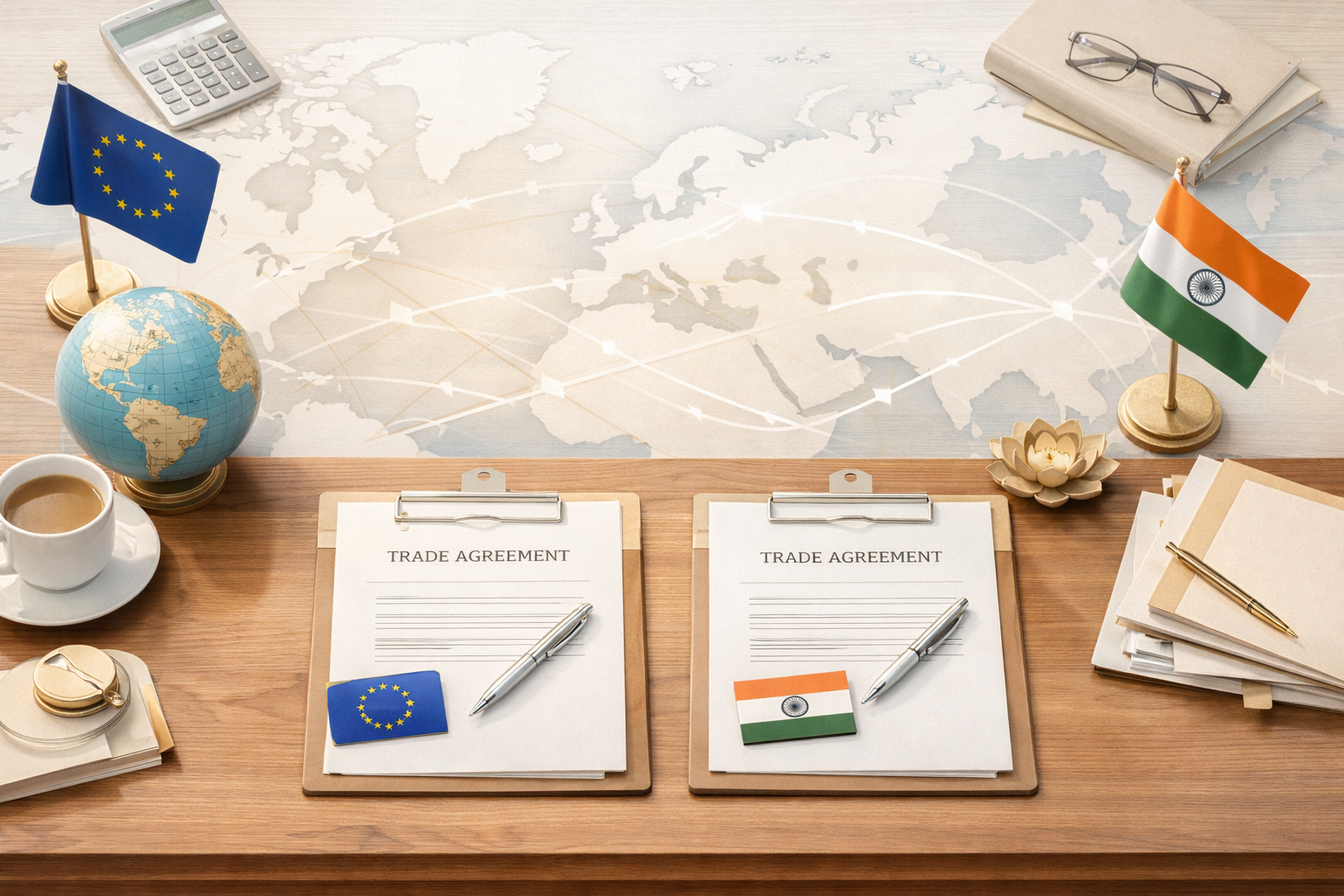
The climax of this effort was the conclusion of the India–EU trade deal on 27 January 2026. After nearly two decades of negotiations, the pact was announced as finalised in New Delhi, with Commerce Minister Piyush Goyal and EU leadership present. Both sides embraced the label “the mother of all deals.” Indian sources highlighted that this agreement would eliminate tariffs on over 99 per cent of Indian exports to Europe and open a market of nearly two billion consumers, accounting for around a quarter of global GDP. EU Commission President Ursula von der Leyen said Europe and India were “making history today,” framing the pact as a model of cooperation and mutual benefit. This deal carries outsized strategic value for India. It gives exporters in textiles, gems and jewellery, leather and footwear, and marine products immediate duty-free access to Europe’s markets.
At the same time, imports of European machinery, automobiles, wines, and chemicals into India will see phased tariff reductions. In a sense, the pact is not just about goods but about confidence and long-term alignment. It signals to investors and policymakers around the world that India is a partner of choice for trade and growth in the years ahead.
But this breakthrough emerged in an environment shaped by tension with Washington. As the EU talks matured, the United States recalibrated its approach. On 2 February 2026, President Trump announced an agreement with India that lowered U.S. tariffs on Indian goods from 25 per cent to 18 per cent, contingent on India’s commitment to halt purchases of Russian oil and to increase U.S. imports, including energy. Trump framed this as a win for both nations and an effort to “help end the war in Ukraine.” Modi, for his part, described his conversation with Trump as “wonderful” and said he looked forward to taking the partnership with the United States to “unprecedented heights,” while omitting any explicit affirmation about halting Russian oil purchases in his public comments. What these developments reveal is a nuanced negotiation of interests. India did not capitulate to external demands. It did not abruptly sever ties with longstanding partners like Russia or surrender its energy autonomy. Instead, in engaging both Europe and the United States, it created multiple avenues of economic opportunity with diverse powers, reducing reliance on any single market or alliance. In doing so, it has showcased the strategic patience and tactical flexibility that many observers in international relations had underestimated in recent years.
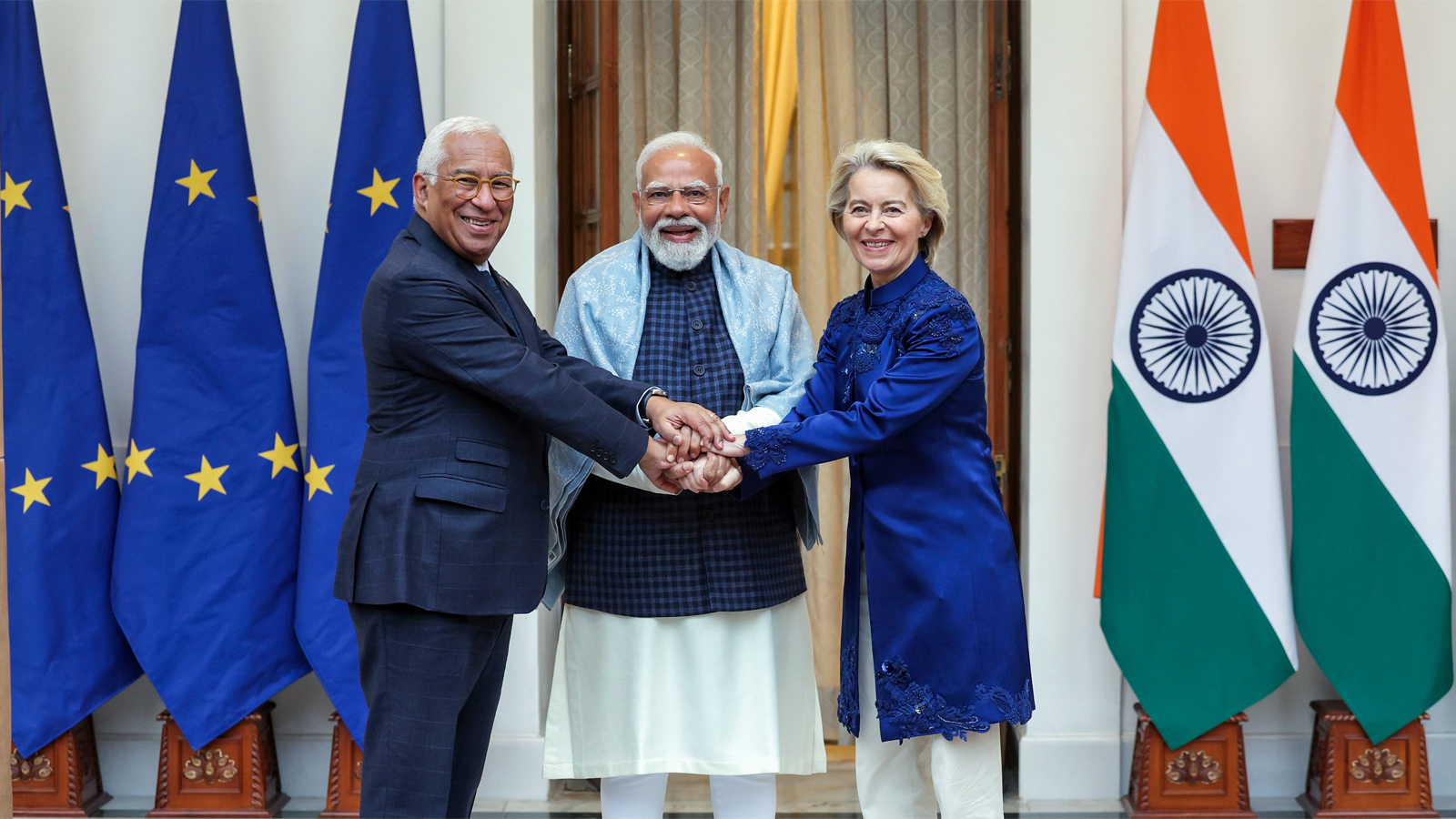
The contrast is stark. The EU, long perceived as a distant, sluggish trading bloc, was jolted into concluding one of itlargest-everer trade pacts. Analysts have even linked this urgency to the fracturing of traditional Western alignments under a U.S. administration that has at times shown open scepticism toward longstanding partnerships. Trump’s trade actions and his historically transactional foreign policy disrupted old assumptions about transatlantic unity. A once-stable Western bloc found itself hedging, not just over ideological disagreements, but over concrete economic interests. In this context, Europe’s willingness to seal a far-reaching trade deal with India even as it criticised India for its earlier energy ties with Russia reflects how geopolitical uncertainty can turn one actor’s crisis into another’s opportunity. That the EU chose to pivot toward India when U.S. pressure on tariffs and trade disputes emerged is instructive. From a European perspective, deepening economic links with a rising India offers an alternative anchor in Asia that balances Chinese influence and provides resilience against fragmented global supply chains. For India, Europe provides a stable, predictable customer base for key exports and a platform for technological and regulatory collaboration.
The United States, for its part, did not stand on the sidelines. Trump’s pragmatic shift toward reducing barriers and rekindling the trade dialogue with New Delhi reflects a broader geopolitical reality: America still sees value in partnering with India in a contest of influence with China and throughout the Indo-Pacific. The tariff reduction and trade agreement, framed as beneficial for both economies, including commitments by India to buy more U.S. products, is not just about commerce. It is about shared strategic positioning in a competitive global order. This three-way dynamic, India, the EU, and the United States, encapsulates how crises or ruptures in existing relationships can create new bargaining space. India’s ability to navigate these waters, bringing the EU into a historic agreement and then pivoting back to Washington for a complementary arrangement, demonstrates diplomatic dexterity.
Still, there is a balance to be struck. Economic gains must translate into internal stability. India’s priority remains creating jobs and sustaining growth for its people. The country must guard against being enamoured by praise or becoming entangled in normative clashes that divert attention from tangible outcomes. Pragmatism should trump rhetoric. The fact that tariff lines have been adjusted and new markets opened is important, but translating these shifts into manufacturing expansion, service sector jobs, and inclusive growth remains the real challenge. In the domestic arena, the results are visible.
Approval ratings for Prime Minister Modi have remained strong amidst these diplomatic gains. Public perception in India has coalesced around the narrative of a leader who did not bow to external pressures but instead navigated them to India’s advantage. This perception matters because the credibility of a foreign policy rests on how it resonates with and benefits the people it ultimately serves. The India example also resonates beyond its borders. Israel, for example, has begun to rethink its strategic posture toward the United States in terms of defence manufacturing and broader cooperation. Early conversations with India hint at a willingness to diversify partnerships beyond traditional anchors. These signals, though tentative, underscore a broader shift: middle powers are more willing to exercise autonomy and shape their own cartography of influence.
In conclusion, the recent developments in India’s external economic engagements demonstrate the classic pattern in international politics where disruptions become openings for strategic gain. India turned criticism over energy policy and trade tensions into an incentive to secure the “mother of all deals” with the EU. It then used that momentum to reset its engagement with the United States, securing tariff reductions and renewed economic cooperation. Throughout, the guiding principle has been national interest moderated by pragmatic engagement rather than rigid alignment. This is not merely the story of two deals in quick succession. It is a case study in disciplined diplomacy, where navigating a crisis with foresight and flexibility can generate opportunities that reshape a country’s position in the global balance of power. India’s trajectory in these months shows that a measured, diversified approach to partnerships — capturing opportunities as they arise — can yield lasting dividends for national prosperity and global relevance.

Dr. Nanda Kishor M. S. is an Associate Professor at the Department of Politics and International Studies, Pondicherry University, and former Head of Geopolitics and International Relations at Manipal University. His expertise spans India’s foreign policy, conflict resolution, international law, and national security, with several publications and fellowships from institutions including UNHCR, Brookings, and DAAD. The views expressed are the author’s own.
 Ajith Shetty Heranje
  Atri Patel
  Anusreeta Dutta