
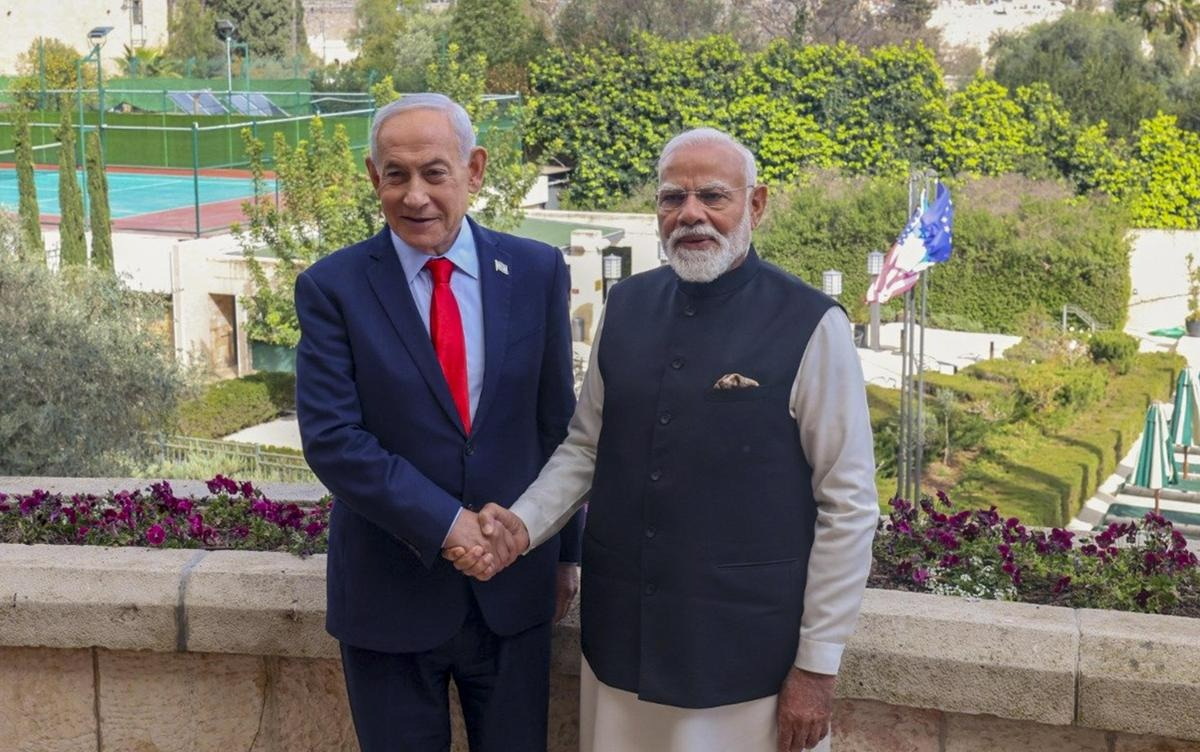
- Modi’s visit signalled a renewed commitment to enhance cooperation between India and Israel in innovation, trade and defence.
- Leaders reinforced their intent to conclude a bilateral FTA, which could significantly increase trade volumes beyond the existing roughly $3–4 billion annual exchange.
- PM Modi highlighted 2 major multilateral initiatives: IMEC and the I2U2 grouping, which are key to understanding India’s vision of its global economic and strategic footprint.
Indian Prime Minister Narendra Modi’s two-day visit to Israel marked a significant deepening of bilateral relations between New Delhi and Tel Aviv against a backdrop of intense geopolitical tension. The trip, hosted by Israeli Prime Minister Benjamin Netanyahu, was a mix of symbolic outreach and strategic cooperation, economic ambition.
At its core, the visit aimed at two agendas: solidifying defence and technological cooperation, and expanding economic ties, including negotiations toward a free trade agreement (FTA). Leaders also underscored collaboration in emerging areas seen as vital for future competitiveness, such as artificial intelligence, cybersecurity, quantum computing, and critical minerals.
While addressing the Knesset, PM Modi received a standing ovation after declaring: “India stands with Israel firmly, with full conviction, in this moment and beyond.” He talked about dialogue, peace, and stability in the region. Yet this diplomatic visit unfolded amid debate, particularly in India, over how it aligns with India’s historical stance on the Middle East and its long-standing support for Palestinian self-determination.
Defence, Tech and Trade: A Deepening Strategic Partnership
Modi’s visit signalled a renewed commitment to enhance defence cooperation between India and Israel. India is Israel’s largest arms importer. Both governments pledged to ramp up joint development, production, and transfer of defence technologies, a significant move given Israel’s reputation as an advanced developer of military systems. The two countries will cooperate in the field of “horizon scanning”, which would enhance India’s strategic capabilities. This cooperation is expected to go beyond traditional arms sales toward co-production and co-innovation, with potential implications for India’s defence industrial base. Israel would allow 50,000 additional Indian workers into the country over the next five years, especially in manufacturing sectors, an Indian foreign ministry statement said.
At the same time, leaders reinforced their intent to conclude a bilateral FTA, a move that, if realised, could significantly increase trade volumes beyond the existing roughly $3–4 billion annual exchange. The negotiations already underway signal a bold effort to bring a longtime strategic partnership into a comprehensive economic framework. Both leaders also emphasised cooperation in emerging technologies, notably artificial intelligence, quantum computing, and cybersecurity sectors, where India’s vast talent pool and Israel’s innovation ecosystem could complement each other.
The joint discussions also included mobility partnerships, investment cooperation, water and agriculture collaboration, and direct air connectivity, illustrating a much wider bilateral agenda than defence alone.
Elevating strategic ties, IMEC and I2U2
During the visit, Modi highlighted two major multilateral initiatives: the India–Middle East–Europe Economic Corridor (IMEC) and the I2U2 grouping, both of which are key to understanding India’s vision of its global economic and strategic footprint.
The IMEC envisions India linking with the Middle East and Europe via integrated rail, shipping, and logistics networks, potentially bypassing traditional routes such as the Suez Canal. This corridor is seen as a way to boost trade, reduce transit times, and foster deeper economic integration between South Asia, the Middle East, and the European market, countering dominant global trade routes. The economic corridor would pass through India, the UAE, Jordan, Saudi Arabia, Israel, and Europe. It was unveiled in September 2023 during a G20 summit in New Delhi.
For India, IMEC represents more than just a transit project. It could serve to anchor New Delhi firmly within the Middle East’s economic architecture, deepening interdependence with partners such as the UAE, Saudi Arabia, Israel, and European states. In calling for renewed momentum on IMEC during his visit, Modi signalled India’s interest in being central to 21st-century connectivity networks, not only in South Asia but across multiple continents.
Alongside IMEC, Modi emphasised the I2U2 grouping, an economic cooperation forum comprising India, Israel, the United States, and the United Arab Emirates. The grouping is focused on collaborative projects in food security, clean energy, transportation, space, and health infrastructure, and serves as an economic complement to strategic cooperation in the region. The I2U2 has often been described as a kind of “West Asian Quad” due to its collaborative structure and potential to foster deeper ties among like-minded economies in the region. Modi’s emphasis on both IMEC and I2U2 underscores a broader diplomatic strategy to embed India in regional economic architectures that can reinforce stability, growth, and trade diversification.
Before Modi’s visit, Netanyahu spoke about the “Hexagon Alliance”, which refers to a proposed strategic multilateral framework that includes India, Cyprus, and other unnamed Arab, African, and Asian states, an expanded collaborative grouping of countries that could work together on security, diplomatic, and economic issues in and around the Middle East region.
Regional tensions
Prime Minister Modi’s visit to Israel comes amid rising tensions in West Asia. While India joined more than 100 countries in condemning Israel’s expansion of settlements in the West Bank, its delayed response reflected New Delhi’s effort to balance its traditional support for Palestine with its growing strategic ties with Israel.
The visit represented more than symbolic diplomacy. It was an engagement reflecting economic interests and strategic priorities, alongside evolving diplomatic principles and evolving geopolitical realities.

Anshika Agrawal is a research scholar at the Centre for Russian and Central Asian Studies, Jawaharlal Nehru University, with a strong interest in current affairs, bilateral and multilateral relations, and public policy. Views expressed are the author’s own.
 Pranav S
  Ajith Shetty Heranje
  Atri Patel