
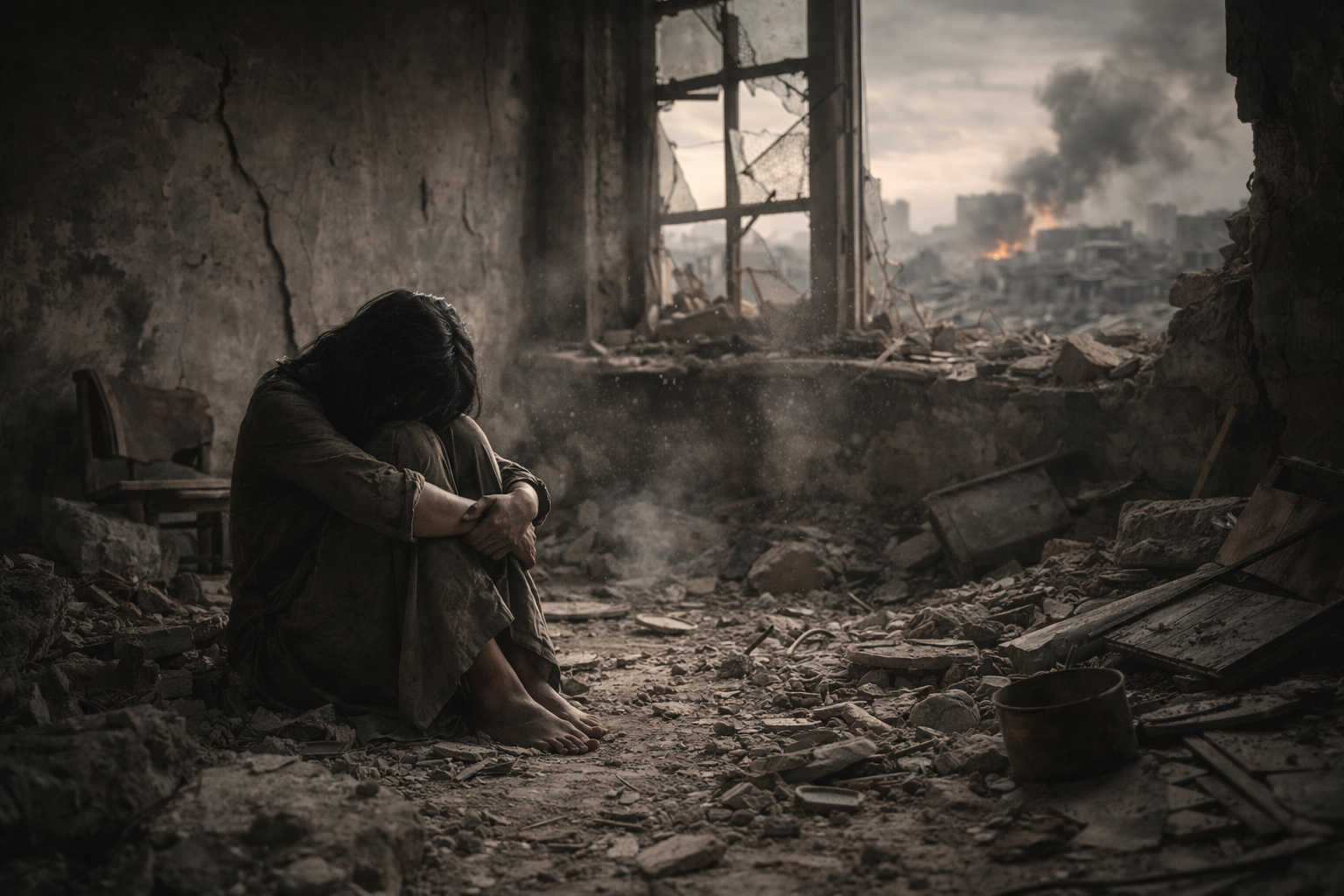
- Sexualized and gender-based violence exists in times of peace, intensifies during armed conflict, and continues even after wars end.
- Many women continue to experience the trauma of war and displacement, which has severely affected their mental health.
- Despite increased efforts, there has been limited leadership commitment to women’s rights, including in Security Council negotiations and in peace talks.
Violence against women and girls is an expression of discriminatory gender relations. Throughout the world, women and girls are denied their rights to self-determination concerning their own bodies. Sexualized and gender-based violence exists in times of peace, intensifies during armed conflict, and continues even after wars end. The use of rape as a strategic tool of war is, in the end, a consequence of injustice. According to the 2025 UN Secretary-General’s report on women, Peace and Security, 676 million women now live within 50 kilometres of deadly conflict, the highest since the 1990s.
Armed Conflict Violence Against Women
Throughout history, women and girls have been among the most frequently targeted victims in war, particularly through sexual violence. Women are often excluded from participation in conflict prevention and resolution efforts. Despite increased efforts, there has been limited leadership commitment to women’s rights, including in Security Council negotiations and in peace talks. Organisations working at grassroot level often face inadequate funding.
More than 80 years have passed since the end of the Second World War in Europe, yet among the many grave human rights violations committed during that period, violence against women and girls was widespread, with millions of rapes reported. Violence against women during the Second World War was systematic, as women and girls, particularly those of Jewish, Romani, and Sinti descent, were confined in concentration camps. A large number of rapes also occurred under German occupation in regions such as France, Poland, and parts of the Soviet Union. In the present context, violence against women in Sudan has reached an alarming level, where women are deprived of basic necessities and subjected to sexual violence amid ongoing conflict.
Initiatives Of International Organization
Various measures and legal frameworks have been initiated by international organisations to address violence against women in conflict-affected areas. In October 2020, the United Nations Human Rights Council, through Resolution A/HRC/RES/45/28, recognised the crucial role of women in the prevention and resolution of conflicts, as well as in peacebuilding and confidence-building processes, emphasising their full, equal, and meaningful participation in all efforts related to the maintenance and promotion of peace and security.
In 2000, the Security Council adopted Resolution 1325 on Women, Peace and Security, which calls for increased participation of women and the incorporation of gender perspectives across all United Nations peace and security initiatives, including decision-making, peace processes, training, peacekeeping, and reporting mechanisms. This was followed in 2008 by the adoption of Resolution 1820, the first Security Council resolution specifically devoted to addressing sexual violence in conflict situations. Resolution 2467, adopted in 2019, further strengthened this framework by calling for a survivor-centred approach to preventing and responding to sexual violence in both conflict and post-conflict contexts. Additionally, on 20 July 2018, the United Nations Special Representative of the Secretary-General on Sexual Violence in Conflict and the Committee on the Elimination of Discrimination against Women (CEDAW) signed a Framework of Cooperation to reaffirm their shared commitment to promoting and protecting the rights of women and girls affected by conflict-related sexual violence.
Mental Health crisis due to war violence
Many women continue to experience the trauma of war and displacement, which has severely affected their mental health. Despite the alarming scale of the crisis, United Nations reports indicate that mental health receives only 1-2 per cent of global humanitarian funding, even though mental health and psychological conditions account for approximately 20 per cent of health issues reported in emergencies. 68% of women describe their mental health as “bad” or “very bad”, and 80% of them have tried to attempt suicides. The devastating impact of women’s mental health crises also extends to families, children, communities, and entire nations, undermining long-term social stability and recovery.
Women are consistently neglected during conflict and post-conflict periods, and violence against women has become a serious threat to nations, as it reflects both the security capacity of a state and the commitment of the international community. Although various initiatives have been taken, their implementation remains limited. The mental health of girls and women is still not treated as a priority, leaving many to live with lifelong post-traumatic conditions.

Antara Deka is a student of Political Science at North Eastern Hill University and History at Indira Gandhi National Open University. Her interests include political awareness and civic engagement, and she has been actively involved in initiatives promoting informed participation among youth. Views expressed are the author’s own.
 Joy Aditya Phookan
  Anshika Agarwal