
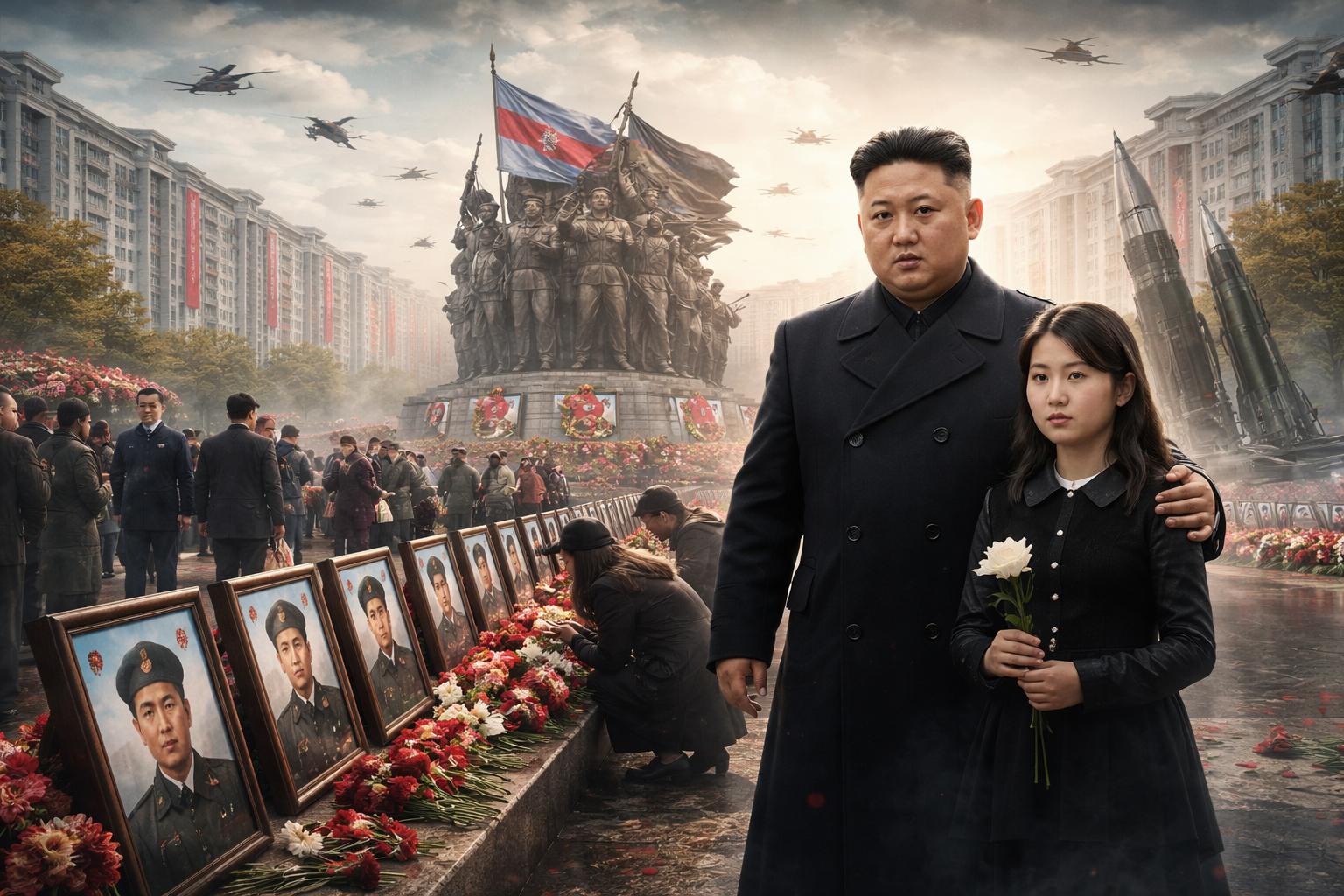
- North Korea unveiled a new housing district in Pyongyang for the North Korean soldiers who were killed while fighting alongside Russian forces in Ukraine.
- Analysts argue that the project is a “highly calculated political move” designed to justify overseas troop deployments and strengthen domestic unity ahead of a major party congress.
- South Korea’s Intelligence Service says that Kim Jong Un’s daughter, Kim Jau-ae, could be named as the country’s next leader, a move that could pit her against her aunt, Kim Yo Jong, for control of the party and the country.
- For North Korea, participation in the Russia-Ukraine war is not merely ideological solidarity; it is also a political and economic move aimed at military modernisation and political consolidation at home.
North Korea unveiled a new housing district in Pyongyang for the North Korean soldiers who were killed while fighting alongside Russian forces in Ukraine. This is an effort put in by the leader, Kim Jong Un, to honour the war dead. He walked through the new streets called Saeppyol Street and visited the homes of martyrs with his daughter, Kim Jau-ae, to pay tribute to the young martyrs who sacrificed their lives for their motherland. Kim said, “Saeppyol street was a source of honour for our generation and the pride of Pyongyang and our state”.
According to multiple intelligence estimates, North Korea deployed about 14,000 troops to support Russian operations, with more than 6,000 reportedly killed in combat. These losses are significant for a country that controls the information from being released. The creation of the new Saeppyol Street housing district serves as a symbolic compensation mechanism to maintain public support. Such a move by the state, by giving tangible benefits to the families of the fallen soldiers, legitimises controversial foreign deployments.
Analysts argue that the project is a “highly calculated political move” designed to justify overseas troop deployments and strengthen domestic unity ahead of a major party congress. The timing of the housing announcement is critical. North Korea is preparing for a congress of the ruling Workers’ Party at which Kim Jong Un is expected to outline the country’s five-year political and economic agenda. The housing project also fits into a broader propaganda campaign. State media has increasingly glorified troops deployed abroad, constructed memorials, and emphasised the idea of “young martyrs” sacrificing for the nation. The state has also unveiled a new memorial complex in Pyongyang with sculptures of soldiers.
Further, South Korea’s spy agency, South Korea’s National Intelligence Service (NIS), says that the Communist country is headed for a family showdown as they suggest that Kim Jong Un could name his daughter, believed to be around 13, as the country’s next leader. This move could pit her against her powerful aunt, Kim Yo Jong, for control of the party and the country. NIS told lawmakers that Kim Ju Ae is nearing formal designation as heir. The timing is crucial, as Kim Jong Un is expected to set major goals and tighten his grip at the party congress.
Strategically, the move to dedicate the new housing district underscores the deepening military partnership between Pyongyang and Moscow. North Korea has supported Russia by providing troops, artillery, and missiles to the Russian war effort. In return, intelligence reports suggest Pyongyang is receiving financial aid, military technology, and other forms of aid from Russia.
In geopolitical terms, it shows the growing cooperation between Pyongyang and Russia, as both countries face Western sanctions and external pressure. For North Korea, participation in the Russia-Ukraine war is not merely ideological solidarity; it is also a political and economic move aimed at military modernisation and political consolidation at home.

Anshika Agrawal is a research scholar at the Centre for Russian and Central Asian Studies, Jawaharlal Nehru University, with a strong interest in current affairs, bilateral and multilateral relations, and public policy. Views expressed are the author’s own.
 Joy Aditya Phookan