
- US airstrikes in December 2025 were described as directed at jihadist threats and carried out at Nigeria’s request, not as punitive action against the Nigerian state.
- The vast oil reserves of Nigeria give it strategic importance, and the US National Security Strategy places a high premium on protecting these resources.
- Analysts interpret Nigeria’s shift from rejecting U.S. accusations to embracing American support as a pragmatic move to manage its deepening security crisis.
In late 2025, tensions between the United States and Nigeria escalated sharply when U.S. President Donald Trump publicly accused Abuja of failing to protect Christian communities from violent armed groups, a characterisation that Trump and some U.S. politicians had framed as evidence of an ongoing “Christian genocide.” Trump went beyond rhetoric by redesignating Nigeria on Washington’s “Countries of Particular Concern” watchlist for alleged religious freedom abuses and warning of potential punitive measures, including cuts to U.S. aid and even military action.
Trump’s posts on social media stating that the U.S. Department of War was preparing to intervene “guns-a-blazing” if alleged anti-Christian violence persisted, sparked alarm within Nigeria. Nigerian authorities, led by President Bola Ahmed Tinubu, immediately rejected the characterisation, emphasising that insecurity in the country stems from multifaceted armed conflicts rather than targeted persecution of one religious group. Armed organisations such as Boko Haram and the Islamic State West Africa Province (ISWAP), along with local bandits, have inflicted violence across regions and communities, affecting the local population of Nigeria.
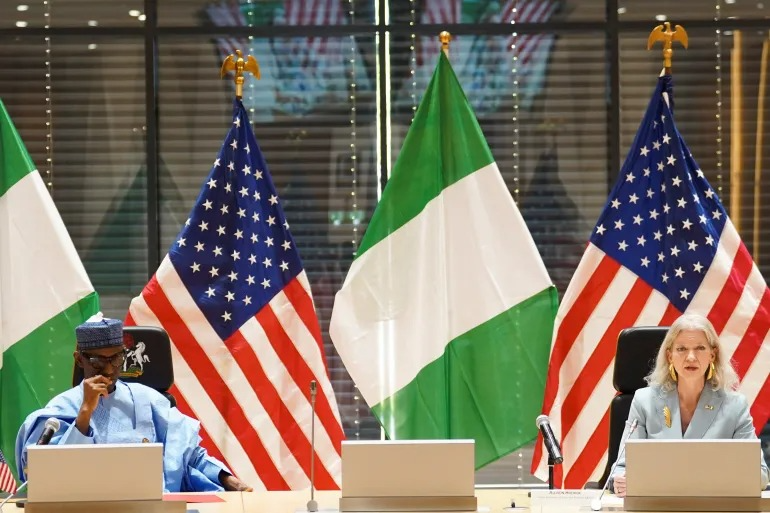
Despite the initial hostile rhetoric, a remarkable shift occurred within a few months. Instead of confrontation, cooperation between the US and Nigeria has appeared to grow. In December 2025, U.S. forces conducted airstrikes against militant camps in northwest Nigeria, operations that the U.S. described as directed at jihadist threats and carried out at Nigeria’s request, not as punitive action against the Nigerian state. This transition culminated in recent weeks with the deployment of approximately 100 U.S. military personnel to train Nigerian forces, provide intelligence support, and strengthen counterterrorism efforts.
Officials in both capitals say the collaboration targets extremist groups that threaten national stability, not any religious community specifically. Analysts interpret Nigeria’s shift from rejecting U.S. accusations to embracing American support as a pragmatic move to manage its deepening security crisis, which remains beyond the capacity of its overstretched military.
Analysts argue that Nigeria’s shift from rejecting American charges to accepting American aid is a pragmatic effort to manage its worsening security situation, which remains beyond the capacity of its overworked military. The U.S. is pushing for closer ties with Nigeria for reasons beyond counterterrorism, including broader geopolitical considerations, especially regarding access to energy resources. The vast oil reserves of Nigeria give it strategic importance, and the US National Security Strategy places a high premium on protecting these resources. Nigeria’s government saw cooperation as a pragmatic “trade-off,” gaining security support and stronger diplomatic relations while retaining oversight.

Anshika Agrawal is a research scholar at the Centre for Russian and Central Asian Studies, Jawaharlal Nehru University, with a strong interest in current affairs, bilateral and multilateral relations, and public policy. Views expressed are the author’s own.
 Anusreeta Dutta
  Hridbina Chatterjee
  Mohmmad Rizwan