
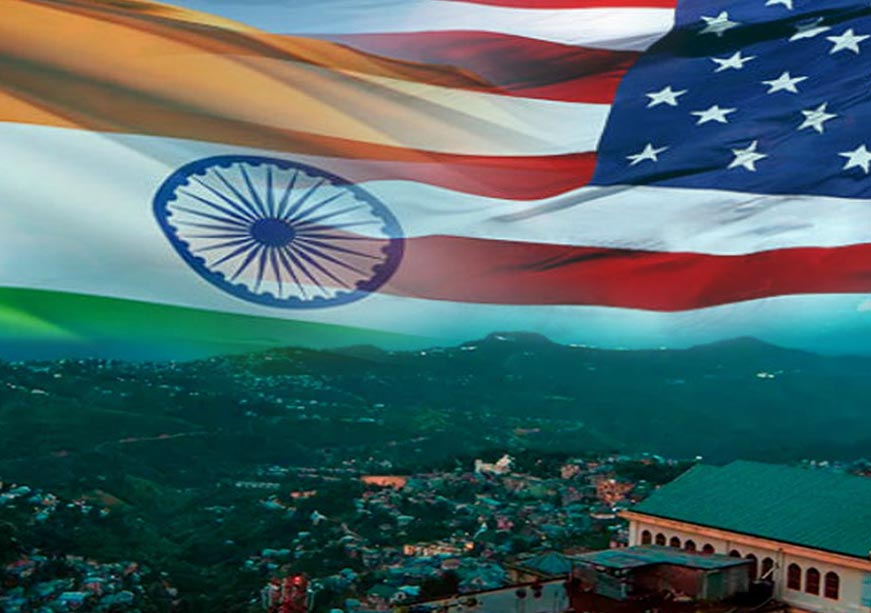
- The India-US partnership finds its most consequential expression in the Indo-Pacific, the primary geopolitical theatre of the 21st century.
- This convergence is a direct response to China’s assertive expansionism, visible in its construction of artificial islands within the Exclusive Economic Zones of Vietnam, Japan, and the Philippines, and its sweeping claims under the Nine-Dash Line.
- For India, the Indo-Pacific is not merely a security construct but an economic imperative.
- The India–US partnership in the Indo-Pacific is no longer a matter of choice—it is a strategic necessity.
“Both President Abraham Lincoln and Mahatma Gandhi led from the front, with indomitable courage against the forces of reaction and outmoded beliefs,” observed Prime Minister Narendra Modi during his 2017 White House visit. The remark was not a rhetorical flourish—it reflected a deeper civilisational and political alignment that has, over time, matured into a strategic partnership. Today, that partnership finds its most consequential expression in the Indo-Pacific, the primary geopolitical theatre of the 21st century.
The revival of the Quadrilateral Security Dialogue (QUAD) in 2017 marked a structural shift in regional geopolitics. Comprising India, the United States, Japan, and Australia, the QUAD has evolved into a platform for strategic coordination, with India and the US as its central anchors. At its core lies a shared commitment to a rules-based international order, freedom of navigation, and stability across maritime commons. This convergence has not emerged in isolation—it is a direct response to China’s assertive expansionism, visible in its construction of artificial islands within the Exclusive Economic Zones of Vietnam, Japan, and the Philippines, and its sweeping claims under the Nine-Dash Line. These actions have compelled both New Delhi and Washington to move from cautious engagement to calibrated strategic alignment.
For India, the Indo-Pacific is not merely a security construct but an economic imperative. Its ambition of becoming a $5 trillion economy by 2030 is deeply intertwined with secure sea lanes and maritime connectivity. Initiatives such as Vision SAGAR—now evolving into MAHASAGAR—and SAGARMALA underscore India’s intent to position itself as a net security provider in the region while ensuring the free and safe movement of global trade. The United States, with its longstanding naval dominance, complements this vision, making its partnership both natural and necessary.
This strategic alignment is most visible in defence cooperation. The MALABAR naval exercises, which began modestly, have expanded significantly in both scale and scope. Now involving all QUAD members, these exercises span the Bay of Bengal, Arabian Sea, Indian Ocean, and the Pacific, signalling a coordinated maritime posture. Beyond military engagement, institutional mechanisms such as the Homeland Security Dialogue between the US Department of Homeland Security and India’s Union Home Ministry have deepened cooperation in internal security, intelligence sharing, and countering transnational crimes, including drug trafficking across the Indo-Pacific.
The adoption of the Wilmington Declaration at the fourth in-person QUAD Leaders’ Summit, held under President Joe Biden, further broadened the partnership’s scope. In health security, India’s Vaccine Maitri initiative during the COVID-19 pandemic earned global recognition, leading to India being entrusted with delivering 4.0 million HPV vaccine doses in partnership with GAVI across the Indo-Pacific. This effort is particularly critical for Small Island Developing States (SIDS), which face disproportionately high cervical cancer burdens, and aligns with the QUAD’s broader “Moonshot” vaccine initiative.
Cooperation has also expanded into humanitarian assistance and disaster relief (HADR), where QUAD nations are now designating specific areas of responsibility within the Indo-Pacific for coordinated response. In maritime security, initiatives such as the Indo-Pacific Partnership for Maritime Domain Awareness (IPMDA) and collaboration with the Pacific Islands Forum Fisheries Agency have laid the groundwork for enhanced surveillance and coordination. Building on these, the Maritime Initiative for Training in the Indo-Pacific (MAITRI) aims to strengthen regional capacity to monitor Exclusive Economic Zones, protect biodiversity beyond national jurisdiction, and secure critical sea lanes.
On the infrastructure front, the Coalition for Disaster Resilient Infrastructure (CDRI), launched at the UN Climate Action Summit in New York and headquartered in New Delhi, represents a significant institutional innovation. Its rapid success has led to its designation as the nodal agency for implementing sustainable Quick Impact Projects (QIPs), reinforcing the developmental dimension of the India–US partnership in the Indo-Pacific.
Yet, the road ahead is not without obstacles. China’s Belt and Road Initiative (BRI/OBOR) continues to challenge the strategic and economic space available to India, the US, and the QUAD, particularly in East Africa and other developing regions. Additionally, fluctuations in US trade policy, including tariff measures, and a relative decline in sustained in-person diplomatic engagement have occasionally diluted momentum.
The way forward demands renewed strategic discipline. Revitalising dialogue mechanisms—Track 1.5, Track 2.0, and 2+2 ministerial engagements—must become a priority, even as global attention remains divided by developments in the Middle East. Expanding platforms like the Raisina Dialogue to the United States, Japan, and Australia would institutionalise deeper defence and strategic conversations. Above all, consistent and high-level in-person participation by the United States in QUAD Leaders’ Summits is essential to maintaining credibility and momentum.
The India–US partnership in the Indo-Pacific is no longer a matter of choice—it is a strategic necessity. If sustained with clarity and commitment, it has the potential to shape not just regional stability, but the very architecture of the emerging global order.

Joy Aditya Phookan is a lawyer by profession with interests in geopolitics, geo-economics, and public policy. He writes on contemporary international issues with a legal perspective.
 Anshika Agarwal