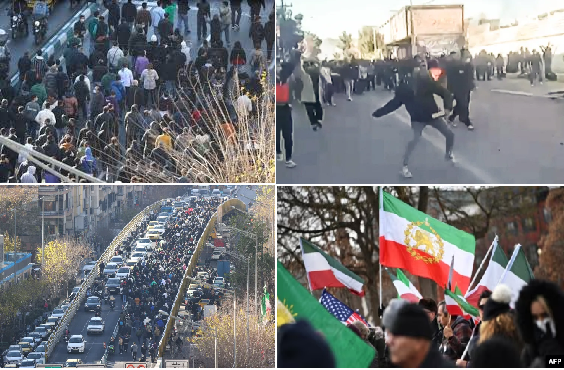
- The protest in Iran, which began on December 28, 2025, spread nationwide unrest, leading to the killing of approximately 31 people, causing significant political and economic disruption.
- The Iranian people have criticised the ruling government for its foreign policy priorities, political corruption and emphasis on supporting regional proxies such as Hezbollah and Hamas over addressing domestic needs.
- The condition of Iran remains at one of the most critical points due to prolonged economic stagnation and deepening political instability.
The protest in Iran, which began on December 28, 2025, spread nationwide unrest, leading to the killing of approximately 31 people, causing significant political and economic disruption. The unrest began with shopkeepers’ protests in Tehran against rising prices and economic stagnation.
The current President of Iran, Masoud Pezeshkian, was sworn in as President on July 28th, 2024, following the death of Ibrahim Raisi in a helicopter crash. In his victory speech, Masoud Pezeshkian thanked the Iranian people and promised to serve the country, raising public hopes for political and economic improvement. However, from the beginning of 2024, Iran’s economy has stagnated, leading to rising inflation, currency devaluation, and an energy deficit. Iran has been facing economic crises due to multiple sanctions imposed by the United States and other Western nations. The most severe shock was the sharp devaluation of the Iranian currency, with the U.S. reaching approximately 145,000 tomans, which pushed the inflation rate up to 42.2% in December 2025. The Iranian people have criticised the ruling government for its foreign policy priorities, political corruption and emphasis on supporting regional proxies such as Hezbollah and Hamas over addressing domestic needs.
The situation escalated on 28th December, 2025, when people from various cities in Iran staged mass demonstrations expressing dissatisfaction with the government and the ongoing economic crises. The protest began with shopkeepers and merchants demanding an end to Islamic rule, which soon spread to universities, drawing large numbers of students from multiple institutions. Demonstrations raised slogans such as “Death to the Dictator”, arguing that the removal of the Islamic regime was essential for resolving Iran’s problems. Many protesters also called for the return of Iran’s exiled crown Prince, Reza Pahlavi, whose father, the Shah, was deposed during the Islamic Revolution in 1979.
The 1979 Iranian revolution, which gave rise to the Islamic Republic, widened gender disparity and curtailed women’s rights, particularly in education and employment. The clerical leaders of the revolution undermined all the women’s rights that were achieved under the monarchical regime, forcing women to return to their traditional roles. The hijab was imposed on women and made compulsory in government offices and public spaces. Under the Islamic rule, the Family Protection Law was suspended; this law had granted women the right to seek divorce and child custody and had raised the legal age of women for marriage. Subsequently, the minimum age of marriage for girls was reduced to nine from eighteen.
The death of Mahsa Amani in 2022, who was arrested for allegedly violating the Hijab regulations and later died in police custody, led thousands of women to pour into the streets of Tehran and other cities. These protests sparked a global movement, “Women, Life, Freedom”, which resonated worldwide. More recent developments included the arrest of 2 marathon organisers for allowing women to participate without wearing the hijab, which encouraged many women to abandon the hijab as a mandatory form of clothing. A change in the current government is widely perceived as a pathway toward greater personal freedom for women, free from institutional constraints.
The condition of Iran remains at one of the most critical points due to prolonged economic stagnation and deepening political instability. However, a potential regime change could restore greater freedom for women, similar to that which existed before the Islamic Revolution. The US threats toward Iran have further intensified pressure on the current President and the ruling government, exacerbating internal and external tensions. Iran’s United Nations ambassador, Amir Saeid, sought UN intervention to condemn U.S President Donald Trump’s alleged “unlawful threat”.

Antara Deka is a student of Political Science at North Eastern Hill University and History at Indira Gandhi National Open University. Her interests include political awareness and civic engagement, and she has been actively involved in initiatives promoting informed participation among youth. Views expressed are the author’s own.
 Joy Aditya Phookan
  Anshika Agarwal