
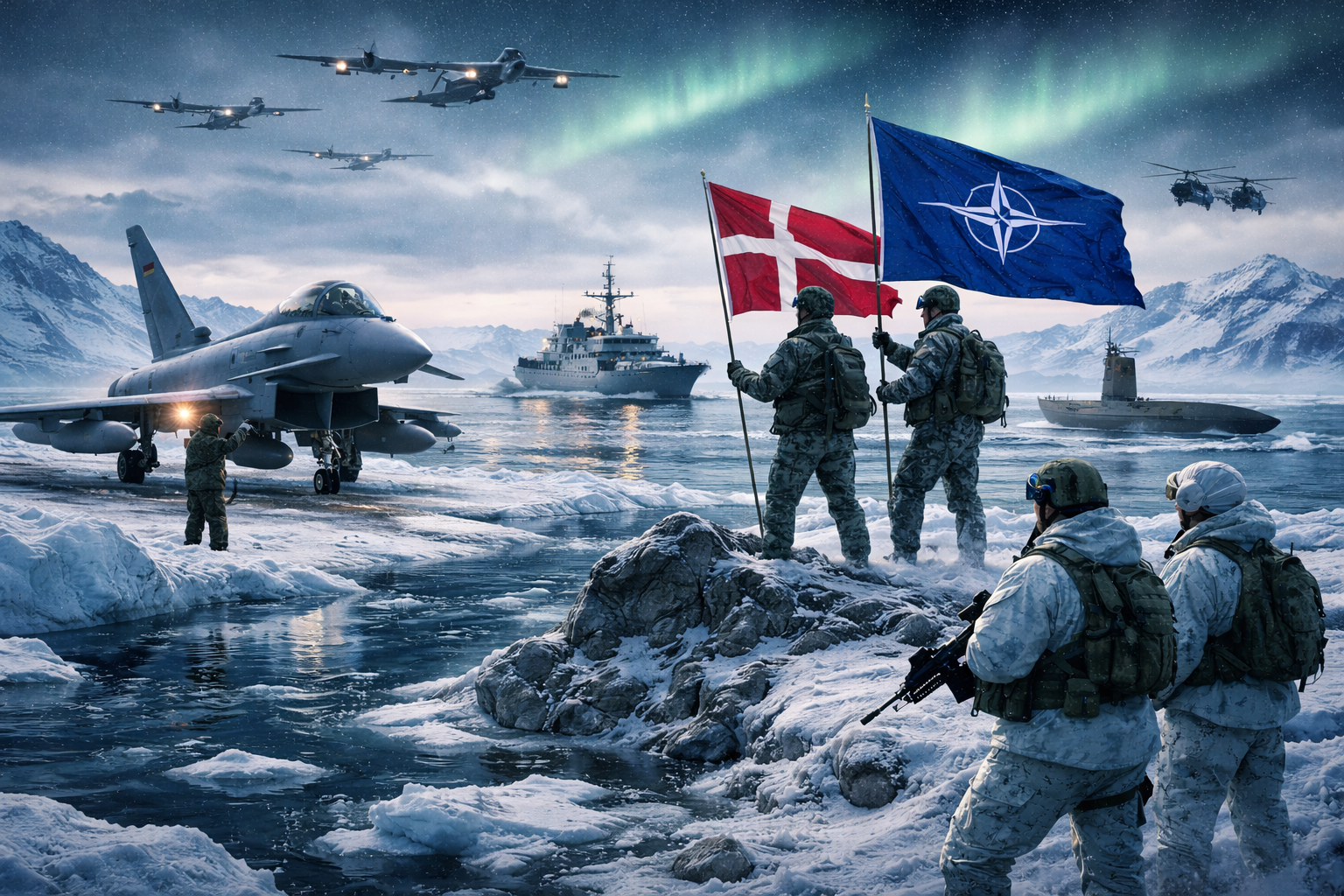
- The new mission, “Arctic Sentry”, is less about immediate combat readiness and more about managing internal alliance tensions triggered by U.S. President Donald Trump’s push to acquire Greenland.
- The initiative illustrates how military deployments are being used as political instruments to preserve cohesion within the transatlantic alliance while responding to emerging strategic competition in the Arctic.
- Officials describe Arctic Sentry as an “enhanced vigilance activity” rather than a permanent deployment, and it mainly consolidates existing exercises instead of creating new forces.
NATO said on Wednesday that it had launched a mission to strengthen its presence in the Arctic. The new mission, “Arctic Sentry”, is less about immediate combat readiness and more about managing internal alliance tensions triggered by U.S. President Donald Trump’s push to acquire Greenland. The initiative illustrates how military deployments are being used as political instruments to preserve cohesion within the transatlantic alliance while responding to emerging strategic competition in the Arctic.
At the operational level, Arctic Sentry is designed to coordinate existing national exercises and deployments across the High North under a single NATO command. The mission will bring together activities such as Denmark’s Arctic Endurance exercise and future multinational drills, with oversight from NATO’s Joint Force Command in Norfolk.
NATO has not specified troop numbers or assets, but individual contributions are emerging: Germany is sending four Eurofighter jets with refuelling capabilities, while the United Kingdom plans to double its troop presence in Norway from 1,000 to 2,000 over three years.
Additional deployments, such as Swedish fighter jets and ranger units, further indicate growing European military engagement in the region.
Moreover, the political context is crucial. Citing Greenland’s advantageous location for spotting long-range missile strikes on the United States, Trump said that the country was necessary for national security. He threatened to impose tariffs on Denmark and seven of its European allies, but he did not rule out capturing Greenland by force.
Strategically, the Arctic’s importance is rising due to melting sea ice opening new shipping routes and resource prospects. NATO leaders have cited increasing Russian military activity and China’s growing interest as key drivers for a coordinated presence. Seven of the eight Arctic states are now NATO members, making the region central to the alliance’s deterrence posture against Russia.
Yet the mission’s character is revealing. Officials describe Arctic Sentry as an “enhanced vigilance activity” rather than a permanent deployment, and it mainly consolidates existing exercises instead of creating new forces. This suggests the operation is as much about optics and alliance reassurance as about military necessity. By visibly strengthening the Arctic posture, European allies aim to address U.S. security concerns and reduce the political appeal of unilateral moves on Greenland.
In essence, Arctic Sentry represents a classic NATO compromise: a limited but symbolic military initiative designed to balance three pressures simultaneously, U.S. strategic demands, European sovereignty concerns, and growing Russian-Chinese interest in the Arctic.

Anshika Agrawal is a research scholar at the Centre for Russian and Central Asian Studies, Jawaharlal Nehru University, with a strong interest in current affairs, bilateral and multilateral relations, and public policy. Views expressed are the author’s own.
 Joy Aditya Phookan