
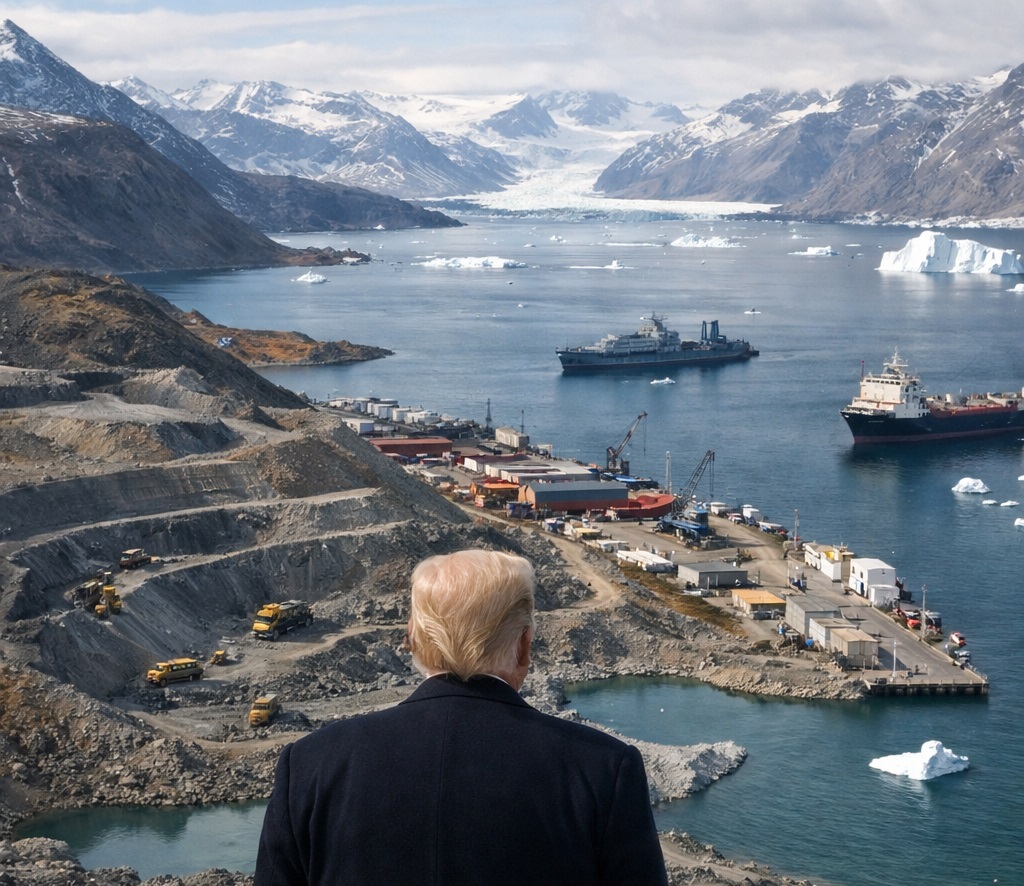
- President Donald Trump publicly expressed interest in the U.S. potentially purchasing Greenland in 2019, characterising the idea as a “large real estate deal”.
- Greenland is important for the U.S. because of its strategic geographical location, which is significant for trade and for countering major powers like Russia in the North Atlantic.
- The oil deposits of the Arctic make up to 13% of the world’s undiscovered petroleum resources and 30% of the undiscovered natural gas resources.
- In 2022 and 2024, the U.S government updated its Arctic strategy to advance its interests and enable its allies to maintain a stronger military presence in the region.
The U.S., soon after its takeover of Venezuela, expressed its desire to pursue Greenland; however, this is not a new aspiration associated with U.S President Donald Trump. He first publicly expressed interest in the U.S. potentially purchasing Greenland in 2019, characterising the idea as a “large real estate deal”. But the idea was quickly shut down by Greenlandic and Danish authorities, who stated that the island was not for sale.
Why The Arctic Region Matters?
The Arctic Region is important for various countries such as Denmark (including Greenland), Canada, Finland, Iceland, Norway, Russia, Sweden and the USA due to its strategic geographical location for security purposes and its rich minerals. The Arctic is the polar region located to the north of the planet, dominated by the Arctic Ocean basin, defined by a line of latitude approximately 66.3 degrees north of the equator and encompassing the northern parts of Scandinavia, Russia, Greenland, Iceland and the U.S. state of Alaska.
This region is entirely covered by water, much of which is frozen. Some frozen features, such as glaciers and icebergs, are frozen freshwaters. Most of the Arctic, however, consists of liquid saltwater within the Arctic Ocean basin. Some parts of the ocean’s surface remain frozen all or most of the year. This frozen seawater is called sea ice; it is often covered by a thick blanket of snow, which plays a crucial role in regulating the Earth’s climate.
The Arctic has enormous deposits of oil and natural gas, and various companies work with indigenous groups known as native corporations to drill and export millions of barrels of oil every year. Alaska’s North Slope is home to the Prudhoe Bay oil field, one of the largest in North America. The oil deposits of the Arctic make up to 13% of the world’s undiscovered petroleum resources and 30% of the undiscovered natural gas resources. This region is also rich in minerals, such as nickel and copper ore; these mineral resources also include gemstones and rare earth elements, which are used in batteries, magnets and electronic devices.
Greenland’s Strategic Significance for Denmark
Greenland is a self-governing territory of Denmark, which is a NATO ally of the United States. Greenland is part of NATO through the membership of Denmark. It is strategically important for military purposes, particularly for ballistic missile early-warning systems, as it lies along the shortest route from Europe to North America, which runs via an Arctic island.
Furthermore, Greenland enables Copenhagen to strengthen its military presence in the wider North Atlantic. The Danish government announced a roughly 14.6 billion kroner defence agreement with parties including the government of Greenland and the Faroe Islands, another self-governing territory within the kingdom of Denmark. This plan includes three new Arctic naval vessels, two additional long-range surveillance drones and enhanced satellite capacity.
Denmark’s Joint Arctic Command is headquartered in Nuuk to maintain Danish sovereignty and military defence of Greenland and the Faroe Islands. Greenland also overlooks the GUIK gap (Greenland, Iceland, United Kingdom), where NATO monitors Russian naval movements.
Consequently, the Government of Greenland has opposed U.S. designs on the island, stating that the future of the island will be decided by its own people. Greenland lies to the north-west of Canada, with more than two-thirds of its territory lying within the Arctic Circle. However, Russia’s presence in the region creates concern over trade competition and access to the region’s natural resources.
Why Does the US Want Greenland?
The US seeks Greenland given its strategic location, which is significant for trade, rare earth minerals, resources, and to counter major powers like Russia and China in the Northern Arctic. The U.S wants to limit China’s influence in the region and its growing military co-operation with Russia. Joint military exercises between Russia and China in the Bering Strait are also a threatening point for the U.S. to have control over Greenland.
The Arctic has remained a central element of national consciousness in Russia’s foreign policy. In 2007, to underline its ambitions, Russia dispatched a nuclear ice breaker and two mini submarines and planted a titanium Russian flag on the Arctic seabed at the Lomonosov Ridge to mark its claim over approximately 1.2 million sq km of maritime territory after the United States Convention on the Law of the Sea (UNCLOS) rejected its claim. Russia subsequently focused on developing its Arctic Zone and opening the Northern Sea Route to assert sovereignty and economic interests, a strategy that has created tensions for the U.S.
A Geopolitical Focal Point
Over the years, both NATO and the U.S have adopted a more pragmatic approach to the Arctic region. In 2022 and 2024, the U.S government updated its Arctic strategy to advance its interests and enable its allies to maintain a stronger military presence in the region. The U.S has modernised its military bases in Alaska and expanded facilities in Greenland, deployed advanced fighters and aviation assets and reoriented its 11th Airborne Division.
Greenland has now become a focal point of geopolitical competition between countries such as Denmark, China, Russia and the U.S., all seeking to expand their influence in the region. However, Denmark is working closely with its allies to counter the U.S. attempts to assert control over Greenland. Several allies of Denmark, including Germany, Poland, Italy, the U.K. and Spain, have extended their support to Greenland.

Antara Deka is a student of Political Science at North Eastern Hill University and History at Indira Gandhi National Open University. Her interests include political awareness and civic engagement, and she has been actively involved in initiatives promoting informed participation among youth. Views expressed are the author’s own.
 Joy Aditya Phookan
  Anshika Agarwal