
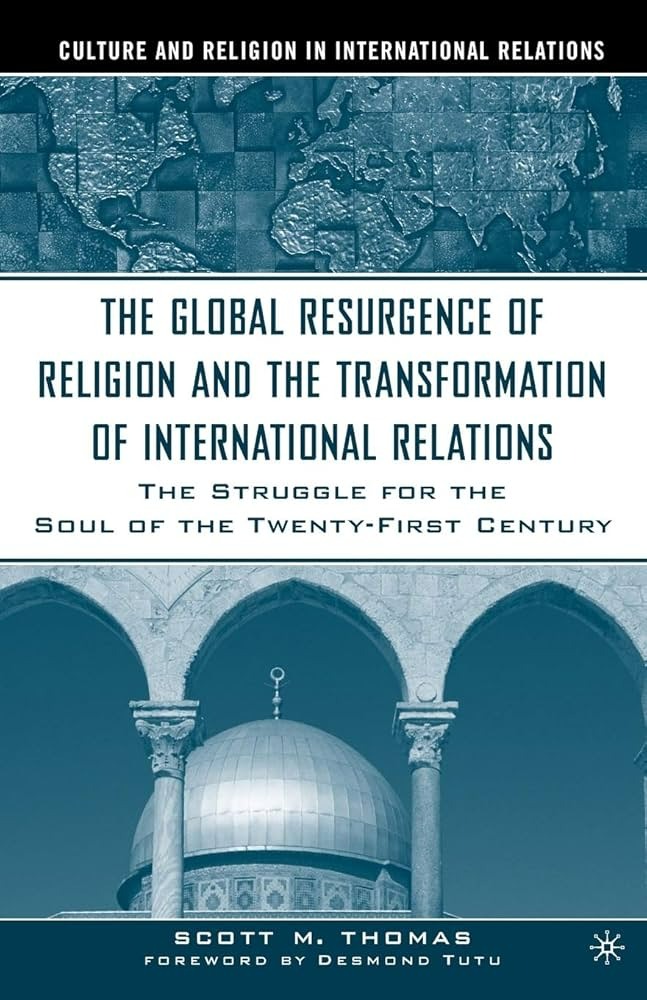
- The book demonstrates how religion played a major role in International Relations, even though it was thought of as a private affair and should have been eroded after the emergence of modernisation.
- The book explores the global resurgence of religion, arguing that religion and politics are interconnected worldwide and have become embedded within liberal modernity itself.
- This book overall brings to our attention that religion cannot be kept out of international relations; most countries use their religious principles and doctrines for national interest, and individuals’ decisions in politics are somehow influenced by religion.
The book The Global Resurgence of Religion and the Transformation of International Relations: The Soul of the Twenty-First Century is authored by Dr Scott M. Thomas with a foreword written by Desmond Tutu, former Archbishop of Cape Town and Nobel Peace Prize Winner. It was published by Palgrave Macmillan in London in 2005. Dr Scott Thomas is a Research Associate at the Las Casas Institute, a Research Associate at the Institute of European Studies and Human Rights, Pontifical University of Salamanca, Spain and a contributing editor of The Review of Faith & International Affairs. His current research focuses on the theological turn in international relations.
This book consists of 9 chapters divided into two parts; the first four chapters explain how religion was brought back into International Relations. It demonstrates how religion played a major role in International Relations, even though it was thought of as a private affair and should have been eroded after the emergence of modernisation.
Chapter 1 of Part 1 examines the argument that the concept of “religion” was historically constructed to legitimise a liberal form of politics that portrays the mixing of religion and politics as inherently violent and dangerous to reason, freedom and political stability. It talks about the major religions of the world. The chapter also discusses the major religions of the world and analyses the expectation that religion’s influence would decline with the rise of modernity. However, events such as the September 11, 2001, attacks challenged this assumption. Scholars have revisited questions about so-called “religious wars,” including historical conflicts such as those between Catholics and Protestants in Europe. According to this political narrative, conflict is believed to arise when religion enters the public sphere and becomes intertwined with politics.
The book further explores the global resurgence of religion, arguing that religion and politics are interconnected worldwide and have become embedded within liberal modernity itself. This development challenges the earlier expectation that religion should remain private. The resurgence is not confined to a single country or region; rather, it is visible across developed and developing nations, including oil-rich states. Scholars analyse this phenomenon at multiple levels: global, interstate, societal, and individual.
At the global level, the resurgence of religion is linked to globalisation and its connections with trade, imperialism, religious pilgrimage, and evangelism. In this sense, the revival of religion can be understood as one of the major trends of the twenty-first century. Globalisation has facilitated the cross-border spread of ideas, beliefs, and doctrines, contributing to renewed religious influence. At the interstate level, traditional analytical frameworks such as foreign policy and military power remain relevant. At the state and societal levels, individuals and groups have challenged the marginalisation of religion from political life. At the individual level, the book highlights how personality, education, and psychological factors shape political decision-making and influence how individuals engage with religion in political contexts.
Globalisation and the Rise of Multi-Track Diplomacy
Chapter 2 of Part 2 analyses how religious traditions have strongly influenced the areas of peace studies and conflict resolution. Due to the rise of ethnic and religious conflicts, the historic traditions of peacemaking have come into existence. During the time of the Cold War, superpowers tried to suppress conflicts through their existence; however, after the Cold War, new domestic conflicts arose due to globalisation. Globalisation brought two major changes. First, diplomacy now involves different kinds of actors, and many conflicts happen within countries rather than between them. Second, globalisation changed the nature and purpose of international conflicts. In this context, cultural diplomacy became an important tool in negotiations.
It also explains how multi-track diplomacy came into existence, outside formal diplomacy, which includes non-state actors, media and communications and religion. These were various reasons that led to the rise of multi-track diplomacy and played a great role in bringing about a resolution between states. Nine tracks of diplomacy have been analysed by scholars for bringing peace. It also brings us to highlight how conflict resolution has become a subfield in international relations. However, various questions were raised regarding this field, whether it was a global scholarly effort or just a theory. This chapter further highlights the need for peacebuilding to establish conditions necessary for a community to be a viable polity.
This book overall brings to our attention that religion cannot be kept out of international relations; most countries use their religious principles and doctrines for national interest, and individuals’ decisions in politics are somehow influenced by religion.
Book Title: The Global Resurgence of Religion and the Transformation of International Relations: The Soul of the Twenty-First Century
Author: Dr Scott M. Thomas
Publishers: Palgrave Macmillan
Pages: 300 Pages (Hardcover)
Price: EUR 99.99
SW Ratings: ****

Antara Deka is a student of Political Science at North Eastern Hill University and History at Indira Gandhi National Open University. Her interests include political awareness and civic engagement, and she has been actively involved in initiatives promoting informed participation among youth. Views expressed are the author’s own.
 Balaji Subramanian
  Anshika Agarwal
  Garima Sharma