
- In the early 1990s, Francis Fukuyama hypothesised the “End of History,” suggesting that the universalisation of Western liberal democracy would be the final form of human government.
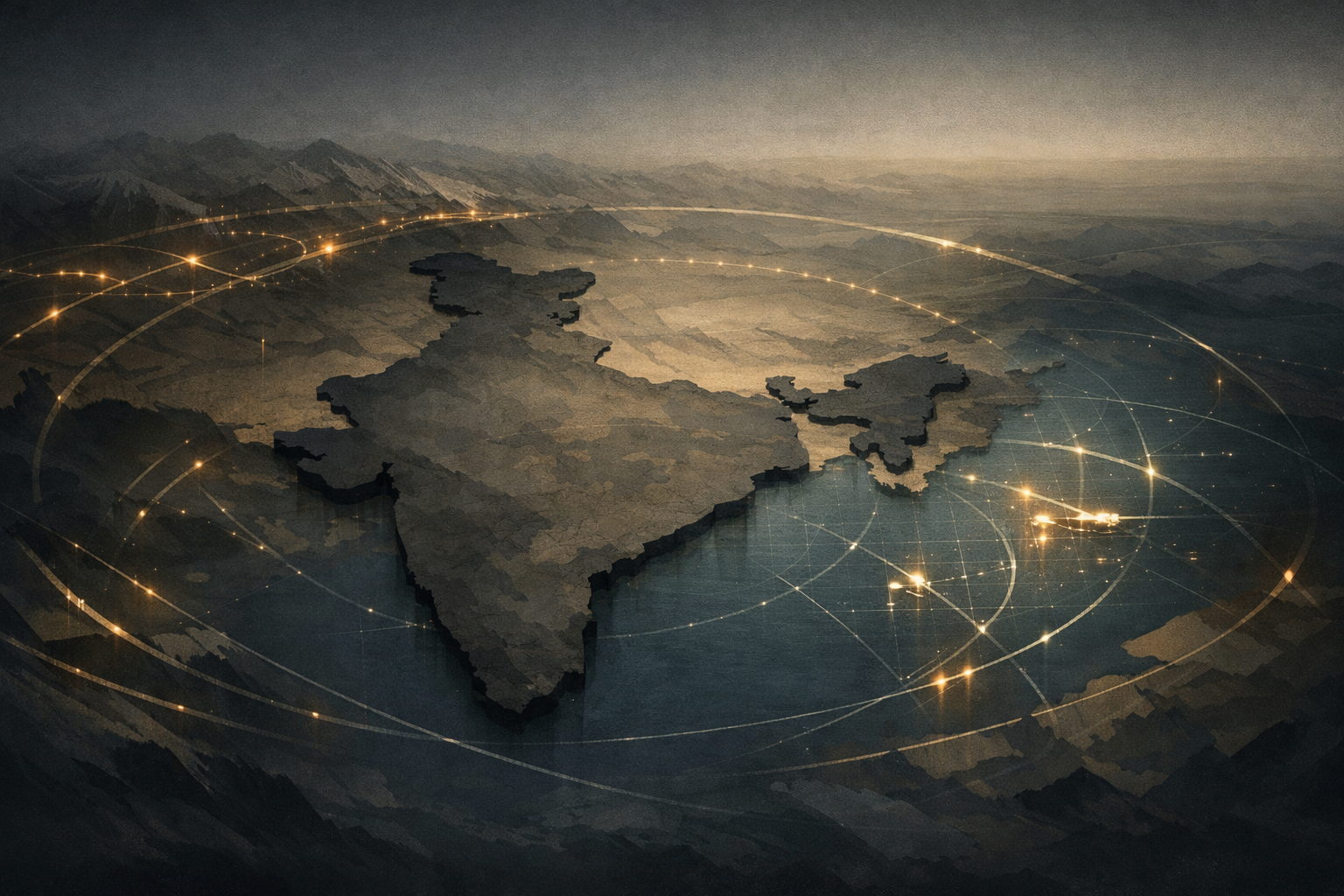
- For years, India’s strategic community worried about China’s “String of Pearls.” But quietly, a new architecture is being assembled.
- The most dramatic manifestation of this “silent encirclement” is currently unfolding across the eastern seaboard.
- India now stands at a crossroads where “Strategic Autonomy” is no longer an academic luxury but a survival imperative.
In the early 1990s, Francis Fukuyama hypothesised the “End of History,” suggesting that the universalisation of Western liberal democracy would be the final form of human government. However, as one surveys the shifting sands of the Indian subcontinent today, it appears that history has not ended; it has merely relocated, re-emerging with a complexity that defies the linear progression that Fukuyama once envisioned. Instead, we find ourselves in a landscape more reminiscent of Samuel P. Huntington’s “Clash of Civilisations,” where cultural and religious fault lines are being weaponised as instruments of high-stakes geopolitics.
For the seasoned observer, the “Pivot to Asia” – a doctrine formalised in Washington over a decade ago was initially interpreted as a maritime strategy to contain China’s blue-water ambitions. Yet, recent developments suggest a more nuanced, terrestrial resurgence of this doctrine. It is a recalibration that is quietly stitching together a perimeter of regimes around New Delhi whose interests are increasingly decoupled from the regional status quo. For years, India’s strategic community worried about China’s “String of Pearls.” But quietly, a new architecture is being assembled. As Henry Kissinger once said, “To be America’s enemy is dangerous, but to be its friend is fatal.”
The Himalayan Chessboard: The Friction of BRI and MCC
The first tremors of this realignment were felt in the high Himalayas. Nepal has long been the theatre for a silent tug-of-war between Beijing’s Belt and Road Initiative (BRI) and Washington’s Millennium Challenge Corporation (MCC). This contest was never merely about infrastructure; it was about the fundamental orientation of the Nepali state and, by extension, the security of India’s northern frontier.
Beijing’s strategy followed a programmatic, infrastructure-heavy trajectory: pushing a series of BRI projects intended to integrate Nepal into a trans-Himalayan connectivity network, effectively pulling Kathmandu out of India’s orbit and offering an alternative to the “Malacca Dilemma.” From Washington’s perspective, such turbulence would be read as a strategic opening, and the response was swift and calibrated, arriving through the $500 million MCC grant[1], grant, framed as developmental aid, carried the weight of a strategic anchor. The friction between these two frameworks paralysed Nepali domestic politics for years. However, the eventual ratification of the MCC, followed by a series of curated political shifts, suggests a definitive tilt towards Washington.
Let’s take the example of the exit of K.P. Sharma Oli from the immediate centre of power, which marks a subtle but telling inflexion point. The timing was surgical as Oli was scheduled to visit India on September 16, 2025. It was a visit intended to stabilise a bilateral relationship that had seen its share of turbulence but remained rooted in geographical pragmatism.[2] His earlier, sensitive engagements with Xi Jinping had already placed him in a precarious position regarding India and China’s tussle. The subsequent surge of domestic unrest and the political realignment that followed provided the necessary cover for extra-regional actors to hint at “foreign interference” while consolidating a framework that favours the US-led strategic architecture.
By embedding Nepal within this new framework, the autonomy of the Himalayan buffer is being traded for a role as a northern outpost in a much larger, extra-regional design. For India, this represents a disruption of the bilateral rhythm that New Delhi has spent decades cultivating, suggesting the quiet onset of a “Colour Revolution” in spirit, a curated transition ensuring the heights remain responsive to Western signals rather than regional equilibrium.
The Transformation of the Bay: Deconstructing the 1971 Consensus
The most dramatic manifestation of this “silent encirclement” is currently unfolding across the eastern seaboard. For fifteen years, the Sheikh Hasina administration provided a bedrock of stability that allowed India to secure its Northeast. This era was defined by what many called a “Golden Chapter.” The 2015 Land Boundary Agreement (LBA) was the pinnacle of this period – a historic humanitarian feat where India and Bangladesh resolved the centuries-old enclave crisis, transferring 111 Indian enclaves to Bangladesh and 51 Bangladeshi enclaves to India. It was a gesture of immense trust, followed by the resolution of maritime boundaries and deep economic integration, ranging from the Adani electricity projects to the Bangladesh Relief Fund.
However, the abrupt ousting of Hasina and the installation of an interim government led by Muhammad Yunus have fundamentally altered the chemistry of regional cooperation. The speed with which Washington recognised the Yunus administration – within hours of Hasina’s departure – raises questions about the long-term trajectory of this transition. The State Department had criticised Bangladesh’s January 2024 elections as “not free and fair” for months, yet the subsequent silence regarding the exclusion of the Awami League from future democratic processes suggests a selective application of democratic norms intended to facilitate a specific strategic outcome.
The strategic prize in this shift is whispered to be St. Martin’s Island, a coral outcrop in the northeastern Bay of Bengal with an outsized strategic significance. For years, rumours have swirled regarding the Western desire for a maritime surveillance node on this island. A foothold here would grant an unprecedented vantage point over the Malacca Straits and the Bay of Bengal, effectively neutralising Chinese naval ambitions at the Mongla and Chittagong ports. But for India, this gain comes at a steep price: the dismantling of the secular regional security architecture that has held for over half a century.
This brings us to the shadow of Tarique Rahman and the BNP. The potential return of a BNP-Jamaat alliance, likely in alliance with a resurgent Jamaat-e-Islami, signals a total reversal of the last fifteen years of security cooperation. In this scenario, the Siliguri Corridor, the “Chicken’s Neck”, becomes not just a geographical vulnerability, but a strategic chokehold. If the new regime in Dhaka allows anti-India separatist groups to resume operations, New Delhi will find itself fighting a multi-front internal security battle, fueled by a regional realignment that could see Pakistan and Turkey gain a strategic foothold in the Bay of Bengal. This is the hallmark of a “terrestrial pivot” where the stability of India’s sovereign territory is traded for the geostrategic convenience of distant powers.
The Radicalisation of the Perimeter
Under the Yunus regime, the internal social fabric of the region is being re-engineered. The human and social costs are being felt acutely. In this “new” democratic environment, the rule of law has often been replaced by the dictates of the street. Systemic communal disturbances and the targeted violence against minority populations are frequently dismissed by international observers as the inevitable “excesses” of a revolutionary moment. Yet, for the analyst, these are not mere aberrations but the symptoms of a deeper ontological shift. The decline of the Hindu population since 1971 is a demographic reality that the current transition seems to treat with a worrying indifference.
The recent attack on the Indian diplomatic mission in Bangladesh signals a breakdown in the sanctity of international relations that was unthinkable a few years ago. More concerning is the policy shift in Dhaka: the revocation of the ban on Jamaat-e-Islami and the release of militant leaders like Muhammad Jasimuddin Rahmani, head of the radical Ansarullah Bangla Team (ABT). These are not merely domestic policy shifts; they are signals to the radical fringes of the subcontinent.
Furthermore, the rewriting of the 1971 narrative in new textbooks – falsely elevating Ziaur Rahman at the expense of Sheikh Mujibur Rahman is an attempt to sever the ideological bond that linked the liberation of the state to the secular cooperation of the subcontinent. The “genocide doctrine” of the 1971 Liberation War is being inverted into a strategy of tolerated persecution. If the secular foundations are replaced by an Islamic nationalist identity, the very basis of India’s eastern security cooperation will evaporate, replaced by a vacuum that Pakistan, Turkey, and China are eager to fill.
The Myanmar Vacuum
To the east, the upcoming elections in Myanmar offer another theatre for this strategic resurgence. As the military junta struggles, the prospect of a fragmented state on India’s flank mirrors the “Nixon Doctrine” of the 1970s, relying on regional proxies to maintain a balance of power. However, the situation is complicated by the meteoric rise of the Arakan Army (AA) in Rakhine State. The AA now controls significant swathes of territory critical to India’s Kaladan Multi-Modal Transit Transport Project.
The collapse of central authority in Naypyidaw has created a vacuum that is being filled by a sophisticated dual-track diplomacy from Beijing. China is simultaneously providing the junta with diplomatic cover while maintaining deep, functional ties with the Arakan Army to protect its own energy pipelines and the Kyaukpyu deep-sea port. For India, a fragmented Myanmar means the resurgence of “unfriendly” or unpredictable non-state actors on its border. While Washington postures as a supporter of democratic forces, the resulting instability serves to bog New Delhi down in a perpetual border management crisis, effectively limiting India’s ability to project influence further into the Indo-Pacific. This is where the “silent encirclement” becomes most effective: by ensuring India is surrounded by “managed chaos,” its rise as a global peer is effectively deferred.
India’s Strategic Recalibration: A Kautilyan Necessity
India now stands at a crossroads where “Strategic Autonomy” is no longer an academic luxury but a survival imperative. The loss of a cooperative neighbour complicates the land bridge to the Northeast, forcing a reliance on the vulnerable Siliguri artery and the incomplete Kaladan Project. China’s infrastructure investments, such as the Mongla Port modernisation and Special Economic Zones, already provide an alternative architecture; if these now merge with a Western-backed political realignment, India could find itself marginalised in its own neighbourhood.
To navigate this “silent encirclement,” New Delhi must adopt a strategy of hard-nosed realism, reminiscent of Kautilya’s Mandala theory:
- Accelerate Alternative Connectivity: The completion of the Kaladan Multi-Modal project must be treated as a war-footing priority. Simultaneously, the pursuit of the Hili-Mahendraganj expressway through non-hostile routes is essential to ensure the Northeast is never held hostage by a regime change in a neighbouring state.
- Calibrated Diplomatic Pressure: India must move beyond “quiet diplomacy.” The international community needs to be reminded of the “Bengal Cess”—the historical and economic price India has paid for regional stability. The narrative of “democratic restoration” must be challenged with the reality of Islamist resurgence and the systematic erasure of 1971.
- Strengthening the Eastern Anchors: India must deepen its investment in “Look East” partners like Thailand and Vietnam. These nations share India’s concerns regarding extra-regional experiments that destabilise regional norms.
- Preparing for Multiple Scenarios: India must develop contingency plans for a BNP-Jamaat government that may be restrictive, and for a continued Yunus rule that remains strategically uncertain and potentially more aligned with extra-regional pivots.
Conclusion: The Anchor of the Subcontinent
The resurgence of this strategic “Pivot” in the Indian subcontinent is a masterclass in geopolitical subtlety. It utilises the language of “democracy,” “media freedom,” and “human rights” to install regimes that serve as terrestrial anchors for distant powers. Yet, for the nations of the subcontinent, the cost of being a pawn in this realignment is the erosion of regional peace and the empowerment of radicalism.
India stands as the only power with a genuine, long-term stake in the secular stability of South Asia. The investments made over the decades from the resolution of the enclaves to the bridging of economies were not just acts of charity, but foundations for a shared destiny. As the architects of the new regional order continue their work, New Delhi must ensure that it remains the anchor of its own destiny.
The era of assuming that a shared democratic vocabulary translates to shared strategic goals is over. In the high-stakes realism of the 21st century, India must be prepared to defend the secular nationalist spirit of the subcontinent, ensuring that any “pivot” in the region aligns with the stability of New Delhi, and not merely the interests of distant capitals. The “silent encirclement” is a challenge, but it is also an opportunity for India to define its own sphere of influence, free from the curated transitions of external powers.
References:

Nishant is a policy consultant with a keen interest in politics, history and international relations. He analyses and explores the intersections of governance, geopolitical developments and historical perspectives. Ankit Jakhar is a Public Policy Analyst specialising in the nexus of International Relations and global macroeconomics. His work focuses on deconstructing the structural undercurrents of political developments and the evolving architectures of modern statecraft. Views expressed are the author’s own.
 Archita Gaur
  Hridbina Chatterjee
  Aayush Pal