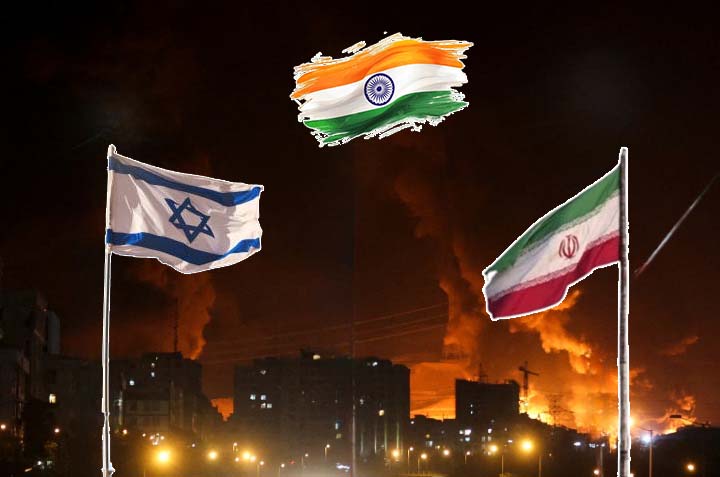
- When Qasim Soleimani, considered by many here as one pro – India voice within Tehran, was assassinated by the Trump administration, India maintained a strategic silence. In contrast, Shias and others here protested over his death.
- The Iranian regime continued to maintain a balanced approach and relationship with India, revamping several sectors from people-to-people connections to access at their Chabahar port, which some say later became a sort of albatross in our policy.
- There seems to be a race amongst Islamic nations to express their supposed concerns for their Muslim brothers and sisters in India, especially when an incident occurs involving a few from the community.
When the Supreme Leader of Iran was killed in an airstrike, many in India celebrated with those from Iran who were living outside of Iran for 2 generations. The Muslim community in India had a mixed response. Shias obviously expressed grief while Sunnis remained silent or expressed tokenistic responses, given how the current conflict has gone. Iran’s strikes over other Gulf nations haven’t helped them express solidarity with the Shia sect since this is purely a mix of geopolitics and Islamic world-based politics.
Be that as it may, the Indo-Iranian ties are going through many changes. Many have seen balanced relationships between Tehran and New Delhi, whilst the late Shia cleric and head of the Islamic Republic of Iran made contentious comments over domestic affairs. Be it with CAA, Shaheen Bagh, the abrogation of Article 370 and 35 A, many incidents within Kashmir and others, the now deceased Ayotollah never missed an opportunity to weigh in on his opinion, expressing his disappointment with India, especially post 2014.
However, here comes the interesting part. The Iranian regime noticeably continued to have a balanced approach and relationship with India, revamping in several sectors from people to people connected to access in their Chhabhar port, which some say, later turned into a sort of albatross in our policy. The port gave us access to central Asia and gave us a strategic point, which was lost by losing Gwadar to Pakistan. Despite late Chinese Engagement, Iran and India managed to keep their relations intact, even in the internal debates of the Organization of Islamic Countries (OIC).
It begs the question, why was the late religious head so hawkish over India and its domestic affairs concerning Muslims?
One can only think that it is due to how politics occur within the Islamic world. Muslims in India are subjected to what many viewsl is the same as that of Palestinian Muslims. There seems to be a race amongst Islamic nations to express their supposed concerns for their Muslim brothers and sisters in India, especially when an incident occurs involving a few from the community. It has less to do with genuine concern and more to show one’s apparent messianic attitude while trying to gain ground to influence them via outreach, especially in multiple ways. So it is of no surprise that the same late Ali Khamenei, who was hawkish over multiple issues, still met the Indian Prime Minister post 2014 and did not needlessly interfere in Iranian diplomacy, much like how it happens in Pakistan.
While the late Ali Khamenei remained polarised with India, the Islamic regime followed a strategic pathway. This is not a recent change. After 1972, the last Shah himself showed signs of change after years of supporting Pakistan. Iran and India don’t have black or white relations. It’s often marred in grey. When Qasim Solemani, considered by many here as one pro – India voice within Tehran, was assassinated by the Trump administration, India maintained a strategic silence. In contrast, Shias and others here protested over his death. So, to see them protest over the death of the late Supreme Leader is of no surprise to me. The only concern remaining is law and order.
Some spoke of a religious cleric from Najaf who should be seen as the main head of the Shia sect. That is frankly not a sacrilegious opinion, but even Shias themselves have multiple strands of associations within the Muslim world. Moreover, many say Shias predominantly support the BJP, but the truth is a lot different from that simple statement. Shias in Kashmir are very different in their political position as compared to the Bohras and other Shia sects from UP and elsewhere.
As for a lack of statement around the assassination, India so far has given neutral statements, more specifically towards the region and less over individuals. They, however, have pointed out the situation with the UAE as well as engaged with almost all nations involved in the region. While the Prime Minister has personally dialled the heads of state sans Iran, the foreign minister has spoken to the Iranian counterpart, making sure that engagement remains the way it is, albeit with some different tweaks. Moreover, the concern with our energy supplies has noticeably seen more attention than personal bilateral business. Call it pragmatic or perhaps a different approach, as you may.
The response back home is predictable as the opposition questions and jumps the trampoline-inspired gun over the government’s silence over the death of the late Supreme leader of the Islamic Republic of Iran, and the non – left plays a pendulum between supporting Israel and supporting strategic ties with Iran. Open displays of personal abuse make any discourse sour, especially in the Indian non-left. The other side doesn’t have it, for they don’t let any progress in divergent thought foster beyond a point. As always, the circus continues, and there are no friends, just narratives.
Anhad Jakhmola is a postgraduate scholar in international relations. He has his undergraduate degree in history and is pursuing his Ph.D. in Defence and Strategic Studies. He is a columnist for many portals and is a keen public speaker in debates and discussions. Views expressed are the author’s own
 Sughosh Joshi
  Mohmmad Rizwan
  Anjali Singh