
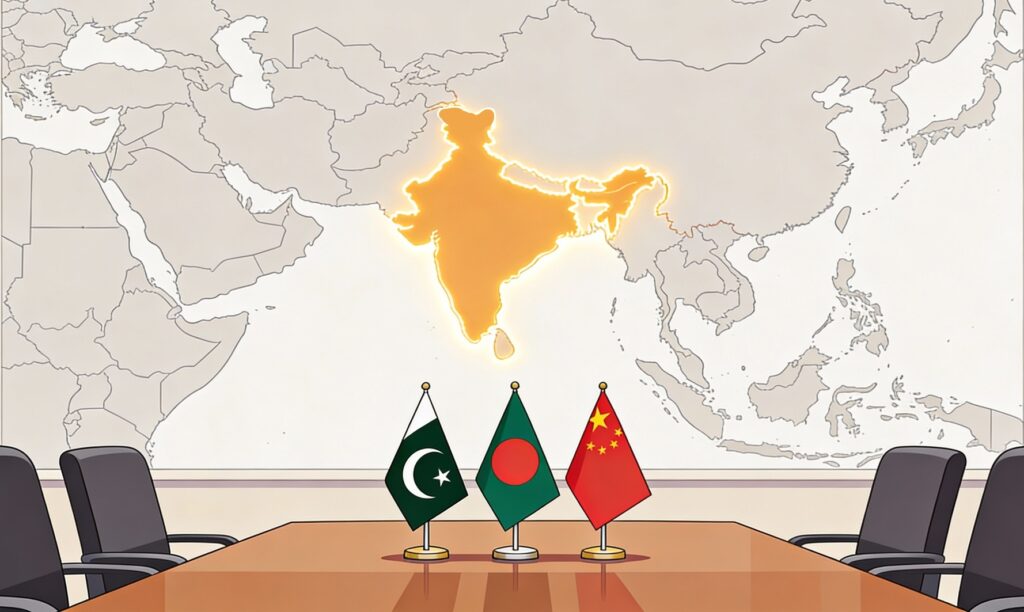
- Bangladesh’s recent openness to a China–Pakistan regional initiative, excluding India, signals a subtle but consequential shift in Dhaka’s outlook and in subcontinental strategic alignments.
- Pakistan has proposed a China- and Bangladesh-linked regional platform framed as a loose arrangement for connectivity, trade and economic cooperation rather than a political or military bloc.
- Dhaka’s stance extends its traditional great-power balancing, but with a sharper post-Hasina assertion of autonomy from New Delhi.
- In India, the grouping is widely seen as constrained by member economies’ fragility, shared China-linked debt and the absence of access to the Indian market.
Bangladesh’s recent readiness to join a China-based regional arrangement with Pakistan, while excluding India, signals a subtle but significant re-tuning of Dhaka’s strategic outlook in the Indian Subcontinent. This signals the desire of Pakistan and China to build an alternative regional framework and to push the boundaries of the conventional centrality of India in the region’s evolving neighbourhood.
The Emerging China-Pakistan-Bangladesh Framework
Pakistan has suggested a new regional platform that is based on collaboration with China and Bangladesh, projected as a loosely-knit connectivity, trade and economic cooperation initiative and not a military or political union. Clearly, this project, positioned as a substitute for a paralysed SAARC, aims to function without India, thus restricting New Delhi’s capacity to establish or veto the regional agenda.
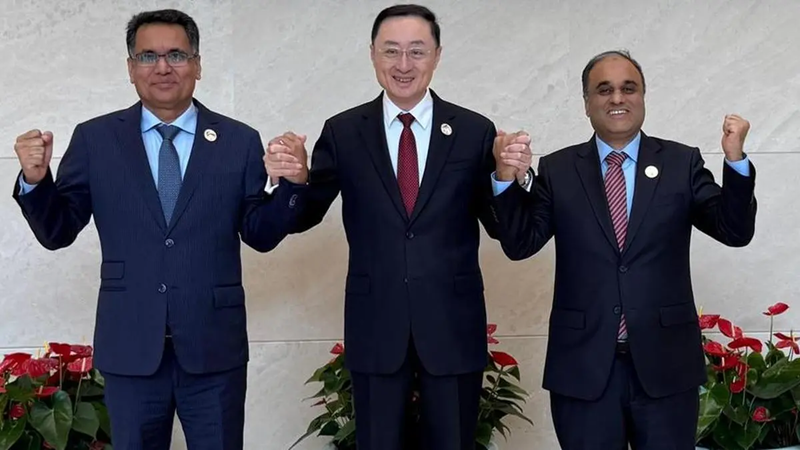
Initial talks between Chinese, Pakistani and Bangladeshi authorities in Kunming were a signal of an intention to institutionalise such an engagement in the long run, potentially by inviting other states in the Indian Subcontinent. The language employed by advocates emphasises development and regionalisation, but the strategic undertones are obvious: to establish a collaborative model where India, at best, is an optional player, not the key point in the game.
Dhaka’s Calculated Ambiguity
The Foreign Affairs Adviser of Bangladesh, Md Towhid Hossain, has diplomatically said that there was a possibility of Dhaka joining a grouping with Pakistan that does not involve India, without making any move to formally announce such a decision. This restrained use of language preserves a strategic ambiguity that shows Dhaka’s willingness to experiment with alternative arrangements without necessarily altering the existing relationships that Bangladesh maintains with other partners, including its prized yet poor relationship with India.
The position taken by Dhaka may be regarded as a continuation of its longstanding history of balancing among the great powers, though the tone has clearly shifted in the post-Hasina period toward a more assertive expression of self-determination vis-à-vis New Delhi. The leadership of the day must keep the doors open to any direction, including Beijing, Islamabad, New Delhi, and key Western capitals, to avoid being overly reliant on any single partner.
Continuity and Change in Bangladesh’s Foreign Policy
The Bangladesh external policy during the reign of Sheikh Hasina was pragmatic and consisted of strong security and connectivity relations with India, significant economic engagement with China, and continued access to Western markets. This approach delivered tangible growth, infrastructural development and regional balance, even as Dhaka managed the delicate issues such as counterterrorism and border management along with New Delhi.
The political shift in Dhaka has unavoidably introduced a degree of uncertainty and strategic recalibration, as Dhaka has responded to Pakistani and Chinese overtures more positively than in the recent past. Nevertheless, the interests of Bangladesh, which are determined by its structural imperatives, namely the need for stable borders, economic stability and diversified relations, still demand a position of compromise instead of an open offensive reaction towards India.
China’s Regional Ambition
In China’s case, a new Indian Subcontinent bloc dilutes India’s influence and offers an opportunity to strengthen its political and economic footprint in the region. Beijing can expand Belt and Road corridors, increase financial and technological reliance, and position itself as the primary facilitator of regional growth by emphasising connectivity, infrastructure, and industrial cooperation.
At the same time, this framework will enable China to work with financially stressed nations such as Bangladesh and Pakistan, thereby increasing its influence over their policy choices. This approach is not risk-free as national pride in partner countries often outweighs concerns over autonomy and strategic independence, and the issue of debt sustainability is being examined more closely at the global scale.
Motivation and Historical Sensitivities of Pakistan
Islamabad sees the suggested bloc as a means to escape regional seclusion, counterbalance India and demonstrate diplomatic relevance amid years of SAARC stalemate and its marginalisation in India-led structures. To Pakistan, a Chinese-supported structure that incorporates Bangladesh also carries symbolic importance, implying that ancient political and historical rifts can be managed or kept at bay in the pursuit of modern economic ambitions.
But the heritage of 1971, unresolved historical grievances, and popular sensibilities in Bangladesh place natural constraints on how much and how rapidly such a rapprochement can be achieved. Any efforts to rush political convergence without genuine overtures on matters related to history and accountability may prove counterproductive domestically and further complicate Dhaka’s internal situation.
Drivers of Dhaka’s Interest
There are a number of reasons that help explain why Dhaka is ready to keep this option on the table. First, the economic strains, slowing exports, balance-of-payments difficulties, and pressures of adjustment induced by IMF-backed programmes motivate Dhaka to look elsewhere for investment and credit sources. The Chinese-supported regional efforts can be presented as a way to modernise infrastructure, diversify exports, and relocate manufacturing, particularly in the environment of tightening Western standards.
Second, certain sections of Bangladeshi opinion and segments of the political elite view India as an overbearing neighbour, citing unsettled issues on river sharing, trade imbalances and border incidents. The current leadership will be able to convey a message of increased strategic independence, even though in reality it is compelled to balance a fine line of interdependence with India by being more outwardly engaged with Pakistan and China.
Despite the rhetoric heating up, there are clear constraints in realising this vision as a long-term institution. A large number of nations in the Indian Subcontinent maintain strong economic, cultural, and security ties with India, and would be averse to being part of a structure perceived as inherently anti-Indian or excessively reliant on Beijing. For nations such as Nepal, Bhutan, and Sri Lanka, a certain distance, in a way, “policy flexibility” would rather be preferable than being part of a grouping that tends to ideologically enforce compliance.
Also, a regional economic structure that bypasses India, as it has been the largest market, major transit point, and a key player in maintaining security in the Indian Subcontinent, would in all probability be limited in magnitude, confined in scope, and lack effective control over conflict. These structural factors would circumscribe the potential ambitions of a “Indian Subcontinent minus India” grouping, despite it possibly yielding short-term tactical advantages to those who sponsor it.
Perspective and Policy Options of India
Concerning the Indian perspective on this matter, as seen through the New Delhi lens, “The China-Pakistan-Bangladesh grouping offers a warning that no regional role can be taken for granted and must periodically be renewed through economic, political, and people-to-people interaction.” Indian policymakers see this development as part of a larger trend in which “China seeks to embed itself in the Indian Subcontinent’s Strategic order and use Pakistan as a partner for constructing discourses and structures that challenge the primacy of India.”
Meanwhile, most people in India assess that the structural weaknesses of the proposed grouping include economic vulnerability of core members, overlapping indebtedness to China and the lack of the Indian market, which restricts the transformational possibility of the grouping. This creates an opportunity for India to respond not through restrained confrontational rhetoric, but by enhancing connectivity, trade and development relations with willing neighbours and leveraging platforms such as BIMSTEC, IORA and issue-based multilaterals.
Navigating the Road Ahead
These are some of the ways that can be pursued in the future. The framework may remain an informal process of coordination, limited to a selective project and diplomatic signalling, rather than evolving into a formal organisation. It could also become more institutionalised so that domestic politics in member states balance towards Beijing and Islamabad if economic interests outweigh concerns over overdependence.
Likewise, domestic politics, sovereignty and reasonable analysis of debt and security threats would curb enthusiasm and keep the initiative at a limited scale. Against this movable interplay, the revealed interest of Bangladesh in contemplating a Pakistan-linked arrangement, in the absence of India, is better understood as an advanced signalling by a state seeking room to bargain, as intensifying great-power rivalry deepens in the Indian Subcontinent.

Parag Gilada is a Mukherjee Fellow who has recently graduated from the Jindal School of International Affairs with a keen interest in Sports Diplomacy. Views expressed are the author’s own.
 Anjali Singh
  Aayush Pal
  Piyush Anand