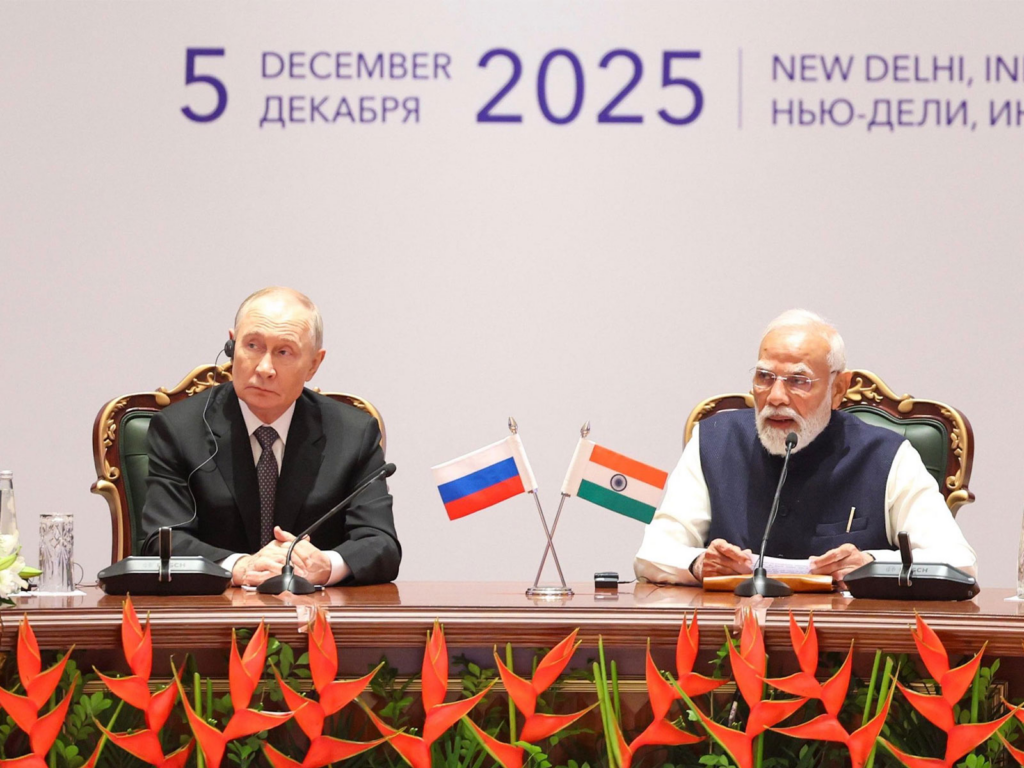
- Russian President Vladimir Putin paid a historic visit to India, his first since the start of the Ukraine war.
- India and Russia signed 16 agreements covering defence, trade, economy, healthcare, academics, culture and medicine.
- One of the most important agreements was the Reciprocal Exchange of Logistics Support, called the RELOS pact.
- At a time when global uncertainty is rising, and the United States is becoming uncomfortable with India’s rapid rise and strategic autonomy, Russia remains a steady and reliable partner.
Russian President Vladimir Putin paid a historic visit to India, his first since the start of the Ukraine war. His last visit to India was in December 2021. This trip was highly anticipated because many things have changed between India and Russia since the conflict began. Both countries have expanded and diversified their engagement, taking annual bilateral trade to 50 billion dollars. Russia has also become more active in Asia, with India and China emerging as its two major partners.
As soon as President Putin landed in India, he was given a red carpet welcome. Prime Minister Modi broke protocol and personally went to the airport to receive and greet him. Neither leader stopped there. They were seen carpooling as they travelled in the same car to the Prime Minister’s residence at 7 Lok Kalyan Marg. This gesture was similar to the warmth shown earlier at the SCO Summit. Later, Prime Minister Modi hosted a private dinner for President Putin.
The next day, major diplomatic exchanges took place. India and Russia signed 16 agreements covering defence, trade, economy, healthcare, academics, culture and medicine. President Putin visited India for the 23rd India-Russia Annual Summit.
Prime Minister Modi reaffirmed that India and Russia share a time-tested and steady relationship. He clarified that India is not neutral on the Ukraine conflict, stating that India is always on the side of peace and diplomacy. President Putin appreciated India’s space achievements and praised Prime Minister Modi for strengthening the special and privileged strategic partnership.
Key Agreements Signed
Among the 16 agreements, the most important was the plan for economic cooperation that aims to increase annual trade to 100 billion dollars by 2030. Last year, India and Russia achieved 50 billion dollars, and doubling this target in the next five years is very realistic considering the current momentum.
Both countries also agreed on a 30-day tourist visa and group tourist visa framework, allowing Russian visitors to get an e-tourist visa for India. Another significant agreement was Russia accepting India’s request for skilled Indian workers to go to Russia through a government-monitored route. This is important because India has a young and vibrant workforce, while Russia has been vocal about its demographic decline. This arrangement will give Indians stable employment opportunities while providing Russia with the manpower it urgently needs.
India and Russia also agreed to curb illegal migration. Recently, some Indians travelling through illegal routes ended up being misled into joining the Russian military services. India has been pushing for transparent mobility, and this agreement addresses that concern. Health and medical partnerships were also strengthened. Russia continues to be a preferred destination for Indian medical students, and both countries want to deepen this academic cooperation. This comes at a time when Indian students are finding fewer opportunities in Western universities due to geopolitical tensions.
Another major agreement involves Russia training Indian seafarers for operations in polar waters. The Arctic region holds immense natural resources and growing geopolitical relevance. Russia’s increased activity in the Arctic and India’s desire to expand its polar footprint align perfectly. This training will help India gain a stronger presence in the region.
Russia also agreed to continue exporting fertilisers to India. In 2024, at Prime Minister Modi’s request, Russia resumed fertiliser exports, which are crucial for India’s agriculture-dominated economy.
Understanding the RELOS Pact
One of the most important agreements was the Reciprocal Exchange of Logistics Support, called the RELOS pact. Before Putin’s arrival, the Russian State Duma ratified this pact. RELOS defines procedures for military unit movement, port access and logistical support for missions and humanitarian operations. This strengthens India’s SAGAR vision announced in 2015. The pact is a potential game-changer for both India and Russia.
For Russia, this provides direct access to the Indian Ocean for the first time. The Indo-Pacific and Indian Ocean are now the centre of global geopolitics, handling over 40 per cent of global trade. Russia does not have bases in the Indian Ocean and has always wanted access to warm waters. This agreement enables Russian naval presence in the region through Indian ports, reducing Russian logistical burdens and giving Moscow strategic reach toward West Asia, Africa and East Asia.
For India, Russia’s presence adds a layer of deterrence in the region. Chinese and American activities have increased in the Indian Ocean. With Russia present, China’s movement will automatically be restricted, even though China and Russia are close partners. Russia cannot use Indian military facilities without Indian consent, giving New Delhi full control.
Continuing the Defence Cooperation
President Putin arrived with a large economic delegation. Several economic agreements were signed, and defence discussions took place on the sidelines. India agreed to lease another Russian nuclear submarine worth two billion dollars and expressed interest in localising production of Russian drones.
It was widely anticipated that India and Russia might sign a deal for India to purchase additional S-400 air defence systems from Russia. There were also strong discussions about India showing interest in purchasing the fifth-generation Su-57 aircraft. This was even indicated by Kremlin spokesperson Dmitry Peskov, who confirmed that India may be interested and that such talks could take place during the visit. However, when the Defence Ministers of both countries met, no official announcement was made. Even so, it appears clear that both sides are engaged in discussions and that talks are ongoing. No conclusion has been reached yet, but India is definitely interested in further strengthening its defence partnership with Russia.
How Global Media Reacted
The visit gained global attention. European media questioned whether India could be trusted, although they ignored the fact that President Putin met President Trump earlier this year, visited China and recently hosted Hungarian Prime Minister Viktor Orban.
The Chinese foreign ministry commented that Putin’s visit may improve India-China ties. Since the 2020 tensions, the two sides have recently taken steps to reduce friction. At the 2024 BRICS Summit, Prime Minister Modi and President Xi held their first bilateral meeting in years, and both countries have agreed to resume limited Chinese investments and restore direct flights. Putin is seen as playing a stabilising role between India and China.
At a time when global uncertainty is rising, and the United States is becoming uncomfortable with India’s rapid rise and strategic autonomy, Russia remains a steady and reliable partner.

Aayush Pal is a freelance writer on contemporary geopolitical developments. The views expressed in his work are entirely his own.
 Pranav S
  Ajith Shetty Heranje
  Atri Patel