
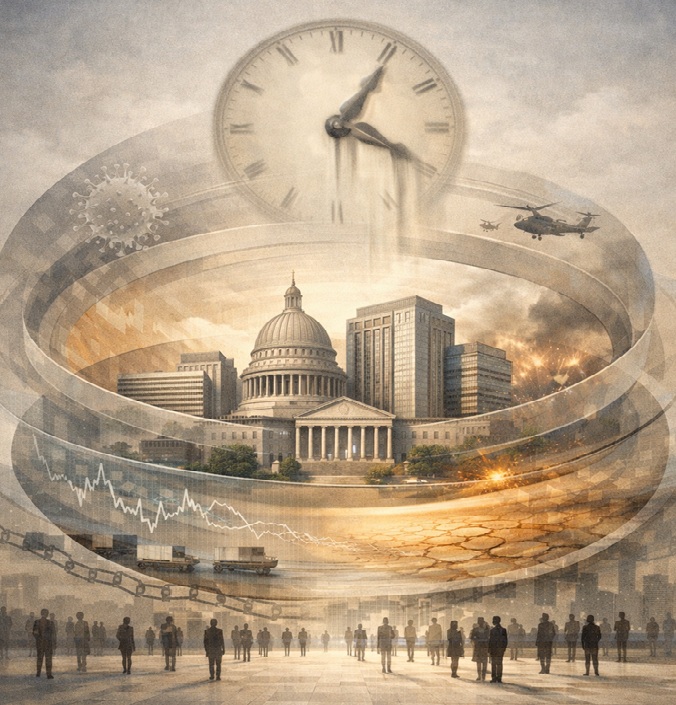
- We are no longer having a string of separate emergencies. We are entering a time when we will always have to deal with crises.
- Instead of long-term stability, policy is now focused on short-term resilience.
- People don’t judge leaders on whether they change society, but on whether they keep systems from falling apart.
- If crisis is the new normal, good governance entails refusing to let emergency thinking become the only way we envision the future.
This essay examines how permanent crisis management is reshaping governance, democracy, and state capacity in the 21st century.
For most of the modern political era, governance was perceived as a sequential process: identify an issue, formulate a policy, execute a solution, and proceed. Wars, famines, and financial crashes were examples of crises that were out of the ordinary and required extraordinary measures. That difference is no longer there. We are no longer having a string of separate emergencies. We are entering a time when we will always have to deal with crises.
Governments all over the world are now in a state of near-constant chaos because of things like pandemics, wars, climate extremes, and economic shocks. Crisis is now the norm, not the exception. This trend is slowly changing how states plan, spend, make laws, and even think about the future.
The COVID-19 pandemic was the most obvious turning point. What started as a public health emergency quickly turned into a disaster with many parts, including broken supply chains, chaotic job markets, paralysed education systems, and a loss of public trust. Even after vaccines made things feel normal again, the idea that stability had returned was wrong. New shocks hit the world system almost right away. These included war in Europe, rising geopolitical tensions, inflationary pressures, and worsening climate disasters.
Governments learned not how to stop crises from happening but how to deal with them. This is what makes this time period unique. Instead of long-term stability, policy is now focused on short-term resilience. Damage control is a better way to measure political success than development outcomes. People don’t judge leaders on whether they change society, but on whether they keep systems from falling apart.
This is a good example of how the economy works. People still use the word “recovery” a lot in official statements, but the truth is that things are more like controlled instability. Central banks need to keep an eye on inflation, growth, changes in the value of the currency, and political pressures. Paying off debt, meeting social needs, investing in defence, and dealing with climate change all make fiscal strategy harder. Instead of boom-and-bust cycles that happen at regular intervals, economies now have shocks that happen all at once and are hard to deal with. Climate change has sped up this change. Extreme heat waves, floods, droughts, and cyclones are no longer just disasters; they are now a normal part of how the government works. Every time something happens, emergency funding, immediate help, and political reassurance are needed. This takes attention and resources away from structural change. There are plans for how to adapt to climate change, but in reality, governments are stuck in “reactionary mode,” dealing with the last disaster while the next one is on the way.
This has significant implications for democratic governance. Emergency powers, formerly used sparingly, are now commonplace. From public health restrictions to surveillance measures and internet shutdowns, extraordinary tools are gradually becoming permanent features. While many of these interventions are legitimate in terms of safety and stability, they blur the distinction between democratic accountability and administrative overreach.
Permanent crisis management also changes the goals of policy. Long-term investments in school reform, institutional capacity, and social trust cannot compete with the current political urgency of the crises. Budgets favour quick, obvious actions over slow, preventive ones. After all, response makes the news, not prevention.
There is a lot of tension in countries like India right now. The state has to deal with climate change, energy changes, job stress, public health capacity, and geopolitical uncertainty all at the same time. All of the areas work together. A heatwave has an impact on more than just the environment; it also has an impact on public health, the demand for power, the safety of water supplies, and worker productivity, which puts pressure on politics and the economy. Instead of fixing problems one at a time, governance is about managing risks that are linked to each other. The language of policy has changed in the same way. “Resilience,” “adaptive capacity,” and “risk mitigation” are now the most common words used in official conversations. These principles are important, but they also show that the goals are less ambitious. Resilience means being able to last, not change. It tells civilisations to deal with shocks instead of getting rid of the sources.
This isn’t just a lack of political will. It shows a more basic structural truth: modern crises happen faster than democratic decision-making can keep up with. Climate research is moving faster than climate policy. Technological changes happen faster than changes to labour laws. Financial markets move in milliseconds, but lawmakers talk about things for months. The result is a constant delay between the problem and the response.
Media ecosystems exacerbate this dilemma. Continuous news cycles and social media intensify each crisis, shortening political time. Leaders are under pressure to act quickly, often symbolically, to comfort frightened citizens. Strategic patience becomes politically dangerous; therefore, performative decisiveness is the safer option.
However, permanent crisis management is fraught with pitfalls. A society that is constantly in emergency mode risks exhaustion, including institutions, individuals, and democratic principles. When promises of “returning to normal” are regularly broken, trust erodes. When crises are managed but not addressed, the public becomes more sceptical.
There is also a fair side. People who have access, a voice, and buffers are more likely to do well in crisis governance. People who are on the outside of society have to deal with repeated shocks and are the least safe. This makes inequality worse and makes people unhappier with society, which leads to yet another crisis that needs to be fixed.
The problem is not that there is always a crisis, but that we need to be more honest and strategic when we govern during it. This means that we need to think about what stability means in a world that is always changing. Stability might not mean that there are no shocks anymore, but that there are institutions that can handle them while still protecting democracy, dignity, and a long-term vision.
Governments must recover room for anticipatory governance by investing in early warning systems, social safety nets, public health infrastructure, and climate adaptation ahead of disasters. This type of governance is less apparent, less dramatic, and significantly more successful. It also takes political bravery, or the determination to choose prevention above show.
It is equally crucial to restore democratic faith. Emergency actions must be transparent, with defined timetables and responsibility. Citizens are more willing to bear hardship when they perceive organisations are open about dangers and limitations.
The age of constant crisis management is not a passing trend. It is the political state of the twenty-first century. The question isn’t whether crises will persist—they will—but whether societies can transition from reactive survival to robust governance without normalising fear, inequality, and executive excess.
If crisis is the new normal, good governance entails refusing to let emergency thinking become the only way we envision the future.

Anusreeta Dutta is a columnist and climate researcher with experience in political analysis, ESG research, and energy policy. Views expressed are the author’s own.
 Amit Dasgupta & Uma Sudhindra
  Shashank Pandey
  Aayush Pal