
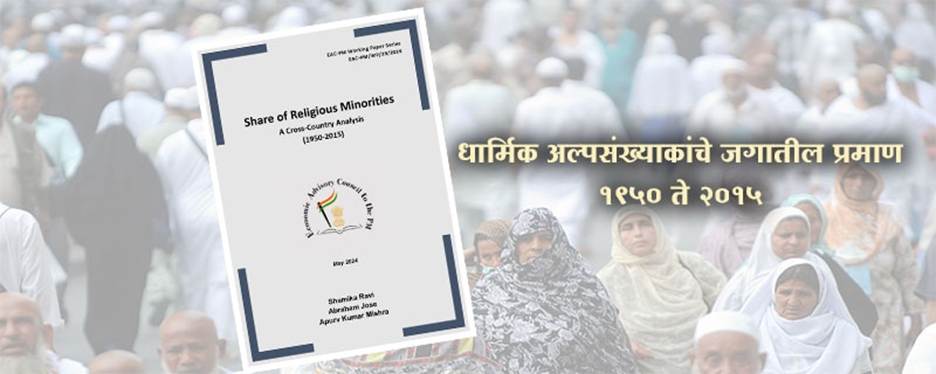
- The Muslim population in India increased by 43.15%, from 9.84% in 1950 to 14.09% in 2015.
- The thriving minority thesis proposes a transformation in how minority treatment is evaluated. Rather than depending exclusively on annual event reports or worldwide rankings, it emphasises longitudinal data.
- If minorities were subjected to continuous structural expulsion, their proportional share would most likely stagnate or fall dramatically over time.
- India’s record demonstrates the opposite dynamic. It has absorbed demographic pressures caused by regional instability while also experiencing growth among its own minority populations over the years.
- The main premise is straightforward and disruptive: India’s minorities are not shrinking. They’re growing. And they’re doing it uniquely across the subcontinent.
In the global discourse on India, a familiar charge resurfaces regularly: religious minorities, particularly Muslims, are facing structural decline under a majoritarian government. International investigations, activist dossiers, and Western academics frequently use India as a case study in democratic backsliding.[1] However, a recent empirical intervention undermines this story. The 2024 working paper “Share of Religious Minorities: A Cross-Country Analysis (1950–2015)”, authored by Prof. Shamika Ravi and co-authors from the Economic Advisory Council to the Prime Minister (EAC-PM), introduces the “thriving minority thesis.”[2] Its findings are based on 65 years of demographic data from 167 nations collected using the Religious Characteristics of States Dataset (RCS-Dem, 2017) [3] rather than relying onanecdotes or episodic events.
The main premise is straightforward and disruptive: India’s minorities are not shrinking. They’re growing. And they’re doing it uniquely across the subcontinent.
A Global Backdrop of Shifting Majorities
According to the report, between 1950 and 2015, the share of the majority religious denomination in 167 nations decreased by almost 22% on average.[4] Liberal democracies and open societies, characterised by migration, uneven fertility rates, and secular governance, exhibit increasing heterogeneity over time. India fits into a bigger global pattern. The Hindu majority’s share fell from 84.68% in 1950 to 78.06% in 2015, a 7.82% drop. This fall is significantly smaller than the global average decline in majority shares, but it is consistent with the trend of diversification. What matters, however, is what occurred to minority communities throughout the same time span.
The Numbers That Disrupt the Narrative
The Muslim population in India increased by 43.15%, from 9.84% in 1950 to 14.09% in 2015. Christians saw a 5.38% gain, from 2.24 to 2.36%. Sikhs saw a 6.58% increase, from 1.24 to 1.85%. Buddhists saw a significant increase, from 0.05% to 0.81%.[5] These are not trivial increases. They indicate steady demographic expansion over the last six and a half decades.
Two smaller communities move in separate directions. Jains decreased partially, from 0.45% to 0.36 percent. Parsis experienced an 85% drop, from 0.03 per cent to 0.004 per cent. Nonetheless, these losses are commonly attributed to low birth rates, ageing populations, and emigration rather than coercion or institutional antagonism.[6] A solely demographic test of systemic persecution might yield unexpected results. In circumstances of persistent governmental antagonism or extensive expulsion, minority shares tend to fall dramatically. India’s long-term population trajectory suggests something else.
The Constitutional Framework
The authors locate this trend within India’s constitutional framework. Articles 25–30 safeguard religious freedom, protect minority educational institutions, and ban religious discrimination. Democratic competition, judicial monitoring, and regular elections serve as institutional corrections.
India did not establish a secularism that excluded certain groups. Unlike strong separationist frameworks found in parts of Europe, the Indian model is based on principled interaction. The state may control religious institutions to promote reform, but it also allows for personal rules governing marriage, inheritance, and family matters across communities. Muslim, Christian, Parsi, and other personal law systems continue to operate under this constitutional framework.
Minority educational institutions, personal law protections, and specific social programs have all operated under this framework. The theory does not assert a utopian reality. It makes a more specific but crucial claim that, over decades, the institutional framework has enabled minority populations to sustain and expand their demographic presence.
The Contrast Within the Subcontinent
The regional comparison sharpens the argument. In Pakistan, the proportion of Sunni (Hanafi) Muslims has increased by 3.75%. When taking into consideration the 1971 partition, the overall Muslim share increased by around 10%. In Bangladesh, the Muslim majority share increased by 18%, the highest growth in the subcontinent.[7] During the same time span, the Hindu minorities in both countries shrank significantly. Partition violence, forced conversions, property confiscation, and discriminatory policies have shifted population balances.
In Bhutan, the Buddhist majority increased by 17.6%, while the Hindu population decreased by 12%. In Sri Lanka, Buddhists increased by 5.25%, while Hindus decreased by approximately 5%. Nepal had a slight decline in its Hindu majority and a 3% decrease in Buddhists, while Muslims increased by 75% and Christians increased from almost zero to 2%. Myanmar had a 10% drop in Theravada Buddhists despite well-documented ethnic and religious strife, notably the persecution of Rohingya Muslims.[8]
The tendency throughout the region is one of majority consolidation and minority shrinking. India stands out. Its majority stake falls somewhat, while most minority shares rise.
Refuge and Reality
India has also provided asylum during regional crises.[9] Following the Chinese onslaught on Tibet in 1959, thousands of Tibetan Buddhists fled to India. The Dalai Lama was granted shelter by the Indian government, which also allowed the Tibetan government-in-exile to establish itself in Dharamshala.[10] Tibetan settlements grew over time in Karnataka, Himachal Pradesh, and other locations, functioning monasteries, schools, and cultural institutions.
The 1971 Bangladesh Liberation War resulted in another massive migration. During that year, an estimated 10 million migrants entered India, most of whom were Hindus fleeing unrest in East Pakistan. Following Sri Lanka’s civil conflict, waves of Tamil refugees arrived in Tamil Nadu beginning in the 1980s. According to government statistics, tens of thousands of displaced people were housed in refugee camps and later provided with long-term settlement arrangements.[11]
This refugee reality sits awkwardly against the assumption that India is a particularly harsh place for minorities. Persecuted minorities from neighbouring states rarely seek refuge in countries where there is systematic religious cleansing. Instead, they tend to drive refugee flows outward.
India’s record demonstrates the opposite dynamic. It has absorbed demographic pressures caused by regional instability while also experiencing growth among its own minority populations over the years. However, none of this excludes the possibility of communal flashpoints. It is worth noting that religious provocations by a single community have frequently resulted in violence, which has been reacted upon by the majority population. The cycle is often one-way.
But episodic violence and long-term demographic annihilation are two distinct phenomena. If minorities were subjected to continuous structural expulsion, their proportional share would most likely stagnate or fall dramatically over time. The data does not support this conclusion.
The Critiques
Critics claim that demographic increase does not adequately convey lived experience. They argue that the paper avoids causal attribution while claiming that Indian policies are accountable for beneficial results. Others question why specific communities, such as Parsis, are declining so rapidly.[12]
These criticisms need attention. Demography is a blunt instrument. It cannot assess workplace discrimination or neighbourhood social issues. It cannot express fear or grief. It does not substitute for civil liberties audits.
However, demographic changes over a period of more than 65 years are significant. There are strict limitations on overstated claims. If the argument is that minorities are on the verge of erasure, the statistics complicate that claim.
Reframing the Debate
The thriving minority thesis proposes a transformation in how minority treatment is evaluated. Rather than depending exclusively on annual event reports or worldwide rankings, it emphasises longitudinal data. What happens to population distributions over generations? Are minorities disappearing, stagnating, or expanding?
In India’s case, most have expanded.
This contradicts a mainstream global narrative that associates current political conflicts with population annihilation. For a country of India’s size and diversity, the survival and flourishing of different religious communities over 65 years is no coincidence. It is the result of a constitutional structure that, despite disagreements and imperfections, has preserved pluralism in measurable terms. In an era of polarised public discourse, empirical clarity is a public good. The prospering minority concept does not call for applause. It asks for proportion. And when it comes to rhetoric vs data, data wins out.
References:
- [1] India: Religious Minorities, Critics Unlawfully Targeted
- [2]Religious Diversity Around the World
- [3] Religious Characteristics of States Dataset Project – Demographics v. 2.0 (RCS-Dem 2.0), COUNTRIES ONLY
- [4] https://eacpm.gov.in/wp-content/uploads/2024/05/Share-of-Religious-Minorities-EAC-PM-Working-Paper.pdf
- [5] India’s Muslim Population Rose Between 1950 and 2015, Share of Hindus Decliageingper centper centned By 7.8%: PM-EAC Study
- [6]https://ndpublisher.in/admin/issues/IJSSv9n4g.pdf
- [7] Hindu population shrunk 7.8 per cent, minorities grew in India during 1950-2015: PM-EAC study
- [8]Share of majority population declined in India, increased in rest of South Asia: Study
- [9] Sheikh Hasina completes a year in exile in India as Bangladesh plans election in 2026
- [10] From Home To Exile-Remembering March 17, 1959
- [11] Asylum Denial Beyond Borders: The International Dimensions of British Responses to Tamil Asylum Seekers in the 1980s
- [12] Clickbait paper: On the EAC-PM working paper

Pranav S is a Project Assistant at the Energy Department, Government of Karnataka with an MA in Public Policy. Views expressed are the author’s own.
 Anusreeta Dutta
  Dhruv Ashok
  Mohmmad Rizwan