
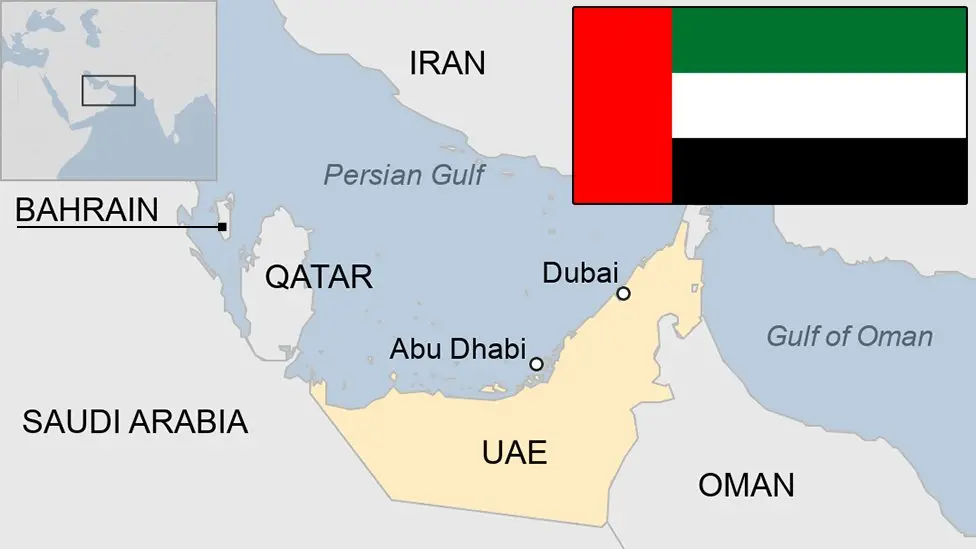
- The diplomatic and geopolitical curtailment of the United Arab Emirates is now being shaped by a Saudi-led alignment.
- One of the primary ways the United Arab Emirates seeks to expand its regional influence is by securing control of major ports and dominating key trade corridors in West Asia and the Red Sea region.
- The deepening relationship between India and the United Arab Emirates represents deliberate geopolitical posturing by both countries, driven by mutual strategic and economic interests.
The United Arab Emirates, one of the major players in West Asia, has been a testament to growth and prosperity in a region that has witnessed prolonged conflicts and repeated invasions. West Asia has historically been a hub of intense geopolitical competition, yet the United Arab Emirates has demonstrated that sustained growth and internal stability are possible even in such a volatile environment. It has maintained largely balanced and pragmatic diplomatic relations with most regional countries. One of its longest-standing and most important relationships has been with Saudi Arabia.
However, in recent times, several strategic challenges have emerged for the United Arab Emirates. The country has suddenly begun facing diplomatic isolation and growing tensions across the Arab Peninsula. A series of geopolitical setbacks and strategic reversals has placed growing pressure on Emirati interests across West Asia and the broader Arab Peninsula. The United Arab Emirates has lately been facing tough geopolitical contention from Saudi Arabia. This is happening amid a renewed struggle for regional supremacy, as both Saudi Arabia and the United Arab Emirates seek to dominate the economic and geopolitical landscape of the region. This rivalry has become a key point of friction between the two countries. To contain Saudi influence, the United Arab Emirates has expanded its support for proxies across the region and has intensified its relationship with Israel. This shift is clearly visible since the Abraham Accords, after which the United Arab Emirates and Israel emerged as strategic partners. At the same time, the United Arab Emirates is also recalibrating its outreach eastward, particularly toward reliable partners such as India.
The diplomatic and geopolitical curtailment of the United Arab Emirates is now being shaped by a Saudi-led alignment. This development is notable because the very coalition once regarded as a pillar of Emirati strategic strength is gradually transforming into a strategic liability. Importantly, these tensions did not originate in Yemen. Instead, the roots of the strain between Saudi Arabia and the United Arab Emirates can be traced to their competition for regional leadership. Both countries want to attract more foreign investment and project economic dominance in the region.
The UAE and Saudi Arabia share a common strategic objective of economic diversification and reduced dependence on oil. Both are trying to shift towards technology-driven sectors such as semiconductors, advanced industrial manufacturing, and artificial intelligence. This parallel shift has intensified competition between the two to attract capital, technology, and strategic investments from major powers such as the United States and China. Whichever state succeeds in leading this economic transition is likely to command greater regional influence, and this competition has become a key driver of bilateral tensions.
One of the primary ways through which the United Arab Emirates seeks to expand its regional influence is by securing control over major ports and dominating key trade corridors in West Asia and the Red Sea region. The management of maritime choke points and critical port infrastructure has become a central pillar of the UAE’s regional strategy.
One of the reasons for the UAE’s involvement in the Yemen civil war in 2015, initially alongside Saudi Arabia, was its ambition to control Yemen’s major ports. Similarly, the UAE’s deep involvement in Sudan, including its alleged support for the Rapid Support Forces (RSF), is driven by the objective of shaping outcomes around Sudan’s Red Sea coastline and port access. Through control over ports in Yemen and Sudan, the UAE aims to assert dominance along the Red Sea trade corridor, which connects Asia to Europe and links to the Mediterranean Sea via the Suez Canal.
Approximately 12 to 15% of global trade passes through the Red Sea, nearly 30% of global container traffic transits the Suez Canal, and close to 10% of global seaborne oil trade passes through the Bab al-Mandeb Strait. By securing influence over these routes, the UAE seeks to challenge traditional regional powers such as Egypt, which has historically dominated the Red Sea and Suez Canal region. Control over the Bab al-Mandeb Strait is therefore a strategic priority for the UAE, as it directly affects global trade flows and regional maritime power dynamics.
The East African Ambition
One of the UAE’s key regional partners in the Horn of Africa has been Ethiopia. The United Arab Emirates has cultivated close ties with Ethiopia to secure regional leverage and strategic visibility. Ethiopia reached an understanding with Somaliland, a self-proclaimed entity that has recently been recognised by Israel, despite objections from Somalia. Under this arrangement, Ethiopia gained access to the port of Berbera in exchange for economic incentives. The UAE’s objective has been to maintain sustained geopolitical access and operational presence in the Red Sea region, particularly in proximity to the Bab el-Mandeb Strait, a critical maritime chokepoint.
Additionally, the United Arab Emirates has extended political and economic support to Ethiopia’s Grand Ethiopian Renaissance Dam (GERD) project. This project poses a significant challenge to water security and resource management in the Nile basin and has been strongly opposed by downstream states such as Egypt. As a result, an emerging regional alignment involving Egypt, Somalia, Eritrea, and Djibouti has taken shape against Ethiopia, with the United Arab Emirates increasingly viewed as part of this bloc’s strategic adversaries.
Another major source of tension has been the UAE’s role in Sudan’s internal conflict. The United Arab Emirates has been accused of supporting the Rapid Support Forces, a proxy group that has contributed significantly to instability and civil war in Sudan. This involvement has alarmed regional players, particularly Egypt, which views Emirati actions as driven by narrow strategic interests that risk destabilising the broader region. Consequently, Egypt has adopted a more confrontational stance toward the United Arab Emirates.
The UAE has also been involved in Yemen since the Saudi-led military intervention began in 2015. Initially, it supported operations against the Houthis. Over time, however, the UAE shifted its focus toward southern Yemen, prioritising its own strategic interests. This shift led to its backing of the Southern Transitional Council. This development conflicted directly with Saudi Arabia’s objectives, as Riyadh continues to favour a unified Yemeni state that aligns with its border security and regional stability concerns. Saudi Arabia views the Southern Transitional Council as a destabilising actor, a perception that has further strained bilateral relations with the UAE.
As a result, Egypt has opposed the UAE in East Africa, while Saudi Arabia has challenged the UAE in Yemen. This overlap of strategic interests has drawn Egypt and Saudi Arabia closer together. Countries such as Qatar have also become active in East Africa, contributing to the emergence of a new regional alignment involving Saudi Arabia, Egypt, and Qatar. This evolving bloc poses a significant strategic challenge to the United Arab Emirates.
The UAE suffered another strategic setback when Saudi Arabia deepened its understanding with Pakistan. This move sent a clear geopolitical signal amid shifting West Asian dynamics and growing rivalry with the UAE. Saudi Arabia’s engagement with Pakistan is widely interpreted as an attempt to establish a nuclear deterrence framework in the region. Countries such as Qatar, Turkey, and Egypt have also shown interest in associating with this arrangement. This prospective nuclear deterrence arrangement is seen as a counterbalance to Israel’s regional military superiority. While Arab states maintain functional diplomatic and security relationships with Israel, they remain cautious of its expanding strategic autonomy and military dominance. Pakistan’s role is therefore seen as central to this emerging deterrence calculus, a development that further constrains the UAE’s strategic space.
The UAE’s Balancing Act Between Israel and Iran
The United Arab Emirates also has to maintain a delicate strategic balancing act between Israel and Iran. Although the UAE has made its position clear in favour of closer ties with Israel, this engagement formally began in 2020 with the signing of the Abraham Accords, which were mediated by the United States between Israel and the United Arab Emirates, along with other regional partners.
At the same time, the UAE remains strategically cautious about Iran’s growing influence in the region. Iran has heavily invested across West Asia through its proxies, including in Gaza, Lebanon, and Yemen. The UAE is fully aware of this expanding Iranian footprint, but does not want to escalate tensions directly with Iran. This approach became evident during recent West Asian tensions, when the UAE stated that it would not permit its airspace to be used for any military action targeting Iran.
India as a Strategic Hedge: Trade, Energy, Defence, and Deterrence
It is in this context that India’s strategic relevance becomes significant. The UAE President, Sheikh Mohamed bin Zayed Al Nahyan, made a brief and high-profile visit to India, lasting only a few hours. Notably, Prime Minister Narendra Modi personally received him at the airport, a gesture that went beyond standard diplomatic protocol and underscored the depth of the bilateral relationship. India and the UAE already enjoy a mature and evolving partnership, strengthened further by their free trade agreement.
During this brief visit, the two countries signed a ten-year LNG deal worth three billion dollars between Abu Dhabi National Oil Company (ADNOC) and Hindustan Petroleum Corporation Limited (HPCL). They also agreed to work toward doubling bilateral trade to two hundred billion dollars. In addition, a letter of intent and a framework agreement on defence cooperation were signed.
The UAE clearly recognises India’s vast market potential and views India as a critical destination for Emirati goods and long-term investments. Beyond economics, the UAE also acknowledges the strategic weight India brings as a nuclear-armed state with growing regional and global influence. Just as Saudi Arabia has sought strategic reassurance through Pakistan, the UAE is signalling deterrence by strengthening ties with India. This serves as a message to regional actors that the UAE is aligned with a major power capable of providing strategic balance in a volatile region.
One of the major advantages shared by India and the United Arab Emirates is the diaspora leverage between the two countries. A substantial Indian expatriate community lives and works in the UAE, creating economic interdependence, people-to-people ties, and sustained political goodwill, which serves as a mutual strategic asset for both India and the United Arab Emirates.
Along with this, energy security cooperation, defence agreements, and India’s capacity to maintain working relations with rival powers across West Asia make India a reliable and strategically preferred partner for the United Arab Emirates. This alignment is equally important for India. Growing ties between Pakistan and key Arab states pose challenges to India’s interests in West Asia. Strengthening its partnership with the UAE allows India to maintain strategic access and influence in the region. Hence, the deepening relationship between India and the United Arab Emirates represents deliberate geopolitical posturing by both countries, driven by mutual strategic and economic interests.

Aayush Pal is a freelance writer on contemporary geopolitical developments. The views expressed in his work are entirely his own.
 Faareha Usmani
  Archita Gaur
  Hridbina Chatterjee