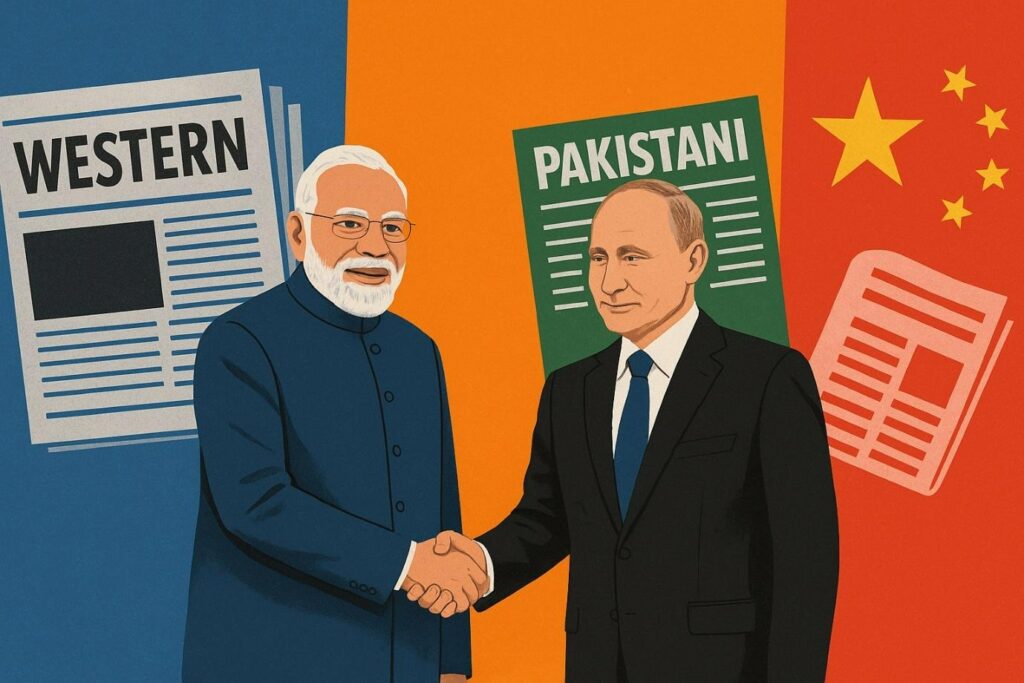
- Western coverage cast Putin’s Delhi visit as driven by U.S. pressure rather than normal diplomacy, downplaying Russia’s wider partnerships and India’s choice to act autonomously.
- Chinese outlets framed the visit as normal, stable diplomacy between long-standing partners, emphasising themes of ‘stability,’ ‘cooperation,’ and ‘multipolar equilibrium.
- Pakistan’s coverage leaned toward strategic unease, reading the visit as a potential shift in regional balance as India deepens defence and diplomatic engagement with Russia.
- These divergent narratives reflect how India’s engagement with Russia shapes global perceptions of its diplomatic autonomy and its emerging identity as a major power in a fragmented world order.
When Vladimir Putin arrived in New Delhi for a two-day state visit, the bilateral agenda was predictable: defence cooperation, energy supplies, trade, and affirming an old partnership. But the global reaction was anything but uniform. Western, Chinese, and Pakistani media each framed the same event through different anxieties, expectations, and geopolitical lenses, creating three distinct stories about one visit.
This article draws on a structured review of coverage across three major media blocs, focusing primarily on how headlines and summaries shaped public perception. The findings reveal not just editorial tone, but deeper insights into how countries view India’s global posture and Russia’s ongoing recalibration.
Western Media: Sanctions, Defiance, and Strategic Unease
Among Western outlets, including Reuters, The Guardian, AP, BBC, and Politico, the dominant tone was wary, critical, and norm-focused. Their coverage gravitated toward sanctions, geopolitical ethics, and strategic discomfort about India’s continued closeness with Russia.
A Reuters article captured the framing succinctly:
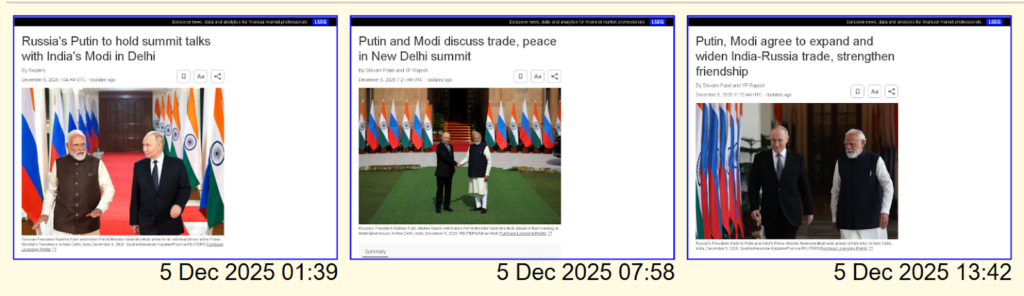
“Putin, Modi agree to expand and widen India-Russia trade, strengthen friendship”
The phrase “despite pressure” became almost emblematic of Western coverage, highlighting the underlying fact of how the Putin-Modi meet-up became inevitable due to U.S. sanctions. It implied that India was consciously choosing a path that complicates the West’s efforts to isolate Moscow. In the Reuters article, the term “pressure” was used a total of 4 times and the headline was updated thrice on the same date, as highlighted below.
The Guardian went further, describing Putin’s pledge of uninterrupted oil supplies to India as:
“oil shipments that would continue in defiance of the US.”
The inclusion of “defiance” shaped the visit as a geopolitical challenge, not a pragmatic energy transaction. For a casual reader, the message was unmistakable: India was opting for Russian barrels over Western expectations.
Another AP article noted that the visit was “in the face of US sanctions,” implicitly positioning the U.S. as the motivating force behind the visit. The repeated use of terms like “tightrope,” “undercutting sanctions,” and “complicating Western unity” projected a sense of unease.
Direct Quotes from Public Reporting
| Source | Quote |
| The Guardian | “Putin “vows oil shipments to India will be ‘uninterrupted’ in defiance of US pressure.” |
| Reuters | “Despite Western pressure, India and Russia agree to expand and widen trade, strengthen friendship.” |
| Al Jazeera | “Russia said it was ready for “uninterrupted shipments of fuel for the fast-growing Indian economy,” signalling defiance amid sanctions pressure.” |
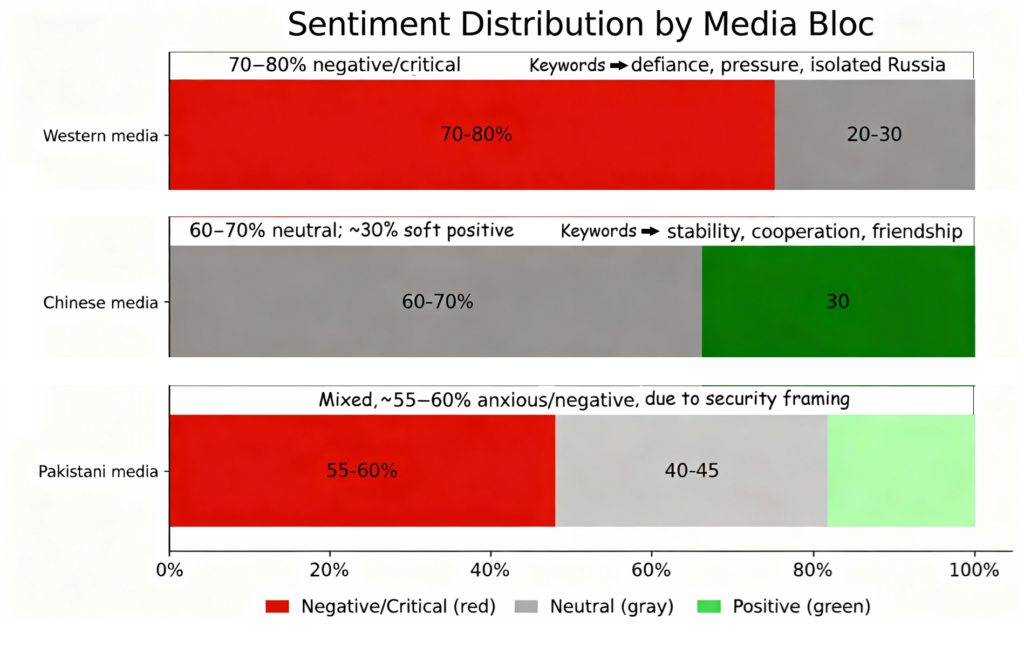
In a gist, Western coverage would land overwhelmingly in the negative quadrant, not necessarily toward India or Russia alone, but toward the political implications of the partnership.
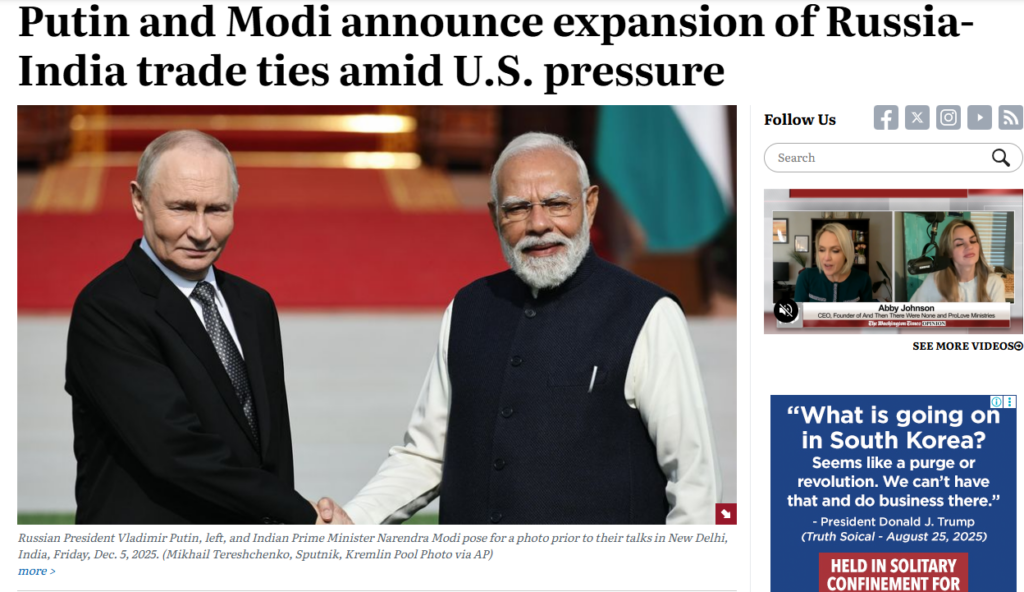
Even the Washington Times gave the higher authority to the U.S., the most-talked-about “U.S. pressure” as the reason for Putin’s visit to India.
How Western Framing Distorts India–Russia Diplomacy
Western editors read Putin’s presence in Delhi not as routine diplomacy but as providing the U.S. the authority and making it the sole driving force for the visit, subtly putting under the carpet the fact that Russia still has major partners and that India is choosing autonomy over alignment. For transatlantic policy watchers, this reinforces the idea that the Global South is no longer willing to follow Western strategic expectations unquestioningly.
Chinese Media: Calm, Positive, and Geopolitically Measured
In striking contrast, Chinese state media led by Global Times, CGTN, and China Daily adopted a smoother, more diplomatic, almost reassuring tone. Rather than highlighting sanctions or Western pressure, Chinese outlets framed the visit as normal, stable diplomacy between long-standing partners. Global Times’ coverage emphasised Putin’s own words:
“India and China are Russia’s closest friends… and these relationships are important for regional stability.”
Another article described the visit as reinforcing “mutual trust, energy cooperation, and multipolar equilibrium.” The language was gentle, polished, and carefully non-provocative.
Crucially, Chinese outlets avoided framing India as choosing Russia over the West, or Russia over China. Instead, they highlighted equilibrium, suggesting that the Russia–India partnership is not a threat to Beijing, but part of a balanced Asian landscape.
Global Times article quoted “Engagement between India and Russia conveys a clear message to the international community: neither country is isolated, and both demonstrate strong resilience in the face of external pressure or interference.” Meanwhile, China Daily’s article quoted “Russia is a reliable supplier of oil, gas, coal, and everything that is required for the development of India’s energy. We are ready to continue uninterrupted shipments of fuel for the fast-growing Indian economy, showing a delicately balanced perspective towards the tri-lateral partnership of China-India-Russia. Chinese media outlets adopted a careful approach while measuring. In a nutshell, Chinese articles would cluster around neutral-to-soft-positive, with the dominant themes being “stability,” “cooperation,” and “friendship.”
How China Calibrates the India–Russia Narrative
Beijing has no incentive to dramatise India–Russia ties. A “calm” frame maintains its own diplomatic breathing room, avoids escalating trilateral tensions, and subtly reinforces the idea of a multipolar Asia where Moscow maintains balanced relations with both Beijing and New Delhi.
Strategically, it also helps China position itself as a stable, non-confrontational actor, a contrast to louder Western anxieties.
Pakistani Media: Anxiety, Balance-of-Power Concerns, and Strategic Unease
Pakistan’s coverage, represented by outlets such as Dawn, Geo, and Express Tribune, took a different route: security-first, regionally anxious, and politically watchful.
Dawn’s headline was direct: “Putin in India on visit seen as a tightrope walk for Modi.”
This phrase, “tightrope walk,” echoed the Western frame, but Pakistan’s underlying concern was different: What does deeper India–Russia cooperation mean for Pakistan’s strategic environment?
Articles noted that the visit “carries serious implications for regional stability,” with some commentators warning that expanding India–Russia defence cooperation, even symbolically, shifts the balance.
The Express Tribune quoted “Russian President Vladimir Putin arrived in India on Thursday for a two-day visit aimed at deepening defence ties, as New Delhi faces heavy US pressure to stop buying oil from Moscow”, while the Dawn quoted “Putin, Modi fortify alliance against backdrop of Western pressure.”
In a narrative description of a sentiment graph, Pakistani coverage would sit between neutral and negative, driven not by hostility toward India–Russia ties per se, but by fear of strategic marginalisation.
Why India–Russia Optics Stir Unease in Islamabad
Pakistan views India–Russia engagement through its own security lens. Even if no new defence deals were announced, the symbolic optics of Putin warmly embracing Indian leadership can be read as strategic insulation for New Delhi. This naturally produces anxiety in Islamabad’s discourse.
If one were to place the sentiment findings in a visual chart (refer to annexure A):
1. Sentiment Distribution by Media Bloc
2. Dominant Themes Across Articles
- Diplomatic optics: highest frequency across all blocs
- Sanctions / Western pressure: dominant only in Western media
- Energy and oil: high across Western and Chinese coverage
- Defence ties & security: especially prominent in Pakistani narration
- Multipolarity & balance: visible primarily in Chinese reporting
Why These Divergent Frames Matter for India
The global media divergence around Putin’s Delhi visit is not simply an editorial flavour; it reflects how India is positioned in different geopolitical imaginations. In the West, India appears as a strategically autonomous actor whose decisions can challenge Western sanctions designs. This portrays India as both a partner and a frustration. In China, India is cast as a stable, predictable neighbour maintaining traditional partnerships without undermining regional balance. This gives Beijing space to avoid escalation and keep trilateral relations calm. In Pakistan, India’s Russia ties appear threatening, shifting the perceived balance of power in South Asia and reinforcing fears of strategic imbalance.
Together, these narratives show how India’s engagements with Russia ripple far beyond bilateral ties, shaping perceptions of India’s global posture, its diplomatic autonomy, and its emerging identity as a major power in a fragmented world order. Putin’s New Delhi visit demonstrates that foreign policy is not just about what nations do, it is also about how the world reads it.
Annexure A
| Western | Reuters | “Putin’s India visit raises concerns in Washington as sanctions pressure grows.” | Negative | Sanctions / Geopolitics |
| Western | BBC | “Putin arrives in New Delhi despite Western criticism over Ukraine war.” | Negative | Norms / War Context |
| Western | The Guardian | “Putin vows uninterrupted oil shipments to India in defiance of U.S. warnings.” | Negative | Energy / Defiance |
| Western | AP News | “India hosts Putin as Western allies watch uneasily.” | Negative | Strategic Anxiety |
| Western | Politico | “Modi doubles down on Russia ties as Putin seeks global legitimacy.” | Negative | Legitimacy Politics |
| Chinese | Global Times | “Russia–India partnership remains a pillar of stability in Eurasia.” | Neutral-Positive | Diplomacy |
| Chinese | CGTN | “Putin says Russia considers India a trusted and time-tested friend.” | Positive | Friendship / Stability |
| Chinese | Xinhua | “Putin’s visit highlights deepening economic cooperation between Russia and India.” | Neutral | Economy |
| Chinese | China Daily | “Experts say Putin’s India trip helps maintain balance in regional affairs.” | Neutral | Regional Stability |
| Pakistani | Dawn | “Putin in India: A diplomatic tightrope walk for Modi as region watches.” | Mixed-Negative | Balance of Power |
| Pakistani | Geo News | “India’s embrace of Putin may alter regional equations, analysts warn.” | Negative | Security Anxiety |
| Pakistani | The Express Tribune | “Putin’s Delhi visit seen as signalling deeper defence alignment.” | Mixed | Defence / Strategy |

Diksha Bharti is currently pursuing a Master’s program in Russian studies. She has previously worked as a Research Associate at Politika and the Consilium Research Institute. She has a keen interest in geopolitics and has contributed to several reputed platforms. Views expressed are the author’s own.
 Aayush Pal
  Rajeev KS
  Hridbina Chatterjee