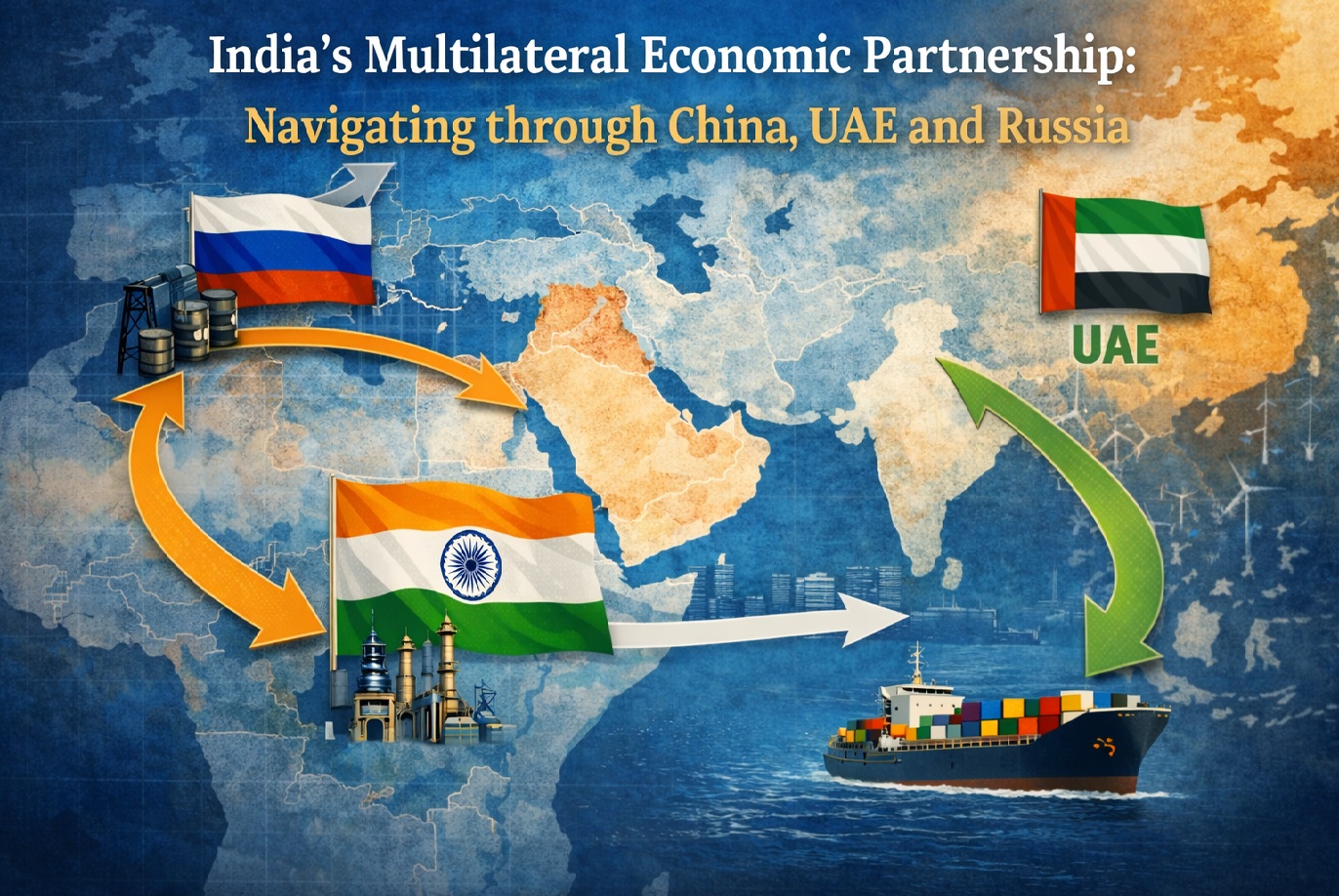
- The bilateral trade between China and India has grown nearly fourfold over the past decade, with trade volumes crossing US$100 billion for the fourth consecutive year, reaching US$127.71 billion in FY25.
- The landmark free trade agreement deepened bilateral economic ties with the UAE, pushing trade volumes to $100.06 billion in 2024-2025, while granting zero-duty market access to nearly 90% UAE exports to India.
- The current trade value between India and the European Union is approximately USD 120 billion as of 2024.
India has established multilateral economic partnerships with several of its major global partners, including China, the United Arab Emirates, and the European Union. It is seeking alternative economic partners to reduce its reliance on the U.S. amid repeated trade tariff pressures.
The US has been exerting pressure on India since last year by imposing high trade tariffs on India’s continued imports of Russian oil. This escalated significantly in August 2025, when tariffs were raised from 25% to 50%. Despite these measures, India recorded an 8.2% economic growth rate. According to IMF forecasts, India is projected to grow at a 6.5% GDP growth rate in 2026, surpassing the global average. India has also witnessed a notable 20% increase in its total exports in November 2025.
India-China Economic Partnership
The economic partnership between both countries formally began on July 18, 1994, following the signing of the Double Taxation Agreement, which granted Most Favoured Nation (MFN) status to each other. However, full-fledged bilateral trade relations had already commenced in 1992. Currently, India is the second-largest trading partner of China, amounting to $113.45 billion in FY25 and US$101.74 billion in FY24. India’s major exports to China include ores, slag, ash, as well as nuclear reactors, mechanical appliances, and organic chemicals.
The bilateral trade between China and India has grown nearly fourfold over the past decade, with trade volumes crossing US$100 billion for the fourth consecutive year, reaching US$127.71 billion in FY25. Both India and China have sustained their economic relations despite ongoing border clashes and disputes. This economic engagement was further reinforced when the New Development Bank, headquartered in China, opened its India Regional Office at Gujarat International Finance Tec-city in 2022, with India emerging as the largest borrower, securing USD10 billion across 28 projects as of 2025. India’s membership in the Shanghai Co-operation Organisation in 2017 further facilitated economic engagement between the two countries through institutional dialogue and diplomatic coordination.
India-UAE Economic Partnership
India and the UAE have been trading partners for several decades, with a significant transformation occurring in the post-1990s period, making the UAE India’s third-largest trading partner and second-largest export destination, with bilateral trade valued at USD 100.06 billion in FY25, up from approximately US$180 million annually in the 1970s. Major exports to the UAE include gems, electronic goods, while India imports petroleum products, aerospace and spacecraft components, etc.
The India-UAE trade relationship grew after both countries signed the Comprehensive Economic Partnership Agreement on February 18, 2022, which came into force on 1st May, 2022, and was signed by Prime Minister Narendra Modi and the President of the UAE, Sheikh Mohamed. This landmark free trade agreement deepened bilateral economic ties, pushing trade volumes to $100.06 billion in 2024-2025, while granting zero-duty market access to nearly 90% UAE exports to India.
Both countries have also signed the Bilateral Investment Treaty in February 2024, which became effective on August 31, 2024. The UAE’s largest sovereign wealth fund established an office in GIFT City, Gujarat. The recent development can be seen after a major talk was held on connectivity in the India-Middle East-Europe Economic Corridor, alongside initiatives such as the Master Application for International Trade and Regulatory Interface (MAITRI) and the Virtual Trade Corridor.
India-European Union Economic Partnership
The European Union and India initiated their trade relations in 1962 when India became the first country to establish diplomatic relations with the European Union Community. This relationship was further strengthened at the 5th India-EU Summit held in Hague in 2004, where both countries upgraded their relationship to a Strategic Partnership. Today, India stands as the largest trade partner of the EU. India has been increasing its economic engagement with the EU, viewing it as a potential alternative trading partner amid strained trade relations with the United States.
On June 28, 2007, India and the EU began negotiations on a broad-based Bilateral Trade and Investment Agreement(BITA) in Brussels, Belgium, in line with commitments made at the 7th India-EU Summit held in Helsinki on 13th October 2006. These negotiations covered trade in goods and services, trade remedies, rules of origin and other regulatory frameworks. Until 2013,15 rounds of negotiations were held alternatively in Brussels and New Delhi, with the final round conducted on 13th May, 2013, in New Delhi.
On 8th May 2021, both sides agreed to resume negotiations, which had stalled due to political differences. On 17 June 2025, India and the EU formally relaunched negotiations for a Free Trade Agreement, and while initiating separate discussions on an Investment Protection Agreement and an Agreement on Geographical Indications. A breakthrough followed the 2025 visit of Ursula von der Leyen, which helped complete 14 rounds of negotiations. However, the 15th round revealed unresolved challenges, particularly related to the Carbon Border Adjustment Mechanism (CBAM), Geographical Indications(GIs), critical minerals and Intellectual Property Rights (IPRs).
As of now, Commerce and Industry Minister Piyush Goyal is scheduled to visit Brussels for a two-day engagement with EU Commission President Ursula von der Leyen and EU Council President Antonio Costa to resolve outstanding issues. The current trade value between India and the European Union is approximately USD 120 billion as of 2024.
Conclusion
India’s multilateral trade relations with other economic powers will not only help strengthen economic growth but will also reduce its reliance on the U.S. for its bilateral trade. Persistent trade pressures and tariff threats from the U.S. pose a strategic challenge, compelling India to reassess and recalibrate its economic engagement with alternative global partners.
References:
- https://etedge-insights.com/featured-insights/how-india-can-pivot-as-higher-u-s-tariffs-reshape-global-trade-dynamics-in-2026-27/
- https://www.ibef.org/indian-exports/india-china-trade#:~:text=A%20Double%20Taxation%20Agreement%20was,significant%20economic%20and%20bilateral%20relations.
- https://www.indiatoday.in/opinion/story/three-years-on-what-the-world-can-learn-from-india-uae-trade-agreement-2686974-2025-02-28
- https://economictimes.indiatimes.com/news/economy/foreign-trade/india-uae-trade-at-100-bn-since-signing-cepa/articleshow/122843588.cms?from=mdr
- https://www.ibef.org/indian-exports/india-uae-trade#:~:text=India%2DUAE%20trade%20has%20increased,US%24%20100.06%20billion%20during%20FY25.
- https://www.forbes.com/sites/krnkashyap/2026/01/07/india-and-eu-are-on-the-cusp-of-signing-a-consequential-trade-deal/
- https://www.commerce.gov.in/international-trade-trade-agreements-indias-current-engagements-in-rtas/india-eu-broad-based-trade-and-investment-agreement-btia-negotiations/#:~:text=On%2028th%20June%202007%2C%20India,BTIA)%20in%20Brussels%2C%20Belgium.
- https://policy.trade.ec.europa.eu/eu-trade-relationships-country-and-region/countries-and-regions/india/eu-india-agreements_en#:~:text=India%20is%20the%20EU’s%209,%E2%82%AC30.4%20billion%20in%202020.
- https://indianembassybrussels.gov.in/pdf/India-European%20Union%20Bilateral%20Relations-10-05-2024.pdf

Antara Deka is a student of Political Science at North Eastern Hill University and History at Indira Gandhi National Open University. Her interests include political awareness and civic engagement, and she has been actively involved in initiatives promoting informed participation among youth. Views expressed are the author’s own.
 Joy Aditya Phookan
  Anshika Agarwal