
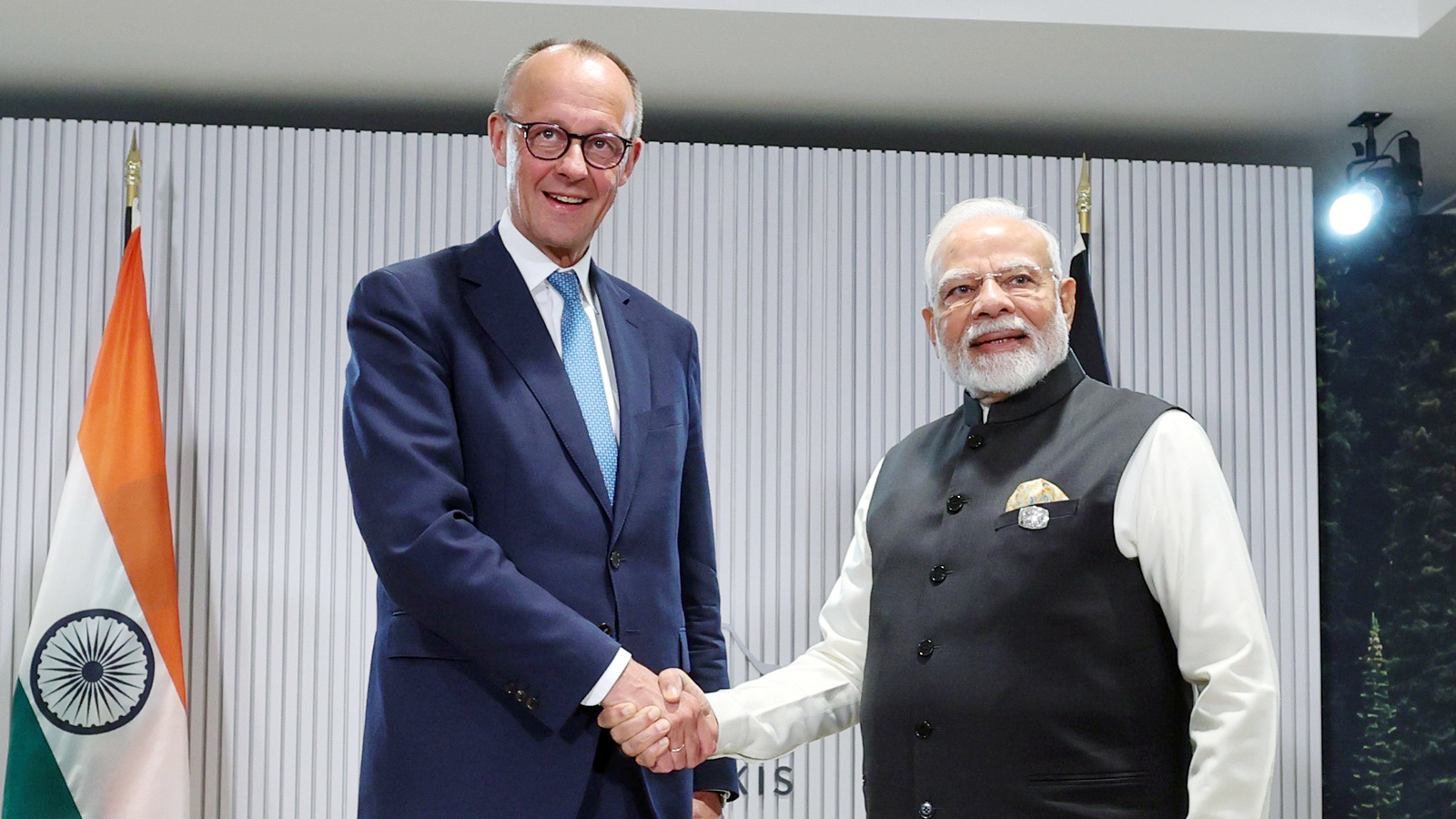
- Chancellor Merz’s visit comes at a time when Germany is increasingly looking towards Asia, particularly India, amid economic turbulence, domestic economic troubles, and continuous international geopolitical pressure.
- Chancellor Merz and Prime Minister Modi agreed to sign 19 major agreements covering defence, trade, critical minerals, and other important sectors.
- European countries have now started to realise that their excessive dependency on the United States of America is no longer sustainable.
- This is clearly reflected in the German Chancellor’s statement that an India-EU free trade agreement could be concluded by the end of January.
German Federal Chancellor Merz visited India for two days on his first Asian trip, during which he met his counterpart, Indian Prime Minister Narendra Modi, in Ahmedabad, Gujarat. This visit was historic, as it marked his first visit to India and, more importantly, his first visit to Asia.
This visit comes at a time when Germany is increasingly looking towards Asia, particularly India, amid economic turbulence, domestic economic troubles, continuous international geopolitical pressure, economic pressure from the United States of America, and ongoing economic issues with China. In this context, the German Chancellor’s visit to India is both strategic and timely.
Chancellor Merz and Prime Minister Modi agreed to sign 19 major agreements covering defence, trade, critical minerals, and other important sectors. It was also agreed that Indian tourists would be provided visa-free airport transit through Germany. This is a milestone agreement reached between India and Germany.
It is important to note that negotiations are currently ongoing between India and Germany to conclude an 8 billion dollar submarine deal, along with cooperation in defence industrial development and co-production. Both countries have also agreed to strengthen military cooperation through multiple joint training programs. Additionally, both sides agreed to conclude the 1.5 track foreign policy and security dialogue on equal terms.
Germany is one of the largest economies in Europe and has traditionally been the growth engine of the continent. However, in recent years, Germany’s domestic sectors have suffered significantly. The German economy has crumbled due to multiple factors, including energy shortages, lower investment, and sustained international pressure, which has not only isolated Germany but has also stagnated the broader European market.
German industries are struggling to attract new investments, and energy has become a major challenge. After the Ukraine war, Germany cut its dependence on cheap Russian energy and is now purchasing energy at much higher prices from the United States. This has created a serious strategic problem within Germany.
The US – EU Rift
More importantly, in the changing geopolitical environment, President Donald Trump’s belligerent policies have shocked and isolated European allies. This includes his claims over Greenland, the tariffs imposed on European allies, and the shifting of much of the responsibility for the Ukraine war onto European countries.
At the same time, the United States of America is pressuring European countries to increase their commitments towards NATO. This has created a serious dilemma for European nations, particularly Germany, which is already bearing a significant share of responsibility related to the Ukraine war. European countries have now started to realise that their excessive dependency on the United States of America is no longer sustainable. They feel increasingly isolated and believe they are no longer being treated as equal partners.
There is a growing perception in Europe that the United States of America is not necessarily indispensable anymore. This realisation is driven not only by strategic concerns but also by economic pressure. The United States has imposed economic constraints on Germany, making it increasingly difficult for European products to access the American market, while American products continue to enter European markets. This imbalance has created serious economic stress across Europe.
This widening rift between the United States of America and Europe has forced major European players such as France and Germany to look beyond the transatlantic framework. It is in this context that India and Asia have become strategically important. This shift is not solely due to differences with the United States but also because of the existing and deepening differences between the European Union and China.
The China Factor
China remains one of the largest trading partners of the European Union. However, for a long time, the European Union has accused China of unfair trade practices and the absence of a level playing field. European economies are heavily dependent on China in critical sectors, including semiconductors. This dependency has emerged as a major strategic vulnerability for the European Union.
Moreover, the trade imbalance between China and the European Union has become a serious concern. During his visit to China last month, President Macron conveyed a clear message to President Xi Jinping that the European Union would impose tariffs if trade terms were not corrected. In 2024, trade between China and the European Union stood at approximately 800 billion dollars. China exported around 550 billion dollars worth of goods, while the European Union’s exports were limited to around 200 billion dollars. This trade relationship is clearly not on equal terms.
A Win-Win for India
This massive trade surplus has compelled the European Union to look for alternative partners. This is where India’s strategic importance comes into focus. European policymakers believe that India can absorb a significant portion of the trade volume currently dominated by China. More importantly, India offers a safer and more reliable market due to its expanding consumer base and stable economic environment.
At the same time, India does not pose a geopolitical challenge to the European Union. There is a strong sense of political and strategic alignment between India and Europe. This makes India an attractive destination for European investment and long-term economic cooperation. As a result, discussions within Europe have increasingly focused on decoupling and diversification strategies. India has emerged as the most viable alternative. This shift also aligns with Europe’s broader strategic goal of reducing indirect dependencies that could benefit China and, by extension, Russia, particularly in the context of the Ukraine war.
For India, this evolving geopolitical order presents a significant opportunity. The changing global balance is increasingly working in India’s favour. This is clearly reflected in the German Chancellor’s statement that an India-EU free trade agreement could be concluded by the end of January. Such an agreement would rank among the most significant free trade agreements in India’s history.
A closur ties with Germany and the EU will provide a greater opportunity for India to diversify its markets. It is a more balanced and equal arrangement, as it would be an agreement of equal length and benefit for both the European Union and India. The European Union is looking for alternative markets, while India is facing heavy tariff impositions of 50 per cent from the United States of America. India is also in need of markets where it can make the tariff pressure from the United States negligible. India has already been able to manage this to some extent, but access to the European Union market can be a game-changer.

Aayush Pal is a freelance writer on contemporary geopolitical developments. The views expressed in his work are entirely his own.
 Hridbina Chatterjee
  Diksha Bharti
  Kumar Satish