
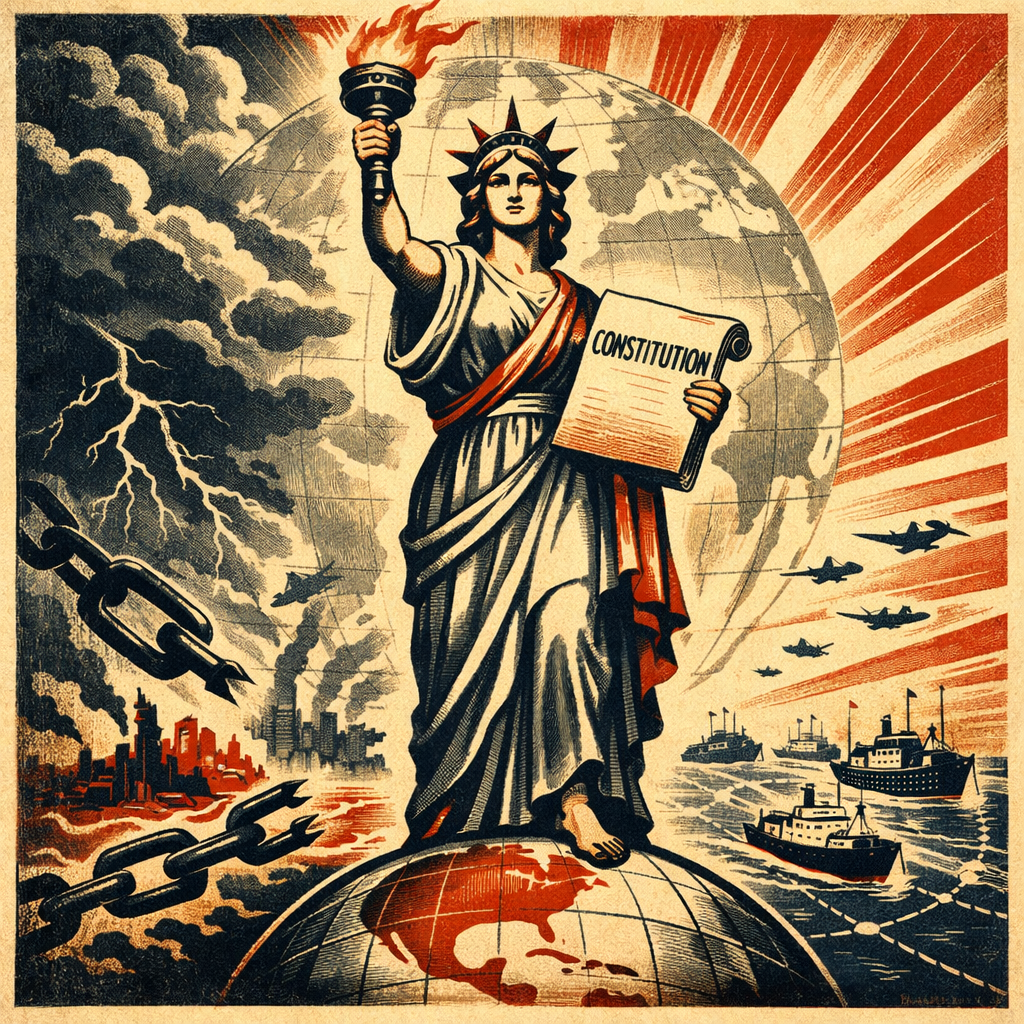
- American exceptionalism is rooted in the belief that the United States is a unique political and economic experiment built on individual liberty, with a historic mission to transform the world.
- U.S. foreign policy first took the form of isolationism, driven by fears that overseas ambition would weaken liberty at home and enabled by America’s geographic security.
- After World War II, isolationism gave way to liberal internationalism—“Pax Americana”—where U.S. power was used to uphold a rules-based global order, promote free trade, and expand democracy.
- Since 2008, American foreign policy has entered a complex phase that combines isolationism and liberal internationalism, reflecting uncertainty about how a “chosen nation” should act in a rapidly changing world.
The recent unilateral military and political involvement by the U.S. in Venezuela has positioned U.S. foreign policy at the forefront of media and academic discussions. Many view President Trump’s America First strategy and use of force as a departure from liberal internationalism. To comprehend liberal internationalism, one must recognise the notion of American exceptionalism. This article presents a theoretical history of U.S. foreign policy grounded in American exceptionalism, rather than addressing the facts.
American exceptionalism is founded on the view of its founders and leaders that the U.S. is a distinctive political and economic experiment centred on individual liberty in human history. It is a chosen or transforming nation tasked with emancipating humanity from the shackles of fascism and economic tyranny. The public of the country likewise held this perspective, as immigrants from Europe arrived in the U.S. seeking economic opportunities and political and religious freedom. It was designated as the ‘New Jerusalem’ on Earth. This American exceptionalism was founded on three principal principles. They firmly believed that the nation’s political and social freedoms are the most progressive on the planet. They believed that Europe was the birthplace of the Enlightenment, but America would refine it. They argued that the Enlightenment’s principles of liberty and equality form the foundation of the nation’s governmental institutions. Secondly, they held a belief in the superiority of their Anglo-Saxon demographic. Third, its distinctive geography conferred geographical immunity.
The U.S. believed it was its job to disseminate its distinctive political, religious, and economic experiment to the rest of the globe. It adopted this messianic goal shortly after achieving independence in 1776. However, the approach for disseminating this U.S. progress globally has consistently evolved. Isolationism emerged as the initial approach of U.S. foreign policy. They held the conviction that the U.S. would transform the world via example rather than through active participation in global affairs. There were two fundamental grounds for isolationism: first, there was concern that the US’s ambition overseas might jeopardise liberty at home. The worldwide overreach would empower the central government and diminish individual liberties. Secondly, the U.S. enjoyed geostrategic immunity, allowing it to pursue a policy of isolationism. It was flanked by the sea on two sides and had a tranquil and calm neighbourhood. It was not obliged to take any additional precautions to ensure its safety.
The isolationist strategy was founded on various principal components: disengagement from international political matters and robust economic ties with the global community, alongside hegemony in the Western Hemisphere. The U.S. is perceived to possess robust economic connections globally and safeguard its trade channels. The Jay Treaty of 1794 sought to remove trade barriers with Britain. The supremacy in the Western Hemisphere was associated with the Monroe Doctrine, articulated by the fifth U.S. president, James Monroe. The Monroe Doctrine held that both the United States and Europe would refrain from interfering in each other’s spheres of influence. The isolationist stance faced opposition as U.S. President Woodrow Wilson sought to amend it. He expected the United States to take an active part in global events to create a new world order based on laws. He thus endorsed U.S. admission to the League of Nations. This brief period of activism concluded upon the election of the new U.S. president in 1921.
The United States maintained neutrality and silence regarding significant events in Europe during the 1920s and 1930s. The isolationist policy faced domestic scrutiny following significant occurrences. The global economic depression of 1929 adversely affected the U.S. economy and sparked criticism and controversy regarding the concept of isolationism. Secondly, the Japanese Air Force conducted an aerial assault on Pearl Harbour, United States, in 1941. The attack obliterated the geostrategic immunity conferred by its distinctive terrain. This episode culminated in the announcement of U.S. involvement in the Second World War by President Franklin D. Roosevelt. These events ultimately resulted in the cessation of the U.S. isolationist policy.
The isolationist approach was replaced by the new paradigm of liberal internationalism. In contrast to isolationism, his approach established a robust political framework for the United States’ strong global engagement from World War II to the Cold War. The new idea, called “Pax Americana,” says that a rules-based international order is necessary for world peace and should be protected by the strength of the U.S. military. This position was further reinforced by the escalating menace of communism. This threat resulted in the formulation of the containment policy by George F. Kennan.
This new policy of liberal internationalism encompasses several fundamental concepts. The initial objective was to avert the emergence of a hegemon in any global region. During the Cold War, the objective was to avert the hegemony of any adversarial state over the Eurasian belt. The second goal of this strategy was to protect free trade in international economic matters. It regarded economic nationalism and mercantilism as a peril to global tranquillity. They believed that the world requires an open trading system that advantages all nations globally. Finally, the advancement of democracy was deemed important. Three of them indicate that U.S. political and economic advancement will henceforth be disseminated globally not by example, but through active engagement.
Liberal internationalism is categorised into two periods. The initial phase commenced with the Second World War and terminated with the termination of the Cold War. This period saw significant American involvement, with 46 military operations by the U.S. in other nations from 1948 to 1991. The United States played a pivotal role in establishing the international alliance with friendly nations, including NATO. The second phase commenced with the conclusion of the Cold War and ended in 2008. Following the dissolution of the Soviet Union, no other superpower existed to monitor U.S. military operations worldwide. America ascended to the status of a hyperpower, a term used by French Foreign Minister Hubert Védrine to describe America in the realm of world affairs.
The United States conducted 188 military actions from 1991 to 2017. The second phase concluded following two significant events: the economic crisis of 2008 and the ascendance of Chinese economic influence alongside Russia’s military endeavours. The United States saw a relative diminution in its economic might following the 2008 financial crisis. Concurrently, it observed the ascendance of China in Asia and Russia in Europe. A significant number of individuals in the U.S. attributed the decline of American influence to the nation’s foreign policy of liberal internationalism. Donald Trump is likewise one of these figures.
American exceptionalism has significantly influenced U.S. foreign policy throughout history. However, this has not provided a definitive strategy for how the U.S. should engage in global affairs. However, it continues to assert that the U.S. is a chosen nation with a distinct destiny and that its system is unparalleled globally. However, it is perplexed regarding its stance on world issues. The current observation is a blend of isolationism and liberal internationalism. This has been evident since 2008, when Democratic presidents sought to implement liberal multilateralism, whereas Republican President Trump adopted an isolationist foreign policy.

Dr Mohammad Rizwan holds a PhD in political science from Jamia Millia Islamia. His doctoral research focuses on Pakistan’s relations with major global powers. Views expressed are the author’s own.
 Aayush Pal
  Anusreeta Dutta
  Archita Gaur