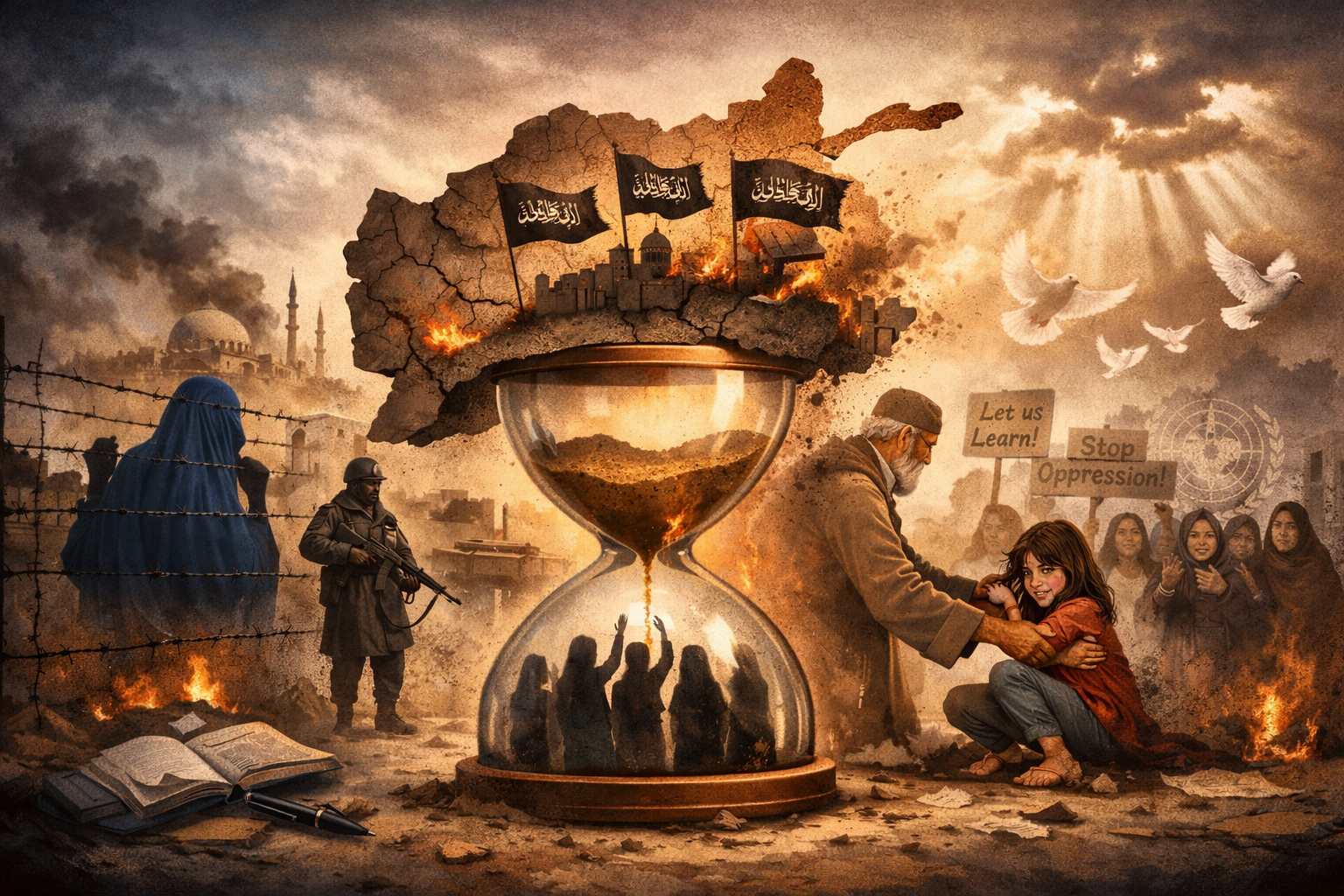
- The Taliban have imposed sweeping restrictions on women, including bans on secondary and higher education for girls, prohibitions on employment, compulsory dress codes, restrictions on movement without male guardians, and the suspension of NGO-led education programmes.
- The most significant social advancement observed under the Communist-led government occurred during the 1980s and early 1990s, when women’s participation in education and the workforce expanded substantially.
- Afghanistan documents the systematic denial of women’s fundamental rights, including the right to education, the right to employment, and the right to dress, directing us to question, ”When will women stop fighting for their own rights?
This article explains the current condition of women in Afghanistan following the Taliban’s return to power. Despite being one of the earliest nations to grant women’s rights in 1919, preceding several developed countries, Afghanistan today ranks among the most restrictive states in terms of women’s rights protections. It documents the systematic denial of women’s fundamental rights, including the right to education, the right to employment, and the right to dress, directing us to question,” When will women stop fighting for their own rights?”
Women’s Rights are universally recognised as fundamental human rights that must not be denied based on nationality, caste, gender, colour or race. The United Nations General Assembly, through the adoption of the Universal Declaration of Human Rights on 10 December 1948, affirmed that women’s rights are inseparable from human rights and called for gender equality worldwide. Subsequently, several international legal instruments were adopted, including the International Covenant on Economic, Social and Cultural Rights (1966), the Convention on the Elimination of All Forms of Discrimination against Women (1979), and the Convention against Discrimination in Education. However, despite these global commitments, Afghanistan has remained largely detached from the effective implementation of these frameworks, failing to ensure even basic rights for women. This not only questions the lack of co-operation in implementing these agreements, but also shows the lack of commitment by the global community.
The Taliban, soon after their takeover in 2021, imposed severe restrictions on women’s freedom of movement, prohibiting them from leaving their homes without a male guardian. Historically, before the mid-twentieth century, women’s rights in Afghanistan remained limited, shaped by conservative interpretations of religion, entrenched social norms, and patriarchal traditions. However, meaningful reform efforts emerged during earlier modernising periods, particularly under the leadership of King Amanullah Khan and King Zahir Shah, who introduced social and legal reforms aimed at expanding access to education and basic rights for women and children.
A more institutionalised expansion of women’s rights occurred after the rise of the People’s Democratic Party of Afghanistan in 1978, followed by the Soviet Invasion of Afghanistan in 1979, a period often regarded as comparatively progressive for Afghan women in legal and educational terms. Under the Communist regime, the Afghan government raised the legal age of women from 18 to 21, restricted polygamy and introduced compulsory education. During this period, Afghanistan acceded to the Convention on the Elimination of All Forms of Discrimination against Women (CEDAW) in the early 1980s, a legally binding international framework that obliges state parties to eliminate discrimination against women and to promote equal rights for women and girls across social, political, and economic spheres.
The most significant social advancement observed under the Communist-led government occurred during the 1980s and early 1990s, when women’s participation in education and the workforce expanded substantially. During this period, approximately 70% of school teachers, 50% of government workers, university students and 40% of doctors were women. These figures, cited in analyses referenced by the European Union, illustrate the extent to which women were integrated into Afghanistan’s public, educational, and professional institutions. The European Union, which has long advocated for women’s rights in Afghanistan, also highlighted the provision of essential services aimed at sustaining basic living standards during this period.
Rise of the Taliban
The rise of the Taliban must be understood against the backdrop of internal resistance to communist reforms, Cold War geopolitics, and prolonged civil conflict in Afghanistan. Opposition to the Soviet-backed People’s Democratic Party of Afghanistan, particularly its progressive reforms related to women’s education and social rights, fuelled armed resistance among conservative and Islamist groups, who viewed these measures as incompatible with traditional and religious norms. Simultaneously, Cold War rivalry between the United States and the Soviet Union played a decisive role, with the United States supporting and financing Islamist factions to counter Soviet influence following the Soviet military intervention in 1979.
After the signing of the Geneva Accords in 1988 and the subsequent withdrawal of Soviet forces, Afghanistan descended into factional violence, creating conditions that enabled the Taliban to emerge as a dominant force. Advancing from southern Afghanistan in the mid-1990s, the Taliban captured Kabul in September 1996, establishing a regime based on a rigid interpretation of Sharia law that severely curtailed women’s rights. Their first period of rule ended in 2001 following the United States–led military intervention launched in response to the September 11 terrorist attacks, which resulted in the deaths of nearly 3,000 people and led to the collapse of Taliban control.
In the post-2001 period, significant progress in women’s rights occurred under successive governments, particularly during the presidency of Ashraf Ghani, when women gained increased representation in government institutions, access to education and healthcare expanded, and female participation in public life rose markedly. Key developments included the appointment of women to senior political and judicial positions, growth in girls’ enrolment across primary, secondary, and higher education, expanded healthcare access for women and girls, and measurable improvements in life expectancy and maternal health indicators.
However, these gains were abruptly reversed after the withdrawal of NATO and U.S. forces in 2021, following the Doha Agreement, enabling the Taliban to regain power. Since their return, the Taliban have imposed sweeping restrictions on women, including bans on secondary and higher education for girls, prohibitions on employment, compulsory dress codes, restrictions on movement without male guardians, and the suspension of NGO-led education programmes. Peaceful protests by women have been met with detention, intimidation, and enforced disappearances, with hundreds of cases documented by independent investigators. As of 2025, Afghan women continue to face systematic exclusion from public life, worsening humanitarian conditions, and a sharp rise in child marriage rates, despite ongoing efforts by international organisations such as UNICEF to mitigate these violations.
Global Response to the Taliban’s Extremism Towards Women
Several international organisations, such as Human Rights Watch, Amnesty International, the European Union, and the United Nations, have undertaken sustained efforts to document human rights violations in Afghanistan and to advocate for the protection of women’s rights. In 2024, UN Women sought to guide international engagement by outlining core principles and policy measures in its Gender Country Profile on Afghanistan. The international community has also provided Afghan women with platforms to amplify their voices, notably through initiatives such as the All-Afghan Women Summit hosted by Albania in 2024 and the Afghan Women Leaders’ Forum established in collaboration with the European Union in 2022.
In addition, Muslim organisations, including the Organisation of Islamic Cooperation (OIC), have condemned the Taliban’s restrictions on women’s education and employment, warning that limitations on non-governmental organisations will undermine humanitarian assistance and further destabilise Afghanistan’s already fragile economy. Despite efforts made by various organisations, the condition of women has been deteriorating; it needs a global call by all the nation-states to introduce strict sanctions on Afghanistan and to protect the people of Afghanistan.
“For now, I wish for the women of my land to be empowered, patient and not disappointed, and I want them not to lose their spirit of struggle and righteousness. A little patience, dawn is near!” – Former employee of an Afghan partner organisation of Medica Mondiale

Antara Deka is a student of Political Science at North Eastern Hill University and History at Indira Gandhi National Open University. Her interests include political awareness and civic engagement, and she has been actively involved in initiatives promoting informed participation among youth. Views expressed are the author’s own.
 Joy Aditya Phookan
  Anshika Agarwal