- Given their massive scale, vast reach, and influence over global information flows, tech companies have begun to function as geopolitical actors in their own right.
- The growing friction between European and American technology platforms highlights a transformation in global digital politics.
- Regulation must strike a careful balance between protecting freedom of speech and safeguarding national security.
- India attempts to balance liberty with stability, innovation with accountability, and openness with sovereign control.
In an unprecedented move, French police recently searched the Paris premises of X, formerly known as Twitter. This action followed a summons issued against X owner Elon Musk as part of a year-long investigation being conducted by the cybercrime division of the Paris Prosecutor’s Office. One of the major accusations levelled by France against X is that the platform has allegedly allowed the circulation of disturbing child sexual abuse material, including images of a pornographic nature. France’s case against X also follows a January controversy in which the platform’s AI chatbot, Grok, was accused of spreading Holocaust denial claims and generating sexual deepfakes.
In response, X’s Paris office released an official statement describing the French government’s actions as politically motivated, arguing that they curtail free speech and endanger freedom of expression across Europe.
France Faces Off With Tech Companies
France’s confrontations with social media companies are not new. A notable precedent was the 2024 Telegram episode, when French authorities detained Pavel Durov, the CEO of Telegram, at Paris International Airport. France accused Telegram of facilitating illegal financial transactions and activities involving non-state and unregulated actors. Following this incident, Telegram reportedly altered several aspects of its operations to comply with French law.
Similarly, it has also been involved in disputes with American technology companies such as Meta. The differences primarily lie in advertising consent, political content, and election-related regulations. In 2024, European regulators escalated action against Meta’s “pay or consent” model, under which users were required either to accept personalised advertising or pay a subscription fee to avoid data tracking. The European Commission ruled that this model violated the Digital Markets Act. Meta was fined millions of euros and was instructed to change the model.
Europe vs US Tech Companies
These tensions are not limited to France. The European Union, along with countries such as the United Kingdom, has enacted sweeping regulations targeting US based technology companies. European governments argue that digital platforms must adhere to domestic laws and should not allow the spread of unethical or harmful content. In this context, the EU introduced the Digital Services Act, under which X was fined 140 million dollars in December for regulatory violations.
The growing friction between European and American technology platforms highlights a transformation in global digital politics. On one hand, European powers insist that foreign technology companies must fully comply with domestic laws and regulatory standards. However, India’s case is distinctly different.
India’s Sovereign Digital Path
Through the Information Technology Rules, India has established clear due diligence obligations for social media intermediaries. Platforms are required to appoint grievance officers, remove unlawful content within prescribed timelines, and cooperate with law enforcement agencies in cases involving serious offences. Recently, the Indian government further tightened compliance standards by reducing the time limit for the removal of certain unlawful and objectionable AI content, requiring action within three hours in specific cases. The idea is clear: digital platforms operating in India must remain accountable to Indian laws.
Tech Platforms as Geopolitical Actors
In the present world, technology platforms are no longer merely private companies providing limited services. Because of their massive scale, vast reach, and influence over global information flows, they have begun to function as geopolitical actors in their own right.
These platforms control critical digital infrastructure, which gives them strategic importance. They manage communication networks, data storage systems, financial transactions, and public discourse across borders. In many cases today, technology companies possess more data about the citizens of a country than that country’s own government. This reality makes it essential to adopt a balanced regulatory approach, as unchecked influence can compromise national sovereignty.
Digital platforms have increasingly become virtual arenas where political discourse unfolds. X, for example, has emerged as a powerful space for shaping global narratives. Such platforms can sometimes serve as grounds for external influence in the internal affairs of nations. The impact is not limited to user conversations; even the statements and positions taken by platform owners can influence public opinion.
Elon Musk’s engagement with European political debates illustrates this trend. His comments on European economic policies, immigration patterns, and governance issues have attracted significant attention and have influenced public discussions. When technology leaders directly intervene in political debates across borders, it raises broader questions about accountability and influence.
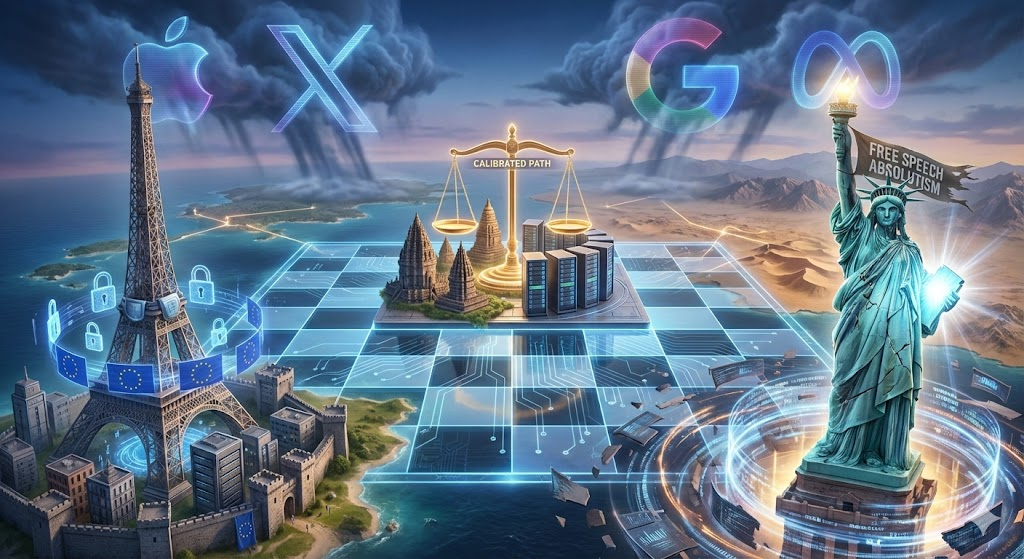
Therefore, it is crucial to develop policy frameworks that ensure due responsibility. Regulation must strike a careful balance between protecting freedom of speech and safeguarding national security. Without such equilibrium, the digital sphere may weaken the sovereign authority of states while amplifying unregulated external influence.
Competing Models of Digital Governance
Different countries across the world have adopted varying models to regulate and govern technology companies. These models reflect their constitutional traditions, political cultures, and societal priorities.
The United States has traditionally leaned toward a free speech-oriented model, rooted in constitutional protections under the First Amendment. Historically, it has favoured limited government interference in online expression. The idea has been that digital platforms should operate with minimal state intervention in matters of speech. However, this approach has faced challenges in recent years. Under President Trump, debates intensified, particularly as he was vocal about criticism directed at him on social media platforms. While many in the United States argue that freedom of speech remains protected, others contend that the boundaries of expression and platform control have become increasingly contested.
In contrast, the European Union has adopted a more interventionist regulatory structure. Through comprehensive legislation and strict compliance requirements, it places significant obligations on technology companies to moderate content, protect user data, and ensure transparency and accountability. Critics argue that heavy compliance burdens may slow innovation and affect platform flexibility, but supporters view the framework as necessary to safeguard consumer rights and democratic institutions.
India’s Calibrated Approach
India’s approach is emerging as a calibrated middle path. It does not embrace speech absolutism, nor does it adopt an overly restrictive regulatory stance. Instead, India seeks to protect freedom of expression while ensuring that digital platforms remain accountable under domestic laws. The framework emphasises due diligence, grievance redressal, data protection, and cooperation with law enforcement authorities.
The Indian model also reflects a broader concern for social harmony and civilisational continuity within a diverse society. In this sense, India attempts to balance liberty with stability, innovation with accountability, and openness with sovereign control.
References:
- https://time.com/7366216/x-grok-offices-raided-france-united-kingdom-probe/
- https://www.intel471.com/blog/france-vs-telegram-what-does-it-mean-for-cybercrime
- https://us.forums.blizzard.com/en/overwatch/t/reasons-for-meta-differences-between-asia-na-and-eu/658156
- https://katv.com/news/nation-world/musk-slams-uk-as-real-fascism-over-12000-arrests-for-online-posts-elon-musk-censorship-laws-social-media
- https://www.ndtv.com/india-news/teen-social-media-debate-puts-big-tech-in-crosshairs-10953842

Aayush Pal is a freelance writer on contemporary geopolitical developments. The views expressed in his work are entirely his own.
 Hridbina Chatterjee
  Diksha Bharti