
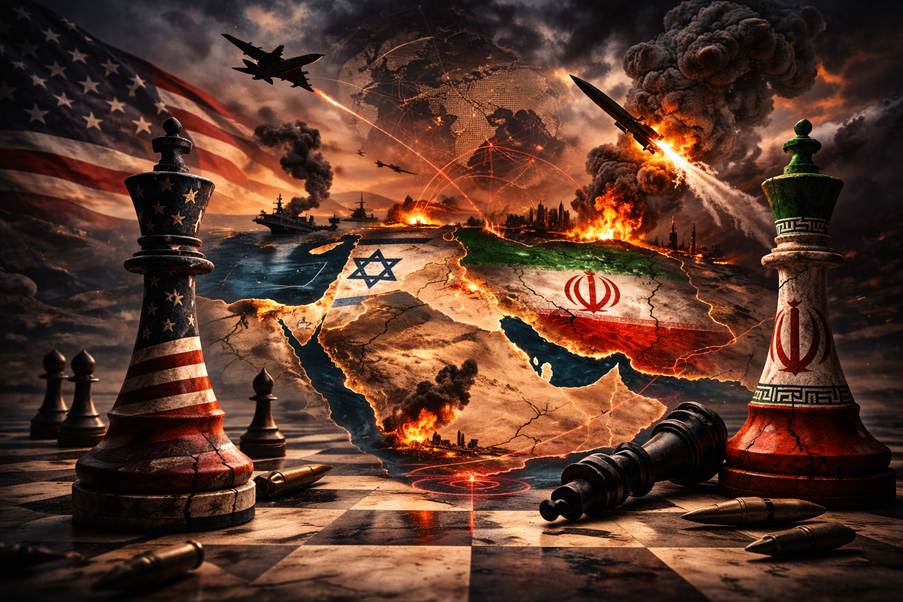
- The upheaval in West Asia isn’t just due to the occasional errant calculation or even a pair of simple ideologically opposed adversaries; it reflects a deeper systemic dynamic that engenders conflict.
- What this produced was a geopolitical framework in which instability was globally embedded, and regional wars were tied to systemic patterns of power struggle.
- The repeated crises in West Asia are not just a function of unstable leadership, ideological enmity, or momentary misjudgment. They are the product of a regional system shaped and sustained by great power rivalry.
Tensions between Israel, Iran, and the US are rising again, bringing West Asia back into the international limelight. Heightened concerns about the proliferation of nuclear weapons and retaliatory escalation are contributing to increasingly aggressive military posturing, creating a dynamic spiral of crises from which the region seems incapable of extricating itself. Although each confrontation appears immediate and event-driven, the repeated emergence of such flashpoints points toward a deeper structural reality. The upheaval in West Asia isn’t just due to the occasional errant calculation or even a pair of simple ideologically opposed adversaries; it reflects a deeper systemic dynamic that engenders conflict. To understand this durability, one must look beyond local divisions and toward the global geopolitical system that organises the region.
For decades, West Asia’s alliances, security doctrine, arms supplies, and diplomacy have been shaped by the competition among great powers. External powers did more than simply intervene during crises; they facilitated the construction of a regional security regime centred on deterrence, patronage, intense strategic competition and self-serving interests. In such a context, peace is tenuous and provisional, maintained more by managed confrontation than by mutual trust. Hence, the perpetuation of conflict is not a fluke, but is built into the structure. [1]
Historical Foundations of Great Power Entrenchment
Great power involvement in West Asia has evolved from episodic mediation to structural entrenchment. External nations have always defined the region’s security priorities. The modern security order in the region emerged through rival competition between superpowers, right from the time of the Cold War. [2]
The region became a theatre of US-Soviet competition during the Cold War years. Security alliances were formed around ideological blocs. Military aid and regime support led to patterns of dependency in West Asia. Moreover, there was no dearth of local rivalries, which were further amplified by superpower backing.
While Soviet influence grew in segments of West Asia during the Cold War, the United States developed its own security arrangements, based on alliances, military assistance, and regime support. What was initially competitive balancing gradually hardened into enduring security dependence. In the post–Cold War era, and especially post-2003 Iraq War era, direct military intervention unsettled power constellations and exacerbated asymmetries. The broadening of American security assurances solidified hierarchical relationships and led regional players to adjust their strategies in alignment with the U.S. patron, as opposed to pursuing self-driven regional collaboration. [3]
The nuclear issue is another example of how great power politics solidified a managed containment rather than conflict resolution. Diplomatic efforts to manage Iran’s nuclear program were constructed to contain the situation, not to reverse the deep-seated antagonism between regional players. Sanctions regimes, inspection mechanisms, and conditional relief institutionalised coercive leverage within the regional order. Instead of changing the nature of threat perceptions, such arrangements institutionalised a system in which rivalry was managed, monitored, and periodically renegotiated. [4]
Eventually, great power engagement stopped being occasional and instead became a defining feature of regional security. Not only did external actors intervene at times in the region’s crises, but they also shaped the contours of crisis developments. What this produced was a geopolitical framework in which instability was globally embedded, and regional wars were tied to systemic patterns of power struggle.
Contemporary Manifestation-Great Power Politics in Action
The current Israel–Iran–United States triangle is illustrative of how this externally imposed security architecture continues to shape regional conduct. The United States’ long-standing security guarantee to Israel institutionalises a profound asymmetry in conventional military power and diplomatic influence. Although this support adds to deterrence and lessens the strategic vulnerability of Israel, it also plays into Iranian feelings of encirclement and strategic containment. As a result, Iran has sought to respond with asymmetric deterrence through missile forces and a web of proxies throughout the region. These transformations are not aberrations but rather are anticipated within a system governed by competing patronage. So, as recent escalations show, this architecture does not eradicate conflict; it modulates it and disperses it. Instead of promoting reconciliation, it engenders tactical adaptation, mutual suspicion, and oscillations of managed confrontation. [5]
Mechanisms Sustaining the Architecture
The durability of conflict in this system can be accounted for by a set of reinforcing dynamics. First, security guarantees change the incentives. Local leaders face fewer pressures to compromise when they act in the name of powerful external patrons. Military backing and diplomatic shielding enhance risk tolerance and mitigate the immediate costs of confrontation. Subordinate allies with great power patronage may also assume that escalation can be managed or contained, while adversaries view such alignments as hostile consolidation. The result is not stability through reconciliation, but stability through deterrence—rivalry is suppressed, but never fully resolved. Security is hierarchical, not cooperative, and this introduces asymmetry into the regional order.
Second, militarisation and proxy proliferation are driving factors in the intensification of hostility in structural terms. The deterrent potential is enhanced by several arms transfers and defence cooperation agreements, but the range of potential escalation is also increased. The region lives in a state of strategic readiness even when direct interstate war is not happening. Simultaneously, rivalries are transported into secondary theatres via proxy war networks, allowing confrontation to continue below the line of open warfare. Consequently, proliferation tends to result in horizontal conflict multiplication across borders rather than its localisation. In this system, crises are seldom isolated to a single geography. Conflict is redistributed across multiple arenas, sustained through calibrated escalation and periodic containment rather than through definitive settlement. [6]
Managed Instability
Together, these mechanisms produce what might be described as managed instability as a norm. Great powers have a stabilising effect by constraining escalation within calculable bounds and by preventing systemic collapse. Direct conflict between major regional powers is also often deterred via strategic signalling, calibrated retaliation, and intervention by third parties. But deterrence is not the same thing as peace. What develops instead is a state in which crises are both recurrent and managed, dramatic yet bounded. Stability thus becomes a function of perpetual management rather than of structural reconciliation.
Escalation is rarely inadvertent in this milieu; it takes place within a known framework of alliance obligations and deterrence calculus. Nonetheless, since fundamental distrust and asymmetries persist, each crisis leaves the architecture intact. The region swings from tension to temporary thaw without addressing the root causes of the rivalry. Managed instability thus substitutes for the stable settlement. It is not total, and it is not resolved; it is regulated, recurring, and institutionalised. [7]
Conclusion
The repeated crises in West Asia are not just a function of unstable leadership, ideological enmity, or momentary misjudgment. They are the product of a regional system shaped and sustained by great power rivalry. Basically, actors external to the region have added deterrence, patronage, and asymmetry to the security structure, allowing confrontation to be manageable, but not resolvable.
Even dramatic escalations or leadership disruptions unfold within this structured environment, constrained by alliance commitments and strategic signalling. So long as the region’s security order is arranged around competitive patronage rather than cooperative regimes, peace will be episodic and provisional. Sustainable stability requires not only management of crises, but a transformation of the underlying system that is still privileging rivalry over reconciliation.
References:
- [1] Walt, Stephen M. “Alliance Formation and the Balance of World Power.” International Security 9, no. 4 (1985)
- [2] Gause III, F. Gregory. “The International Politics of the Gulf.” International Affairs 87, no. 1 (2011)
- [3] Halliday, Fred. “The Middle East and the Politics of Differential Integration.” Global Society (2005)
- [4] Ikenberry, G. John. “Institutions, Strategic Restraint, and the Persistence of American Postwar Order.” International Security 23, no. 3 (1999)
- [5] Posen, Barry R. “Command of the Commons.” International Security 28, no. 1 (2003)
- [6] Phillips, Christopher. “The Syrian War and Multipolar Competition.” International Affairs 92, no. 3 (2016)
- [7] Jervis, Robert. “Cooperation under the Security Dilemma.” World Politics 30, no. 2 (1978)

Archita Gaur is a postgraduate student at the School of International Studies, JNU. She specialises in the World Economy and has a strong interest in public policy, economic research, and governance. The views expressed are the author’s own.
 Hridbina Chatterjee
  Divyanka Tandon