
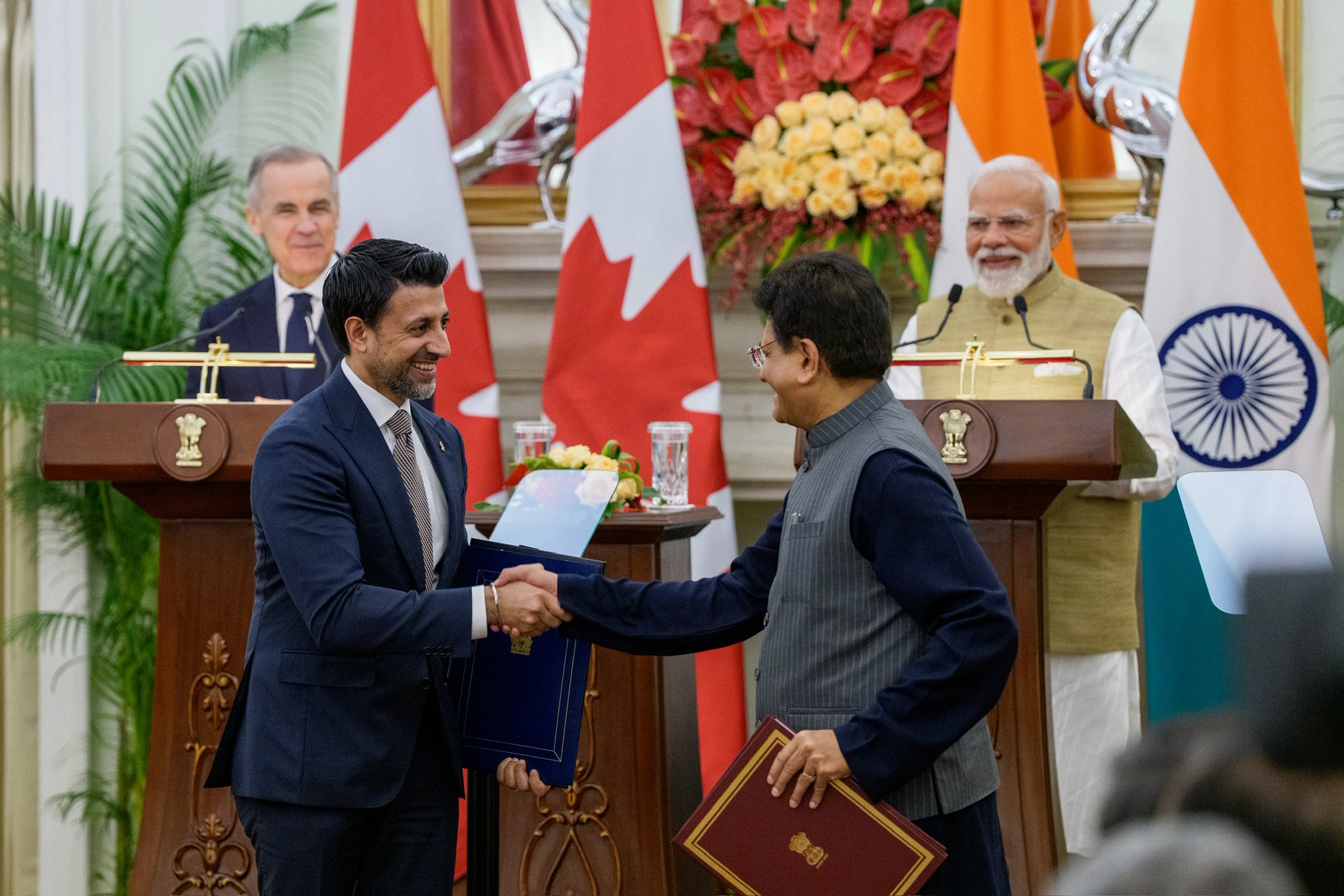
- Prime Minister Mark Carney chose India as one of his first major visits after assuming office, which remarkably signalled a change in the trajectory of relations between the two nations.
- Mark Carney took a bold decision by inviting Prime Minister Narendra Modi to the G20 summit, clearly indicating that both countries are ready to move beyond the troubled past and focus on rebuilding their partnership.
- Both nations have agreed to work toward concluding the Comprehensive Economic Partnership Agreement in the near future.
- In the past month, the Canadian PM has visited China, India, and Australia, indicating Canada’s willingness to diversify its strategic partnerships and reduce dependence on the US.
In a remarkable turn of events, the relationship between India and Canada is once again seen coming back on track. A relationship that was marked by diplomatic isolation, accusations, and a blame game was notably strained under the former regime in Canada. This situation not only damaged the bilateral relationship between the two countries but also sidelined the immense potential that both nations possess.
However, the recent shift appears to be a watershed moment in India-Canada relations, especially after the appointment of Mark Carney as the Prime Minister of Canada. Since then, there have been visible signs of positivity in the relationship between the two countries. This process began from the very early days of his administration. Prime Minister Mark Carney chose India as one of his first major visits after assuming office, which remarkably signalled a change in the trajectory of relations between the two nations.
More importantly, this change had already begun to take shape earlier. During the preparations for the upcoming G20 Summit that will be presided over by Canada, there were many doubts about whether India would even be invited to the summit. However, Mark Carney took a bold decision by inviting Prime Minister Narendra Modi, clearly indicating that both countries are ready to move beyond the troubled past and focus on rebuilding their partnership.
It is in this context that, during Prime Minister Mark Carney’s visit to India, both countries concluded a remarkable and historic agreement worth 2.6 billion dollars. Under this deal, Canada will supply around 22 million pounds of uranium to India from 2027 to 2035. This decision represents an important step toward strengthening energy cooperation and securing along-termm energy partnership between the two countries.
Furthermore, both nations have agreed to work toward concluding the Comprehensive Economic Partnership Agreement in the near future. One of the major problems that had affected India-Canada relations in the past was the issue of security concerns. However, both sides have now acknowledged this matter and emphasised that they will jointly oppose extremism and respect each other’s territorial integrity. Although this issue has been a matter of debate in the past, it was interesting that both countries chose not to publicly highlight these sensitive discussions during media interactions.
Additionally, both nations have agreed to increase their bilateral trade to 50 billion dollars by the year 2030. It is widely believed that once a Free Trade Agreement between the two countries is finalised, bilateral trade could reach nearly 70 billion dollars within the next five years.
Both countries also signed 8 agreements and memoranda of understanding across several sectors. These agreements include cooperation on supply chain resilience, expansion of defence industries, maritime domain awareness, and maritime security partnership. Several other strategic collaborations were also discussed, particularly in sectors such as LNG, LPG, solar energy, and hydrogen cooperation. All these developments clearly indicate that both countries are now ready to expand their bilateral partnership and address the issues that had earlier strained their relationship. This shift also reflects the new approach of the Canadian leadership under Prime Minister Mark Carney.
One of the reasons behind this change is not merely political pragmatism or introspection within the two countries. The evolving global order has also played an important role. Canada itself has been facing significant economic pressure and coercive policies from the United States. The United States has repeatedly placed economic pressure on Canada and even raised questions regarding its security and sovereignty.
In recent political rhetoric from the Trump administration, there have even been remarks suggesting that Canada behaves almost like a dependent state of the United States. Such statements have generated strong reactions within Canada, as many Canadians increasingly question their country’s overdependence on the United States. This situation explains why Canada is now actively trying to diversify its foreign relations. In the past month alone, the Canadian Prime Minister has visited China, India, and Australia. These visits indicate a clear attempt by Canada to diversify its strategic partnerships and reduce excessive dependence on the United States.
India becomes a natural partner in this context. Both India and Canada possess significant potential in terms of economic cooperation, defence partnerships, and strategic coordination. A stronger India-Canada relationship can also create a certain degree of strategic independence for Canada from the overwhelming influence of the United States.
Given that the United States itself values its strategic partnership with India, it becomes important for Canada as well to maintain an independent and balanced relationship with New Delhi. Such a partnership between India and Canada would allow both countries to navigate the changing geopolitical realities and establish a stable and long-term strategic relationship.

Aayush Pal is a freelance writer on contemporary geopolitical developments. The views expressed in his work are entirely his own.
 Hridbina Chatterjee
  Divyanka Tandon