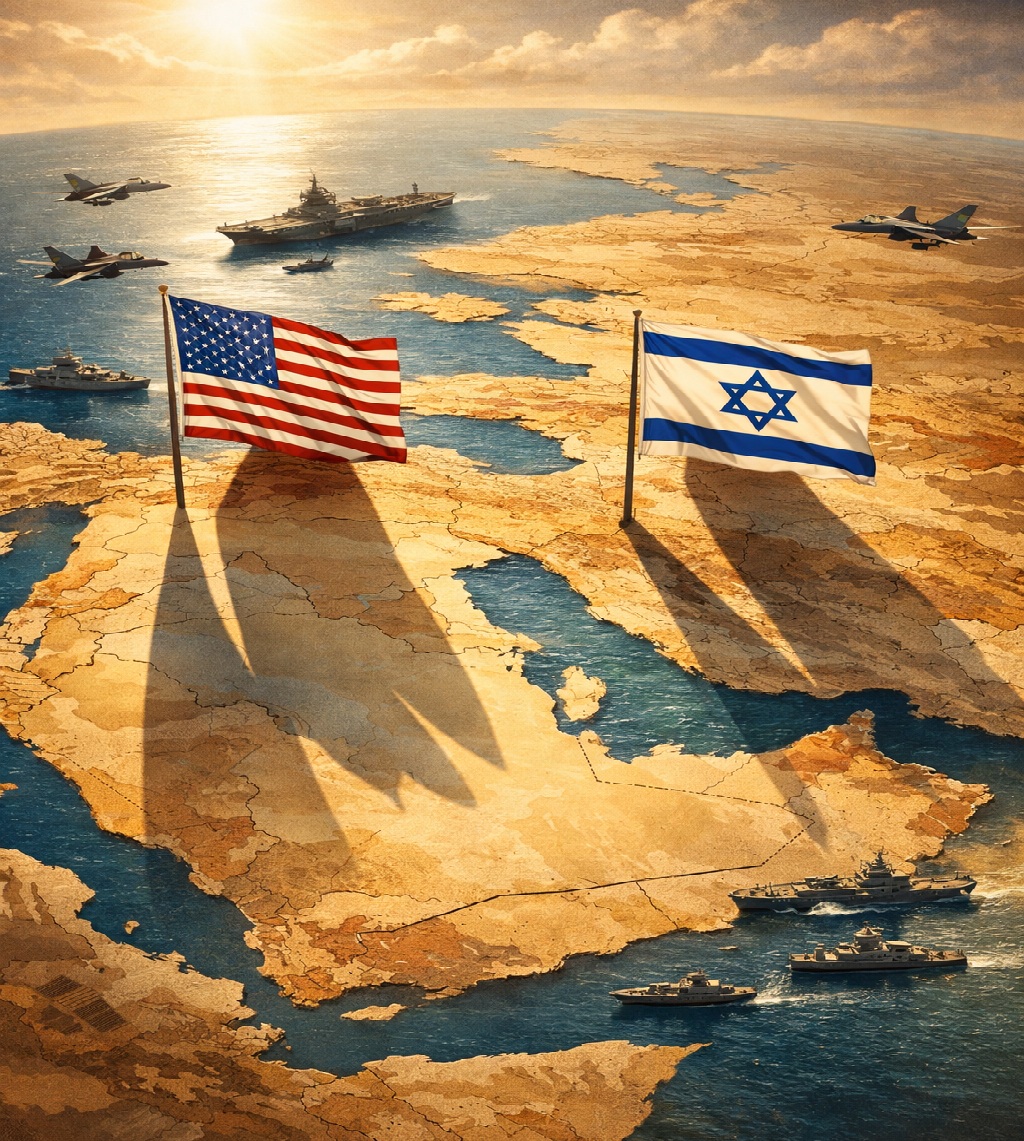
- Equating a threat to Israel with a corresponding threat to the United States places us in unprecedented circumstances, highlighting how the Israel lobby has operated within the power structures of Washington to sway U.S. foreign policy in favour of Israel.
- The U.S. has extended substantial and unparalleled military, economic, and diplomatic assistance to Israel, surpassing the support offered to any other nation by the U.S. or any major power.
- The United States must transcend the influence and allure of the Israel lobby to effectively pursue a balanced approach in its foreign policy, which is essential for fostering peace and stability in the West Asian region.
The Trump Administration has not yet clarified the reasons for its strike on Iran on February 28, 2026. Various justifications were given, ranging from weapons of mass destruction to regime change. It is crucial not to underestimate the significance of the Israel issue in Washington’s assessment of this incident. The U.S. Secretary of State, Marco Rubio, suggested that an Israeli military operation against Iran would provoke a military response against U.S. assets in the region and indicated that failure to preemptively strike Iran would result in suffering for the U.S. This remark emphasises Israel’s significant influence in motivating the U.S. to initiate military strikes against Iran. The fact was further emphasised by the leading Democrat in the Senate, Mark Warner, who asserted that there was a threat to Israel. Equating a threat to Israel with a corresponding threat to the United States places us in unprecedented circumstances.
Despite the ongoing conflict, Israel has played an active role in shaping U.S. foreign policy for West Asia. In their collaborative work ‘The Israel Lobby and U.S. Foreign Policy,’ John J. Mearsheimer and Stephen Walt highlight the influence of the Israel lobby on U.S. foreign policy in the region. This piece aims to emphasise the crucial role of Israel in the formulation of U.S. foreign policy. The Israel lobby operated within the power structures of Washington to sway U.S. foreign policy in favour of Israel. The lobby aims to convey Israel’s shared moral principles and security risks with the United States, positioning it as a strategic asset for the U.S. in the region. This lobby successfully secured the United States’ unflinching support for Israel and its regional policies. However, its actions exacerbated the security situation for the United States.
The Israel lobby is not a conspiracy or cabal; rather, it is associated with traditional interest group politics. Similar to other interest organisations, the Israel lobby endeavours to sway congressional legislation and presidential policies to align with Israel’s interests. The lobby comprises a loose coalition of diverse interest groups, including Christian United for Israel (CUFI), the Republican Jewish Coalition (RJC), the American Israel Public Affairs Committee (AIPAC), and the Anti-Defamation League. These organisations operate both individually and collectively to influence pro-Israel American foreign policy via lobbying efforts. It finances them in elections and supports candidates for high offices who are pro-Israel.
The circumstances were different at the founding of Israel. In 1917, President Woodrow Wilson accepted the Balfour Declaration, which articulated British support for the establishment of a Jewish homeland in Palestine; yet, he took no action to actualise it. The fact-finding team led by American Charles, dispatched by the Paris peace mission, advised against the establishment of Israel, citing concerns over regional stability and the rights of the local Arab population. The quest for oil and the strategy of anti-Communism have strengthened the United States’ involvement in the region since the conclusion of the Second World War. A balanced stance characterised the previous U.S. policy in the region. During the Suez Canal Crisis, President Eisenhower of the United States halted all financial and military assistance to Israel, compelling Israel to withdraw from the land. However, the policy of equilibrium reached its end with the 1967 Arab-Israeli conflict. Following the 1967 war, U.S. policy shifted to a pro-Israel stance for three primary reasons: Israel’s decisive victory over Arab forces, increased Soviet assistance to Arab nations, and the burgeoning influence of the pro-Israel lobby within U.S. politics.
Since that time, the U.S. has extended substantial and unparalleled military, economic, and diplomatic assistance to Israel, surpassing the support offered to any other nation by the U.S. or any major power. U.S. support for Israel is unwavering; regardless of Israel’s actions, the extent of support remains constant. Israel receives the most substantial and advantageous financial assistance from the United States. For instance, in contrast to other nations, Israel obtains its annual financial assistance within the initial 30 days of a financial year. Israel can allocate its resources as it wishes, free from US control. Likewise, Israel benefits from an exception to military assistance from Washington. All U.S. military support to other nations must be utilised exclusively within the United States. It is imperative to maintain employment for American defence workers. Israel is uniquely permitted to allocate one-fourth of U.S. assistance to subsidise its defence industry.
It is now essential to comprehend the mechanisms by which the Israel lobby secures this extraordinary support from America. The Israel lobby employs three primary approaches; firstly, it portrays Israel as a strategic asset for the United States in the region. The nation is a crucial strategic asset for Washington in its counterterrorism efforts and in containing the rogue state in the region. Secondly, it contends that Israel is the sole nation in the area that aligns with the United States’ moral and democratic principles. It is the sole liberal democratic and free market nation in the region. Third, the lobby governs the public debate regarding Israel’s actions in the United States. It suppresses all criticisms of Israel under the pretext of antisemitism. For instance, President Carter’s book ‘Palestine: Peace Not Apartheid’ addresses Israel’s right to exist while critiquing its conduct in the occupied Palestinian lands. The book was designated as antisemitic and a work of Jewish hatred.
However, it is essential to elucidate all the aforementioned assertions; primarily, Israel does not constitute a strategic asset for the United States. At first, terrorist organisations such as Hamas and Hezbollah do not constitute a security danger to Washington. They represent an exclusively local phenomenon. The Palestine Liberation Organisation is not a radical terrorist entity but rather a secular and nationalist movement. The colonial stance of Israel has driven Palestinians closer to violent Islamist factions, such as Hamas and Islamic Jihad, which exploit the situation to gain support and justify their actions against Israel. Secondly, it is accurate that Washington harbours significant problems with the so-called rogue regimes in the region, such as Iran, due to their support for terrorist organisations and their aspirations to obtain weapons of mass destruction. However, they do not pose a direct threat to U.S. interests, save for their commitment to Israel. These governments demonstrated their readiness to establish peace with Washington. Third, the assertion that Israel and the U.S. share a democratic spirit is inaccurate due to the distinct characteristics of their democratic systems. In contrast to U.S. democracy, Israeli democracy is characterised as an ethnic democracy, wherein a certain ethno-religious group possesses democratic rights. Despite the surge in animosity for immigrants and other minorities, the American democracy remains inclusive. For instance, Zohran Mamdani, a Muslim immigrant to the United States, was elected as the mayor of New York.
Despite disregarding these significant facts, the U.S. has consistently supported Israel throughout history. Every administration in Washington disregarded activities that contravened human rights, the national sovereignty of other nations, and international laws. This support did not produce favourable outcomes for the U.S. in the region; instead, it fostered anti-American sentiment and exacerbated extremism among Muslims. The United States’ backing of Israel’s policies towards Palestinians drove Khalid Sheikh Mohamed, the principal architect of the 9/11 terrorist assault. The U.S. military has sustained losses and seen attacks on its assets in the region during the ongoing battle with Iran, which lacks a clear rationale and aims, leading to questions about the effectiveness of U.S. military strategy and its long-term objectives in the Middle East. The United States must transcend the influence and allure of the Israel lobby to effectively pursue a balanced approach in its foreign policy, which is essential for fostering peace and stability in the West Asian region. It must maintain neutrality over the West Asian region to effectively mediate conflicts and promote dialogue among the involved parties. It must have a policy that is based on regional peace and stability.

Dr Mohammad Rizwan holds a PhD in political science from Jamia Millia Islamia. His doctoral research focuses on Pakistan’s relations with major global powers. Views expressed are the author’s own.
 Anjali Singh
  Parag Gilada
  Aayush Pal