- Since the creation of an Islamic Republic in Iran in 1979, Iran has sought to export its revolution to Shia populations around the world.
- Iran’s use of Shia Islam to spread its influence in South Asia is part of its larger ideological goal to establish itself as a leading power in the Islamic world.
- Iran’s growing influence among the Shia communities in India poses a serious threat to India’s national security in the context of the current US-Israel-Iran conflict.
- The Indian state must develop a comprehensive strategy to counter Iranian attempts to influence the loyalties of the Shia community through intelligence operations, law enforcement, and social outreach.
Since the creation of an Islamic Republic in Iran in 1979, Iran has sought to export its revolution to Shia populations around the world. Efforts by Iran’s clerical regime to spread its version of Shia political Islam, also known as “ Khomeinism”, after the Iranian revolution’s founder, Ayatollah Ruhollah Khomeini. Thus, Iran’s use of Shia Islam to spread its influence in South Asia is part of its larger ideological goal to establish itself as a leading power in the Islamic world.
Article 154 of Iran’s Constitution affirms support for the “just struggles of the oppressed ” worldwide – a principle used to legitimise Iran’s influence abroad. While Iran’s proxy strategies in the Middle East, such as support for Hezbollah and Houthis, are well known, its approach to South Asia is more nuanced and extends beyond traditional regional policy.
South Asia hosts the world’s largest Muslim population – approximately 586 million – making it a natural sphere of competition for influence in the Islamic world. To exercise its influence in South Asian countries such as India, Sri Lanka, Pakistan and Afghanistan, Iran relies on deep links with traditional Shia clerical networks to mobilise Shia communities in South Asia in support of Iran. Shias in South Asia and around the world look up to Iran’s clerical leadership as the two holiest sites of Shia Islam are located in the Iranian cities of Mashhad and Qom.
Iran’s Influence Among the Shias in India
Though India remains a peripheral actor in the Middle East, with the third-largest Muslim population, it cannot remain aloof. In 1919-1920, Indian Muslims led by Mahatma Gandhi organised the Khilafat movement to oppose the partition of the Turkish Ottoman Empire. Nearly a century later, the Arab Spring exposed Kashmir’s local jihadist movement to global Islamism, unleashing Middle Eastern Islamist trends, tactics, and organisations in Jammu and Kashmir.
On the Sunni side, countries like Pakistan, Qatar, Saudi Arabia, and Turkey influence Indian Muslims, whereas the Shia, constituting 15 per cent of India’s Muslim population, lionise Ayatollah Ruhollah Khomeini and hold the Iranian religious hierarchy in high esteem.
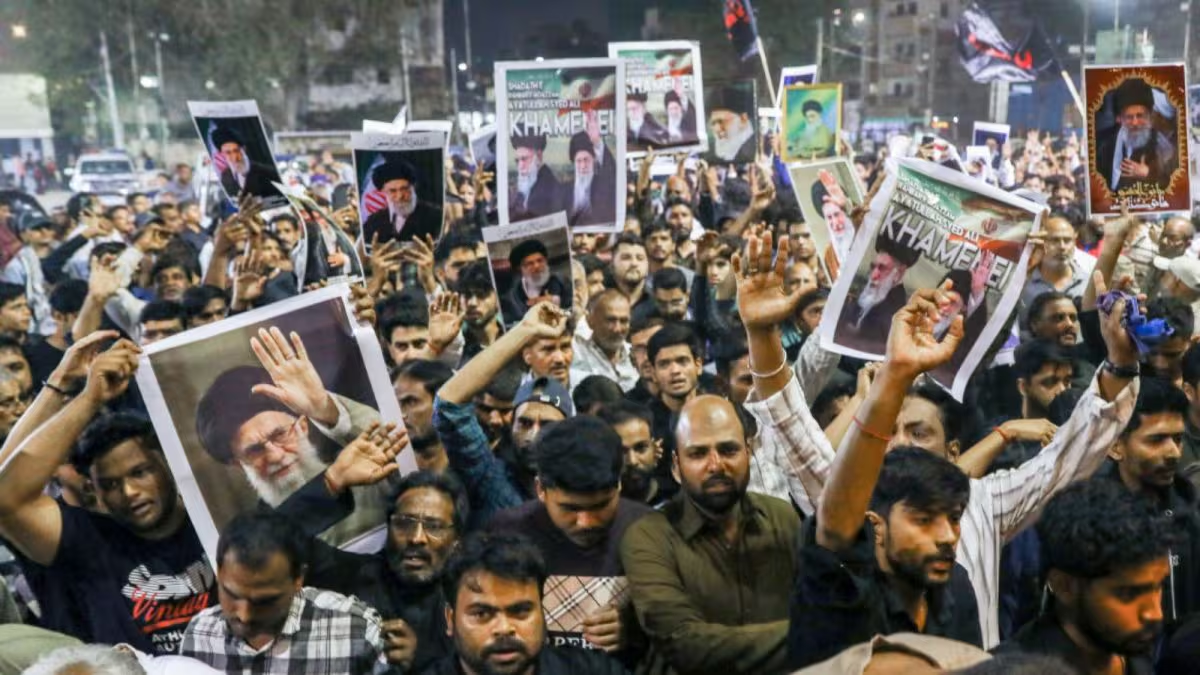
Iran’s expanding influence among Jammu and Kashmir’s Shia community over the past two decades has resulted in huge billboards of Iranian Ayatollahs being put up in parts of Jammu and Kashmir, such as Budgam, Srinagar, and Kargil. Former Hezbollah Chief Hasan Nasrallah’s posters are also common in religious processions and social gatherings. Iranian and Kashmiri Shia scholars and leaders have increased exchanges.
In the Kargil district of Ladakh, traditionally, the Shia clerical establishment organised under the banner of Anjuman- e Jamiat – ul- Ulama Asna Asharia ( Society of Clerics of Twelve Imams) of Kargil, popularly known as the Islamia school. This body of orthodox clerics controlled the religious and political aspects of Ladakh’s Shia community. They had links with Shia learning centres of Najaf and Karbala in Iraq. After the expulsion of foreign clerics from Iraq under Saddam Hussein, many Shia students from Ladakh moved to Qom and Mashhad in Iran.
After the Islamic revolution in Iran in 1979, a new wave swept among the younger generation of Shia of Kargil. This group consisted of younger members from the lower socio-economic sections of society. They were influenced by the writings of ideologues of the Iranian revolution, especially Ayatollah Murtaza Motaharri (1919-1979). This breakaway group from the Islamia School established the Imam Khomeini Memorial Trust ( IKMT ). The Iranian cultural centre in Delhi is the link between the Qom-based clerics and the Indian Shia. These two groups now compete for the Shia community’s religious and political support. The Islamia school uses photographs and posters of Iraq-based Ayatollah Ali Sistani, while IKMT displays Iranian clerics Ayatollah Ruhollah Khomeini ( 1902-1989 ) and Ayatollah Ali Hussain Khamenei ( 1939-2026 ). The Iranian government, as well as Shia religious establishments based in Qom, Iraq, have links with the Shia power centres of Jammu and Kashmir.
Iran’s expanding influence among Jammu and Kashmir’s Shia community over the past two decades has resulted in huge billboards of Iranian Ayatollahs being put up in parts of Jammu and Kashmir, such as Budgam, Srinagar, and Kargil.
In the case of the Kashmir Valley, like other inhabitants, there is strong resentment against the Indian government due to the large presence of Indian security forces, human rights excesses, curfews and internet shutdowns. However, there are very few Shia who have joined the Pakistan-sponsored separatist insurgency in Jammu and Kashmir. The strict and fundamentalist form of Sunni Islam followed by militants in Kashmir from Pakistan-based terrorist groups like the Lashkar e Taiba and Jaish e Mohhamed raised fear among the Shia. This apprehension was due to the fact of rising sectarianism in neighbouring Pakistan, where Shias are targets.
The Shia of the Kashmir Valley are influenced by events in the broader Shia world. There have been protests in the Kashmir Valley when Pakistan arrested a Shia cleric in Gilgit and when Saudi Arabia executed dissident Shia cleric Shaikh Nimr al Nimr. Iran is using this influence for ideological reasons and rallying the support of Shia outside Iran for its geopolitical objectives.
In Kargil, the Shias are mainly focused on increasing their representation in the political and economic hub of Ladakh vis-à-vis Ladakh’s Buddhist majority. The Shia of Kargil opposed the separation of Ladakh from Jammu and Kashmir and its transition to a Union Territory following the Abrogation of Article 370 in August 2019. However, several factors, such as lower socio-economic status and a more ideological bent towards Shia resistance models of the Middle East, make the Shia of Kargil susceptible to subversion by Iran.
In the last three decades, a new generation of Shia has been inspired by Shia resistance literature. Iranian and Lebanese resistance literature is translated and very popular among the young Shia of Kashmir. It is in this context that Iran sought to recruit Kashmiris into its proxy militias, and several Kashmiris travelled to Iraq to fight the Islamic State alongside Pro Iranian Proxy groups. The Iranian- Lebanese “ resistance ” literature is popular among the Shias in Kashmir.
It is in this context that the alignment of Jammu and Kashmir’s Shia community with Iran’s worldview, which divides the world into two groups: mustazaf’een ( oppressors ) like Israel, the United States, the United Kingdom, and the istikhbar’een (oppressed), which includes the Palestinians, Syria, Kashmir, Iraq, and Lebanon. Iran’s former Supreme Leader Khamenei often commented on what he termed “ the oppression of Muslims in Kashmir ’’ which showed that despite relatively good diplomatic and economic relations that exist between India and Iran, Iran’s clerical regime has sought to increase its influence among the Shias but also among the Sunnis in Jammu and Kashmir. This also shows the Islamist ideological goal of Iran’s clerical regime to gain leadership in the largely Sunni Islamic world, though such efforts have largely been unsuccessful in India and the larger South Asian region.
In the Indian hinterland, Iranian influence on Shia communities remains largely ideological. Strengthening religious and cultural ties with Iran’s ability to mobilise Shia sentiment in India was visible when large anti-Israel protests by the Shia erupted in major Indian cities following Israel’s attacks in Gaza. This resulted in the Indian authorities arresting several Shia protestors under the Unlawful Activities Prevention Act ( UAPA ). Anti-Israel slogans chanted by Shia protestors after the killing of a Hezbollah leader in 2024 further underscored Shia solidarity with Iran. However, the presence of Iran’s covert operational networks in India appears serious, as Iran has managed to conduct terrorist attacks outside the Israeli embassy twice with the help of its Indian networks.
Conclusion
Thus, Iran’s growing influence among the Shia communities in India poses a serious threat to India’s national security in the context of the current US-Israel-Iran conflict, as there is a potential for Iranian-backed or Iranian-inspired terrorist sleeper cells to conduct terrorist attacks against Israeli and US targets or against American and Israeli tourists in India. Such attacks linked to Iran could result in diplomatic pressure on the Indian government to crack down on Iranian-backed terrorist cells. Such a crackdown, initiated due to pressure from Israel and the US, in turn, could strain the Indian government’s relations with both India’s Shia community and with Iran. Hence, there is a need for the Indian government and its security agencies to monitor and crack down on Iranian-backed terrorist sleeper cells in the country before they can launch a potential terrorist attack against US and Israeli interests in India. At the same time, the Indian government must, through diplomatic channels, seek to dissuade Iran from sponsoring such attacks on Indian soil.
While there is no doubt that India’s defence and strategic partnership with Israel is important, as was evident with Prime Minister Modi’s recent visit to Israel, at the same time, India needs to make it clear that it does not condone certain Israeli actions that are violative of international law, such as the assassination of Iran’s Supreme Leader. Such actions by the Indian government can be misconstrued by sections of India’s Shia community as the Indian government condoning Israel’s military actions against Iran.
It is in this context that the recent visit of India’s Foreign Secretary Vikram Mistri to the Iranian embassy in New Delhi where he signed the book of condolence for Iran’s Supreme Leader must be viewed step in the right direction because if such a misperception is not effectively addressed could potentially lead to the radicalization of sections of the Shia community who are pro- Iran as was evident by the large number of Shia’s who protested against the joint US-Israel military attack against Iran in different parts of India such as Kashmir, Uttar Pradesh, Telangana, Karnataka and Tamil Nadu.
Finally, the Indian state should also develop a comprehensive strategy to counter the efforts of Iran to subvert the loyalties of the Shia population through effective intelligence-driven operations and law enforcement crackdowns, as well as social outreach to the patriotic sections of the Shia community.
References:
- Amarasinghe, P ( 2025 ). Has Iran’s Endgame Changed? Shia Factor in South Asia. Retrieved from https://www.eurasiareview.com/24112025-has-irans-endgame-changed-shia-factor-in-south-asia-oped/
- Hussein, H ( 2019 ). The Shias of Kashmir. Retrieved from https://www.brownpundits.com/2019/10/12/the-shias-of-kashmir/?utm_source=chatgpt.com
- Pandya, A ( 2026 ). Is India Radicalising Indian Shi’a? Retrieved from https://www.meforum.org/mef-observer/is-iran-radicalizing-indian-shia
- Shankar, A ( 2016 ). The Saudi-Iran Rivalry and Sectarian Strife in South Asia. Retrieved from https://thediplomat.com/2016/10/the-saudi-iran-rivalry-and-sectarian-strife-in-south-asia/

Dhruv Ashok is a PhD research scholar from Christ (Deemed to be University), Bangalore. He writes on current affairs and international politics. His areas of interest include conflict resolution and historical narratives. Views expressed are the author’s own.
 Anjali Singh
  Aayush Pal