
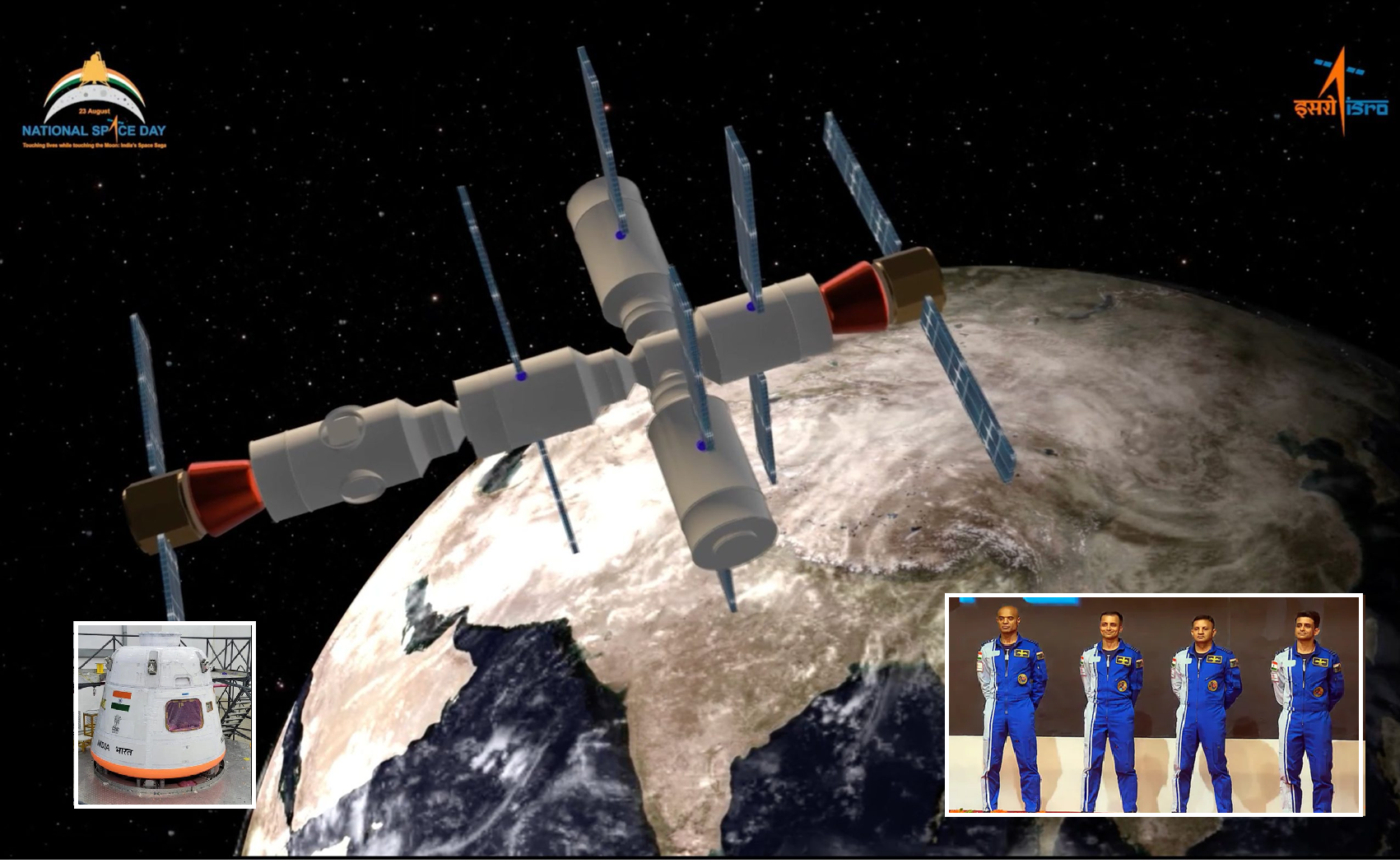
- Space has evolved from a scientific realm into an arena for projecting national power and global influence.
- India has entered into a new era of opportunity and transformation due to a national objective spearheaded by the Gaganyaan human-rated spacecraft program.
- India is increasingly seen as a ‘third pole’ in space—a democratic, cost-effective alternative to the polarised competition between the US-led and China-led blocs.
- The Gaganyaan mission is more than a flight; it is a declaration of intent.
Space has evolved from a scientific realm into an arena for projecting national power and global influence during the third decade of this twenty-first century, the year 2026 marking a significant change in India’s civilisation. The Indian Space Research Organisation (ISRO) is completing the last steps of its Gaganyaan mission by transitioning from testing with high-stakes test vehicles to soon launching uncrewed G1 and G2 missions. As a result of this mission activity and through planned investments, India no longer seeks to compete only as a high-efficiency service provider; rather, India is methodically establishing itself as a global rule-maker in the global space economy.
From Cost-Efficiency to Strategic Autonomy
For decades, India gained prominence within the aerospace industry as a manufacturer of low-cost, dependable lift services for various smaller satellite missions and delivery of essential data products to support domestic social development efforts. However, in today’s world, where everyday geopolitical challenges are occurring along with a “New Space” race and a potential for weaponizing orbital platforms, India has clearly entered into a new era of opportunity and transformation due to a national objective spearheaded by the Gaganyaan human-rated spacecraft program, which builds on India’s heritage of developing reliable HRLV & flight-based on-board life support systems; therefore, effectively transitioning India’s role from one of a service provider to that of an active participant/researcher within both the human habitation and exploration processes taking place in space. Ultimately, this evolution provides India with the necessary degree of strategic autonomy. No longer can India be excluded from international treaties governing outer space, nor do future “rules of the road” governing space operations exist without clear recognition of India’s right to operate human orbital flights independently via its indigenous HRLV development.
Gaganyaan as a Multiplier of National Power
The success of Gaganyaan in 2026 is further evidence of how India has synergised its “Complete National Power” through the integration of all elements of its economy. As an example, the Gaganyaan program pushed many members of the Indian private sector into vertical integration of their company with the Indian supply chain, with over 600 private companies contributing to Gaganyaan. Thus, it has enabled Indian private companies, such as Skyroot and Agnikul, to evolve from early-stage startups into serious international competitors. In addition, technological spin-offs from Gaganyaan (e.g., humanoid robot Vyommitra, high-performance electric propulsion systems, resilient life support systems, and autonomous space vehicles) will contribute to developing national security capabilities. Finally, there is a strong correlation between the technology used for human spaceflight and orbital defence, so the technology required to accurately and precisely dock a crew module is the same technology that can be applied to the servicing of assets in orbit and to protecting critical space-based assets.
Defining the Rules of the New Orbital Order
As a “rule-maker,” India’s strategy is to leverage its growing capabilities to influence space law and ethics. With the world currently debating the Artemis Accords and the governance of lunar resources, India’s seat at the table is secured by its operational successes. By 2026, the successful completion of uncrewed Gaganyaan flights will validate India’s capacity to lead regional space alliances. India is increasingly seen as a “third pole” in space—a democratic, cost-effective alternative to the polarised competition between the US-led and China-led blocs. This enables India to advocate for the “democratisation of space,” ensuring that the rules governing the $1.8 trillion space economy of 2035 are not dictated by a few legacy powers but reflect the interests of the Global South.
The Road to Bharatiya Antariksha Station (BAS)
The progress towards becoming a rule-maker will be further highlighted along the pathway laid out for setting up a Bharat Antariksha Station (BAS), with its first module expected to launch in 2028. Gaganyaan is a prerequisite for establishing a long-term presence in low-Earth orbit (LEO) through a permanent space station.
India will have the ability to carry out long-term microgravity research, provide test and evaluation capabilities for deep-space communications, and support lunar exploration missions through the establishment of a permanent, sovereign space station. More importantly, through the creation of a sovereign space station, India can now establish a physical presence in LEO, which is required for establishing its influence in outer space via new “geopolitical” dynamics.
Through the establishment of its own space station, India will avoid having a “renter” status on the International Space Station and other commercial space stations, which would inhibit its ability to establish its own standards for sharing scientific data, determining commercial docking procedures, and creating safety protocols for spacecraft operations in orbit.
Contemporary Challenges and the Commercial Pivot
The transition to a higher orbit is an upward one, but is not without its own set of challenges. In 2026, there will be a “reliability crisis” in India as a result of recent failures in the PSLV and NavIC constellations, which serve to remind people that space can be an unforgiving environment. In order for India to continue being a rule-maker, it must bridge the gap between its strategic intention and its global space economy share of 2%. The goal of increasing India’s share of the global space economy to 10% by 2033 will depend on the successful “corporatisation” of space through NewSpace India Limited (NSIL) and clear regulations provided by the Indian National Space Promotion and Authorisation Centre (IN-SPACe). To meet this challenge, India needs to move faster in both manufacturing and policy than it did during its early years of development.
Conclusion: A Sovereign Presence in the Void
The Gaganyaan mission is more than a flight; it is a declaration of intent. As India approaches its first crewed flight in 2027, the progress made in 2026 signals to the world that New Delhi is ready to take responsibility for the security and sustainability of outer space. By evolving from a provider of cheap launches to a pioneer of human habitation, India is ensuring that the future of the cosmos is not just discovered but also governed with an Indian perspective. The void of space is being filled with Indian ambition, turning a scientific vacuum into a strategic stronghold.
References:
- Gaganyaan enters final phase as ISRO completes over 8,000 crucial ground tests
- ISRO Targets March 2026 Launch For Gaganyaan Programme’s First Uncrewed Space Mission
- Parliament Question: Bharatiya Antariksh Station
- India’s space economy is at $8.4 billion, with nearly 400 start-ups active
- Gaganyaan uncrewed mission, private rocket launches highlight of India’s space sector in 2026
- 2026, A Turning Point for The Indian Space Programme

Hridbina Chatterjee is a final-year postgraduate student in International Relations at Jadavpur University, Kolkata. She has written for newspapers and think tanks, with interests in South Asian politics, India’s foreign policy, and the Indo-Pacific. Views expressed are the author’s own.
 Piyush Anand
  Aayush Pal
  Pranav S