
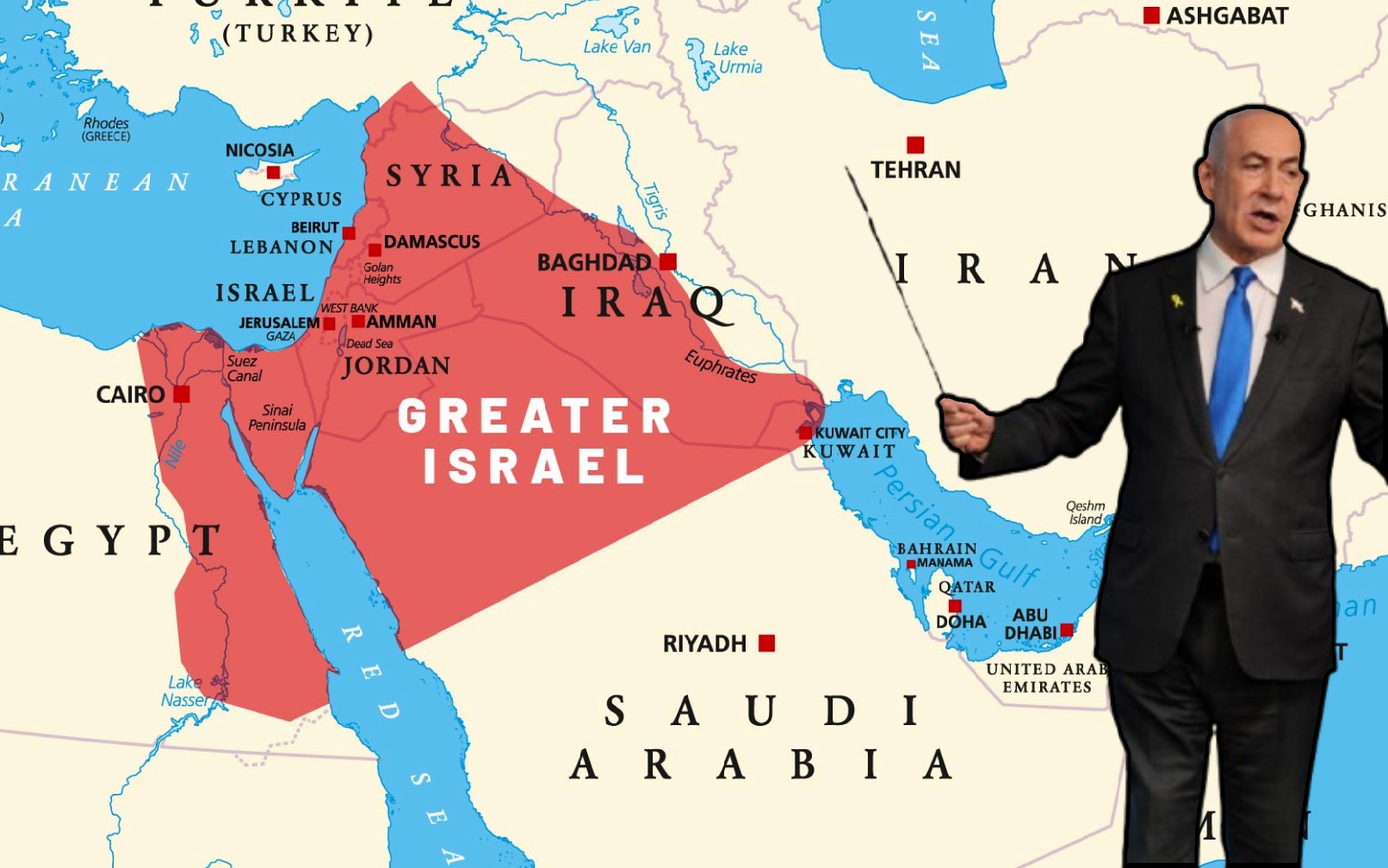
- A controversial remark by the US Ambassador reignited debate on ‘Greater Israel,’ linking ancient prophecy to modern geopolitical tensions.
- What began as a scriptural idea has gradually evolved into a strategic and political framework shaping Israeli statecraft and territorial policy.
- Today, the idea of Greater Israel lies between aspiration and reality, shaped by security concerns, regional dynamics, and shifting power balances.
Introduction
In the third week of the Israel–Iran military confrontation, a statement by the US Ambassador to Israel broke through the noise of geopolitical commentary. Ambassador Mike Huckabee, in an interview with Tucker Carlson, was asked about the biblical covenant in which God promises Abraham a vast territorial inheritance stretching from the ‘river of Egypt’ (the Nile) to the Euphrates replied with casual certainty: ‘It would be fine if they took it all.’[1]
The Middle Eastern nations, which are primarily US allies, swiftly criticised the statement. The concept of “Greater Israel” must be traced from its ancient scriptural roots through the ideological furnaces of early Zionism, the Likud-dominated corridors of modern Israeli statecraft, and ultimately the military arenas of Gaza, the West Bank, and now Iran to comprehend the ayes and nays.
Three Covenants, Three Maps[2]
The Abrahamic Covenant — Genesis 15:18–21: It states that the land was given to all of Abraham’s children, which is considered to have defined the land in a far broader sense. It is defined as a wider area that stretches from the “river of Egypt to the Euphrates.”
Second Definition – Numbers 34:1–15 & Ezekiel 47:13–20: The land given to the Twelve Tribes of Israel following the Exodus is described in Numbers 34 and Ezekiel 47. This territory roughly corresponds to modern-day Israel, the West Bank, Gaza, and portions of Jordan west of the river. In moderate religious Zionist arguments, this concept is most commonly used: a claim to “Eretz Yisrael” as defined by the tribe’s inheritance, rather than the entire Fertile Crescent.
Third Definition – Deuteronomy 11:24 & 1:7: ‘Every place on which the sole of your foot treads shall be yours.’ Historically, this passage has been understood as a process rather than a static map. The current political theory of settlement expansion, which justifies Israel’s presence in the West Bank as the continuous realisation of a centuries-old divine promise, most closely aligns with this interpretation.
From Scripture to Statecraft — The Ideological Bridge
Labour Zionism and the Pragmatic State
Theodore Herzl, the founding father of Modern Zionism, was the prominent voice for Israeli Sovereignty and a greater Israel. Herzl himself was largely secular and saw Zionism primarily as a political solution to European antisemitism. The demands for the Israeli land were then dealt with by the powers (i.e., the former colonial states, Germany, and the US) of those times and were subject to agreements and negotiations. When the United Nations proposed the 1947 Partition Plan (UN Resolution 181), dividing the British Mandate of Palestine into separate Jewish and Arab states, the Labour Zionist leadership under David Ben-Gurion accepted it reluctantly, but deliberately. Ben-Gurion famously wrote in his diary that partition was not a final settlement but a ‘first step,’ yet his public posture was one of accommodation. For the community that witnessed the Holocaust and persecution in Europe, any land for themselves would mean life with dignity.
The subsequent 1948 Arab-Israeli War dramatically altered the territorial calculus. Fought against the armies of Egypt, Transjordan, Syria, Iraq, Lebanon, and Saudi Arabia, who rejected the partition plan, and Israel emerged in control of approximately 78% of Mandatory Palestine, significantly more than the UN had allocated. While the Palestinians viewed this as “Al-Nakba” meaning Catastrophe, the Israelis viewed it as “Al–Yawm al–Mawoud,” meaning Existence.[3]
The Six-Day War
The pivotal territorial transformation came not in 1948 but in 1967. Israel captured the West Bank and East Jerusalem from Jordan, the Gaza Strip and Sinai Peninsula from Egypt, and the Golan Heights from Syria. The territories under the control of Israel tripled in a week.[4]
Israel was called to withdraw from “occupied territories” by the UN Security Council resolution, to which it never fully complied. The West Bank and Gaza became ‘occupied territories’ under international law; the Golan Heights were later annexed unilaterally in 1981, a move recognised only by the United States under President Trump in 2019 but by no other UN member state.[5]
The 1967 conquests did something else: they brought the biblical heartland of Judea and Samaria (the West Bank) under Israeli control for the first time in two millennia. For religious Zionists, this was not a coincidence — it was providence.
Likud Party in Power
The party’s founding charter, written in 1977, stated plainly: ‘The right of the Jewish people to the land of Israel is eternal and indisputable and is linked with the right to security and peace; therefore, Judea and Samaria will not be handed to any foreign administration; between the Sea and the Jordan there will only be Israeli sovereignty.’ [6]
Let’s trace the chain of events that unfolded under the reign of some of Israel’s most prominent and controversial Heads of State –
Menachem Begin: In 1977, it was Begin who led the Likud to an electoral victory against the Labor who were in power since the founding days of Israel. Begin’s vision was unambiguously expansionist. He referred to the West Bank exclusively by its biblical names,s “Judea and Samaria”, and accelerated the settlement enterprise that had begun tentatively under Labour.
Ironically, Begin, though an “Nationalist-Expansionist”, signed the Camp David Accords with Egypt’s Anwar Sadat in 1978, returning the Sinai Peninsula in exchange for peace.
Yitzhak Rabin: In 1993, Rabin, the then Prime Minister from the Labour Party, signed the controversial Oslo Accords with Yasser Arafat of the infamous “PLO”, on the White House Lawn, which seemed to many as a roadmap to Palestinian Statehood and a Two-Nation Solution. Yasser Arafat, Shimon Peres and Yitzhak Rabin were jointly awarded the Nobel Peace Prize in 1994 for their “joint efforts to create peace in the Middle East”. But the Oslo Accords’ flaws were evident; it was left ambiguous, and the chaos continued.
Rabin was assassinated in 1995 by a Jewish Extremist who explicitly cited the religious prohibition on relinquishing biblical land. This marked a shift in the political trajectory of Israel.
Benjamin Netanyahu: Benjamin Netanyahu, the “Bibi”, who has served as Prime Minister from the Likud for longer than any figure in Israeli history (1996–1999, 2009–2021, and 2022–present), represents the maturation of Revisionist Zionism from opposition ideology into governing orthodoxy. Under his stewardship, Greater Israel has shifted from aspiration to architecture.
The landmark legislation of this era was the 2018 Nation-State Law – ‘Basic Law: Israel as the Nation-State of the Jewish People’. In a nation without a constitution[7], ‘Basic Laws’ carried a quasi-constitutional weight. The law, passed by the Knesset with a narrow majority, enshrined several transformative principles:
- Israel is the ‘historic homeland of the Jewish people,’ in which the right to national self-determination is ‘unique to the Jewish people.’
- Jewish settlement is defined as a ‘national value’ to be promoted and advanced by the state.
- Arabic, previously an official language alongside Hebrew, was downgraded to ‘special status.’
- The ‘Land of Israel’ is presented as an undivided national homeland.
The UN Human Rights Office and Amnesty International both described the law as institutionalising apartheid-like conditions. The Israeli government rejected that characterisation. For proponents, the law was simply a clarification of Israel’s founding purpose.
The Security Argument
For many years, border security has been crucial to Israel’s survival, with constant civilian and terror confrontations in and around the Gaza Strip and West Bank. Before the 1967 war, Israel was at its narrowest point, a small country with a 15-kilometre-wide strip with the West Bank and Mediterranean Sea, a distance less than that between two railway stations in another nation.
The Jordan Valley, meanwhile, serves as a natural buffer between Israel and any hostile force approaching from the east. Without it, Israeli military planners argue, the country is indefensible. Whether or not this argument is convincing, it is a genuinely held strategic position, not merely a post-hoc justification for settlement expansion.
The Gaza Precedent
Gaza is instructive. Israel withdrew all its settlements and military personnel from Gaza in 2005, a move championed by Prime Minister Ariel Sharon as a ‘disengagement’.[8] The international community cautiously welcomed it. Then Hamas won the Palestinian elections in 2006, a blockade was imposed, rockets were fired, wars were fought, and in October 2023, Hamas launched the deadliest attack on Jewish civilians since the Holocaust, killing 1,200 people and taking 250 hostages.
This has troubled the world and cemented sympathy for the Israelis while they avenged the Oct 7, with “Operation Iron Sword”, and a chain of war events continues.
Iran, the Proxies, and the Ring of Fire
Now, let’s take a macro lens, a part where we connect the ongoing war with Iran, trying to answer why Israel has condemned Iran for decades.
Iran has, since its Islamic Revolution in 1979, built what analysts call an ‘Axis of Resistance’: a network of armed groups financed, trained, and equipped by Tehran to encircle Israel. Hezbollah in Lebanon has an estimated 150,000 rockets and missiles pointed at Israeli cities. Hamas and Palestinian Islamic Jihad in Gaza. The Houthis in Yemen are capable of firing missiles and drones at Israeli territory. Various Shia militias in Iraq and Syria.
This is what Netanyahu has consistently called the ‘Ring of Fire.’ His argument, stated in front of the US Congress in 2015 and repeated many times since, is that Iran is not merely a hostile government but an existential threat: a regime committed to Israel’s destruction, actively building the military means to accomplish it, and now approaching nuclear weapons capability. He vehemently opposed Iran’s nuclear program, reiterating that ‘the greatest danger facing our (Jewish) world is the marriage of militant Islam and nuclear weapons.’[9]
The current military confrontation with Iran, which has involved strikes on Iranian nuclear facilities, IRGC command structures, and missile production sites, is termed by the Israeli government as pre-emptive self-defence. But the strategic consequences go well beyond defence? With Iran’s military leadership severely weakened and its proxy network disrupted, Israel finds itself in a position it has never occupied before: with no organised military adversary on any of its borders capable of mounting a serious conventional challenge.
For the architects of Greater Israel, this is not incidental. The removal of organised military resistance is the precondition for territorial consolidation. You cannot annex what you cannot control. And control becomes far more achievable when the entities capable of contesting it have been dismantled.
The Abraham Accords and the Arabs
In September 2020, under the Trump administration, Israel signed normalisation agreements with the United Arab Emirates, Bahrain, Sudan, and Morocco. The agreements, branded as the Abraham Accords, were celebrated as a historic diplomatic breakthrough.
For decades, the Arab world had maintained that normalisation with Israel was contingent on Palestinian statehood.
The reading here is that regional economic integration and shared concern about Iran are drawing former adversaries together, and that this normalisation, over time, will create conditions for a broader peace, including the Palestinians. While Tel-Aviv tries another way through effective diplomatic ties and economic normalcy with the Arabs, states set a tone of actual maturation of border issues until the ‘Oct 7’ killings.
Will Greater Israel become a Reality?
Greater Israel was, for most of the 20th century, an aspiration held by a minority within a minority. A dream, not a plan. Today, it sits somewhere between a plan and a process. The formal annexation of the entire West Bank has not happened. A Palestinian state has not been formally declared impossible. These questions remain, technically, open.
Whether we see this as the fulfilment of a divine promise, the completion of a colonial project, or simply the outcome of power operating without meaningful constraint depends enormously on where you are sitting. From Tel Aviv, it may look like survival. From Ramallah or Gaza City, it looks like erasure. From Tehran, it looked like encirclement, until it stopped looking like anything at all.
References:
- [1] https://www.aljazeera.com/news/2026/2/21/absurd-and-provocative-huckabee-faces-firestorm-for-israel-border-stance
- [2] https://en.wikipedia.org/wiki/Greater_Israel
- [3] https://www.aljazeera.com/features/2017/5/23/the-nakba-did-not-start-or-end-in-1948
- [4] https://www.britannica.com/event/Six-Day-War
- [5] https://www.jpost.com/opinion/article-886616
- [6] https://jewishvirtuallibrary.org/original-party-platform-of-the-likud-party
- [7] https://verfassungsblog.de/a-new-chapter-in-israels-constitution-israel-as-the-nation-state-of-the-jewish-people/
- [8] https://www.britannica.com/event/Israels-disengagement-from-Gaza
- [9] https://www.france24.com/en/20150303-netanyahu-us-congress-israel-nuclear-iran

Sughosh Joshi is a CA Finalist and B.Com graduate with a strong interest in economics, geopolitics, and the analysis of international affairs, particularly those impacting India. Views expressed are the author’s own.
 Aayush Pal
  Diksha Bharti