
|
Getting your Trinity Audio player ready...
|
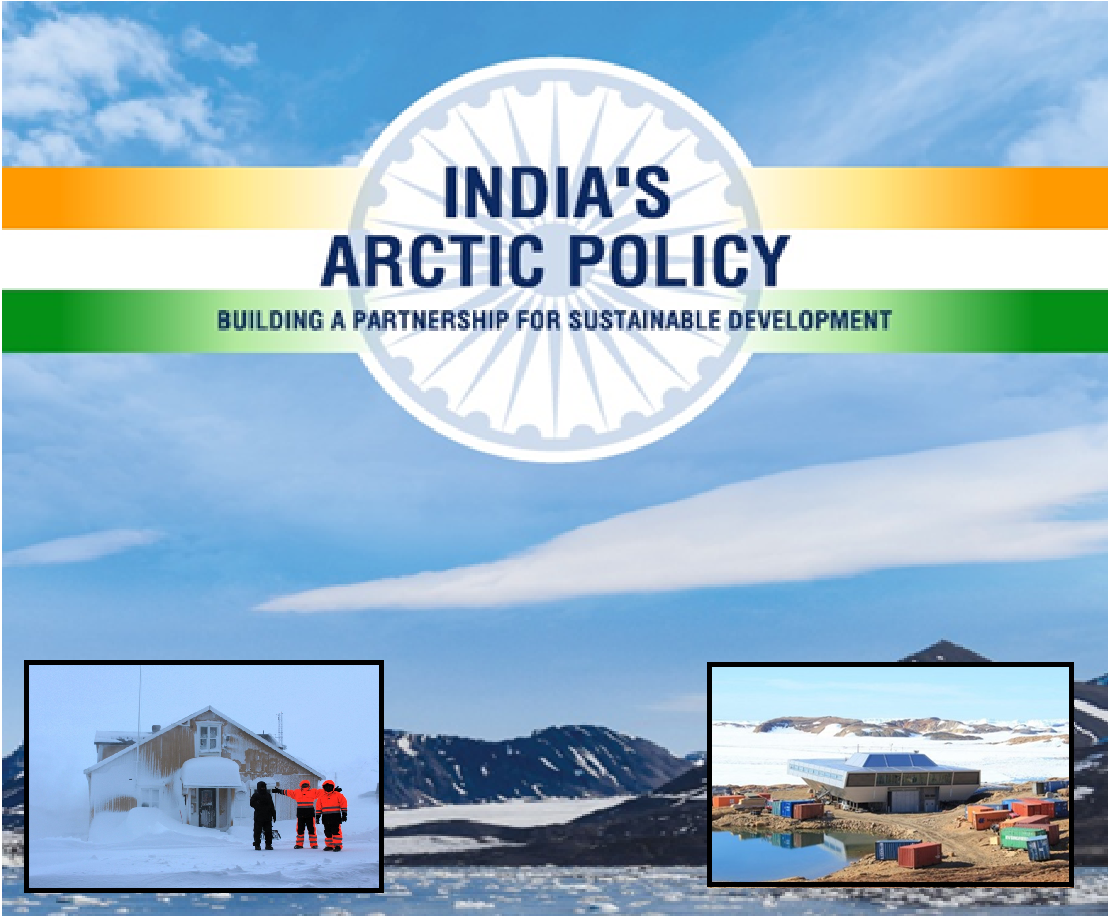
- The Arctic is no longer a distant frontier of ice and mystery; it has become a critical laboratory for understanding the global climate system.
- For India, a nation whose economy and food security are inextricably linked to the whims of the tropical monsoon, the melting of Arctic sea ice is a matter of national strategic importance.
- Arctic Council Strategy 2026 moves India’s role from a passive observer to an active scientific powerhouse, centring on the expansion of the Himadri station to decode the complex “teleconnections” that link the North Pole to the Indian subcontinent.
- A “warm” Arctic will often correspond with extreme weather events in India, and hence, the data collected at Svalbard will be critical for the survival of millions of farmers in India.
The Arctic is no longer a distant frontier of ice and mystery; it has become a critical laboratory for understanding the global climate system. For India, a nation whose economy and food security are inextricably linked to the whims of the tropical monsoon, the melting of Arctic sea ice is a matter of national strategic importance. Under the framework of its evolving Arctic engagement, the Arctic Council Strategy 2026 represents a pivotal shift. It moves India’s role from a passive observer to an active scientific powerhouse, centring on the expansion of the Himadri station in Svalbard to decode the complex “teleconnections” that link the North Pole to the Indian subcontinent.
The Strategic Pivot: India and the Arctic Council 2026
India enhanced its polar credentials after becoming an observer at the Arctic Council in 2013. The latest version of India’s Arctic Policy was published in 2022 and will have a mature version in 2026. The main feature of this document is the emphasis on “Science and Research” as the central point of engagement with Arctic issues. By 2026, India will have established itself as a prominent member of the Council by connecting the “Third Pole-North Pole” link and by giving scientific evidence of the melting glaciers in the Himalayas, and the shrinking Arctic ice since India has been asserting its rights to a larger share of global scientific and technical resources; India can give high quality data to each of the Council’s six Working Groups including the Arctic Monitoring and Assessment Programme (AMAP); and ensure that the voices of the Global South regarding climate change are included in the governance of the circumpolar region.
Expanding the Footprint at Himadri Station
Located in the international research hub of Ny-Ålesund, Svalbard, the Himadri station serves as the vanguard of India’s polar ambitions. The 2026 expansion involves more than just physical infrastructure; it signifies a transition to year-round operations. Historically, Indian expeditions were seasonal, but the current strategy mandates a persistent presence to capture data during the harsh Arctic winter—a period critical for understanding ice formation and atmospheric chemistry. Enhanced with state-of-the-art mass spectrometers, LiDAR systems, and automated weather stations, Himadri is now a multi-disciplinary hub capable of real-time data transmission to the National Centre for Polar and Ocean Research (NCPOR) in Goa.
Decoding Teleconnections: From Arctic Ice to Indian Rain
The 2026 scientific strategy focuses on examining “teleconnections”; that is, atmospheric and oceanic connections that can result in changes in one part of the globe affecting another area thousands of miles away. As an example, researchers in India will examine how Arctic Amplification (the Arctic region is warming at nearly four times the global average) will disrupt the jet stream and Northern Hemisphere circulation.
Research that has been performed at Himadri indicates that when there is less sea ice in the Barents and Kara Seas, this significantly affects the pressure gradient over Central Asia. This affects the strength and timing of the Indian Summer Monsoon (ISM). By linking these changes together, India hopes to enhance its models for predicting the monsoon. As such, a “warm” Arctic will often correspond with extreme weather events in India, e.g., erratic rainfall patterns or extended periods of dryness, and hence, the data collected at Svalbard will be critical for the survival of millions of farmers in India.
The Role of IND-Arc and Deep-Sea Monitoring
The strategy also focuses on the manner in which we will be monitoring the “wet” (or liquid) side of our footprint in the Arctic Region. An upgrade is planned for India’s IND-Arc mooring, which is a multi-sensor water column measuring station located on the West side of the Kongsfjorden fjord, in order to assist in understanding the flow of Atlantic waters into the Arctic. This flow of Atlantic Waters into the Arctic (or “Atlantification”) is the primary driver of the melting of Arctic ice. By the Year 2026, India will have also deployed additional remote-operated underwater vehicles (ROVs) to map the seafloor and quantify the carbon cycling between the ocean surface and the atmosphere. The information collected from these sensors will be used to create a three-dimensional image of how the warmer ocean interacts with the ice, allowing us to understand how thermal processes will flow southward from the Arctic Ocean into the Tropical Ocean, ultimately affecting tropical ocean surface temperatures.
International Collaboration and Science Diplomacy
India’s strategy for the Arctic Region will adopt a collaborative approach, particularly with regard to its working relationship with Norway (the host for Svalbard) and how it will use integrated research through the Svalbard Integrated Arctic Earth Observing System (SIOS). This partnership is much more than just logistics; it serves as a type of “Science Diplomacy” that provides a venue for India to utilise its satellite remote sensing capabilities to contribute high-resolution maps of Arctic ice via ISRO’s RISAT and Oceansat series to the Arctic Council to establish India as a responsible global stakeholder as part of the “common heritage of mankind”.
Conclusion: A Climate-Resilient Future
India’s route to becoming a major polar nation is marked by a landmark document – the Arctic Council Strategy 2026. The study will also expand India’s scientific presence in the region and provide us with information on how to adapt our way of living to climate change. It will include a study of the relationship between the Arctic region and India’s monsoon system, which is critical for predicting how to manage the unknowns and challenges of living through the 21st century; and through ongoing research, technology investments and partnerships with other countries, India will continue to gain knowledge while the ice in the North melts, which will help save India’s agricultural communities’ lives today, as well as in the future.
References:
- https://ncpor.res.in/app/webroot/pages/view/340-himadri-station
- https://ncpor.res.in/arctics/display/452-reports
- https://www.frontiersin.org/articles/10.3389/fpos.2026.1758233/pdf
- https://www.thearcticinstitute.org/india-role-arctic-reviving-momentum-through-policy/
- https://www.researchinsvalbard.no/project/20000000-0000-0000-0000-000000007832/
- https://arctic-council.org/explore/goals/

Hridbina Chatterjee is a final-year postgraduate student in International Relations at Jadavpur University, Kolkata. She has written for newspapers and think tanks, with interests in South Asian politics, India’s foreign policy, and the Indo-Pacific. Views expressed are the author’s own.
 Shivendra Shukla
  Archita Gaur
  Anjali Singh