|
Getting your Trinity Audio player ready...
|
- The South Asian energy landscape is undergoing a profound transformation, from hydro-hegemony to hydro-partnership.
- The year 2026 marks a decisive turning point, as this top-down approach gives way to a “locked-in” regional energy market.
- Bhutan and Nepal no longer merely export electricity; instead, they provide essential balancing services as “green batteries.”
- The emergence of a locked-in regional market reflects a broader shift in energy policy, from nationalistic models of self-sufficiency to frameworks based on interdependence.
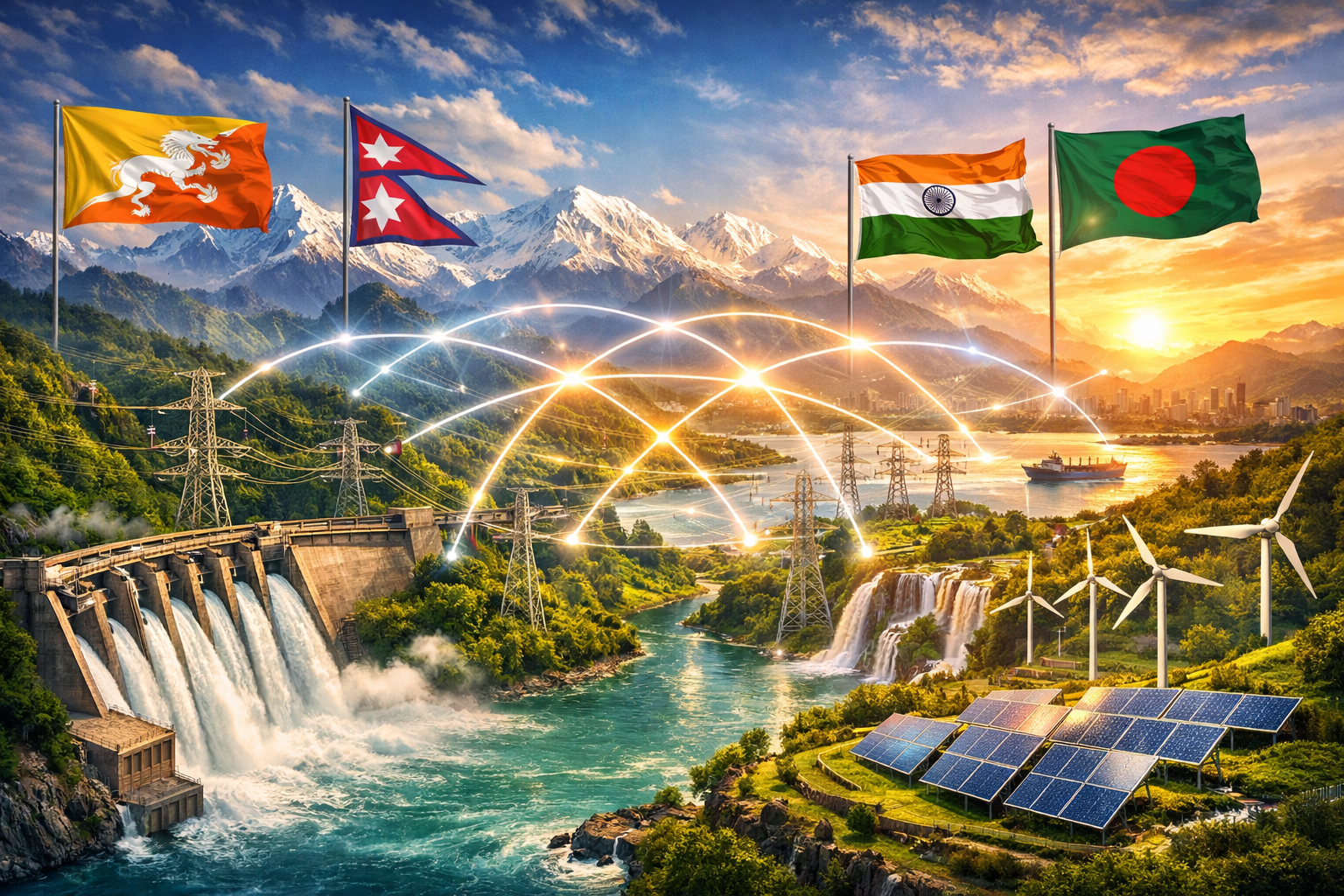
The South Asian energy landscape is undergoing a profound transformation, from hydro-hegemony to hydro-partnership. Historically, the region operated under a “hub-and-spoke” model, with India as the central economic power dictating the terms of water use and energy trade to its smaller neighbours. However, 2026 marks a decisive turning point, as this top-down approach gives way to a “locked-in” regional energy market.
Through integrated power grids and synchronised regulatory frameworks, Bhutan and Nepal are evolving from passive resource suppliers into strategic “green batteries.” This shift is fostering a system of mutual interdependence that enhances regional energy security and economic stability.
The Shift from Hydro-Hegemony to Hydro-Partnership
The transition toward hydropower cooperation is rooted in functional interdependence among nations. The completion of major projects by 2026, such as Arun-3 in Nepal and the Punatsangchhu hydropower units in Bhutan, necessitates a rethinking of how electricity flows across borders.
Cooperative development through a hyper-national regulatory approach to the hydropower sector has resulted in a set of energy resources, of which each resource will contribute as inputs into an integrated energy market, such as India, with respect to how electricity is imported and exported. The energy market will have long-term, multi-directional energy supply contracts. All countries in the region will share regulatory structures that support a synchronized/whole, cohesive sub-regional electric infrastructure.
Under this evolving system, Bhutan and Nepal no longer merely export electricity. Instead, they provide essential balancing services as “green batteries,” enabling India to integrate large volumes of intermittent solar and wind energy. This marks a conceptual shift from commodity exchange to energy service provision.
2026: The Milestone of Technical and Political Integration
By 2026, the technological integration of the regional grid has reached a point of no return, creating a durable “locked-in” effect that makes economic decoupling highly impractical.
The expansion of high-voltage direct current (HVDC) transmission lines and cross-border interconnectors has transformed bilateral exchanges into a more complex trilateral and at times quadrilateral trading system, with Bangladesh participating intermittently. Physical infrastructure now forms the backbone of the regional energy market.
As interdependence deepens, the cost of political friction rises significantly. This “infrastructure-first” diplomacy ensures that electricity continues to flow even during periods of diplomatic strain, maintaining a baseline of cooperation while reducing historical tendencies toward hydro-hegemony.
The significance of 2026 extends beyond infrastructure. The growing role of market platforms such as the Indian Energy Exchange (IEX), with participation from Bhutan and Nepal in both Day-Ahead and Real-Time Markets, signals a structural shift. Traditional long-term Power Purchase Agreements (PPAs), which often disadvantaged smaller countries, are gradually being supplemented by transparent, competitive market mechanisms.
This transition enables Nepal and Bhutan to capture fair value for their flexible hydropower resources. By participating in open markets, they can negotiate on more equal terms with India, reducing long-standing asymmetries and replacing political suspicion with data-driven commercial engagement.
Creating the Locked-In Regional Energy Market
The emergence of a locked-in regional market reflects a broader shift in energy policy, from nationalistic models of self-sufficiency to frameworks based on interdependence.
For India, securing hydropower from the Himalayas is essential to achieving its ambitious net-zero targets, particularly as a complement to renewable energy expansion. For Nepal and Bhutan, reliable access to the Indian market provides a pathway to economic growth, sovereign wealth generation, and increased domestic investment.
This mutual lock-in acts as a stabilising force. The substantial capital invested in cross-border transmission infrastructure creates strong financial incentives for all parties to maintain cooperation and system stability.
In this new paradigm, the grid no longer serves as an instrument of hegemonic influence. Instead, it becomes a shared asset requiring collective stewardship.
Conclusion: Toward a Shared Energy Future
Looking ahead, the legacy of 2026 will be defined by how effectively this integrated grid contributes to broader regional stability.
The hydro-partnership model offers a compelling blueprint for overcoming the long-standing geographic constraints that have historically disadvantaged landlocked Himalayan states. By reconceptualising water as the foundation of a shared regional power market, rather than a contested resource, South Asia is moving beyond the frictions of the 20th century.
This locked-in system ensures that the benefits of the Himalayas’ “white gold” are distributed more equitably, promoting reliability, sustainability, and collective prosperity. In doing so, it signals the end of hydro-hegemony and the emergence of a resilient, interconnected regional energy community.
References
- Ministerial Visit and New Hydropower Agreements
- Ministry of External Affairs (India) – India-Nepal Joint Statement on Power Sector Cooperation
- High-Capacity Cross-Border Transmission Lines Agreements
- South Asia’s Clean Energy Transition (Observer Research Foundation)
- India-Bhutan Power Sector Strengthening (EQ Mag)
- World Bank – One South Asia: Powering Regional Cooperation

Hridbina Chatterjee is a final-year postgraduate student in International Relations at Jadavpur University, Kolkata. She has written for newspapers and think tanks, with interests in South Asian politics, India’s foreign policy, and the Indo-Pacific. Views expressed are the author’s own.
 Anjali Singh
  Archita Gaur