
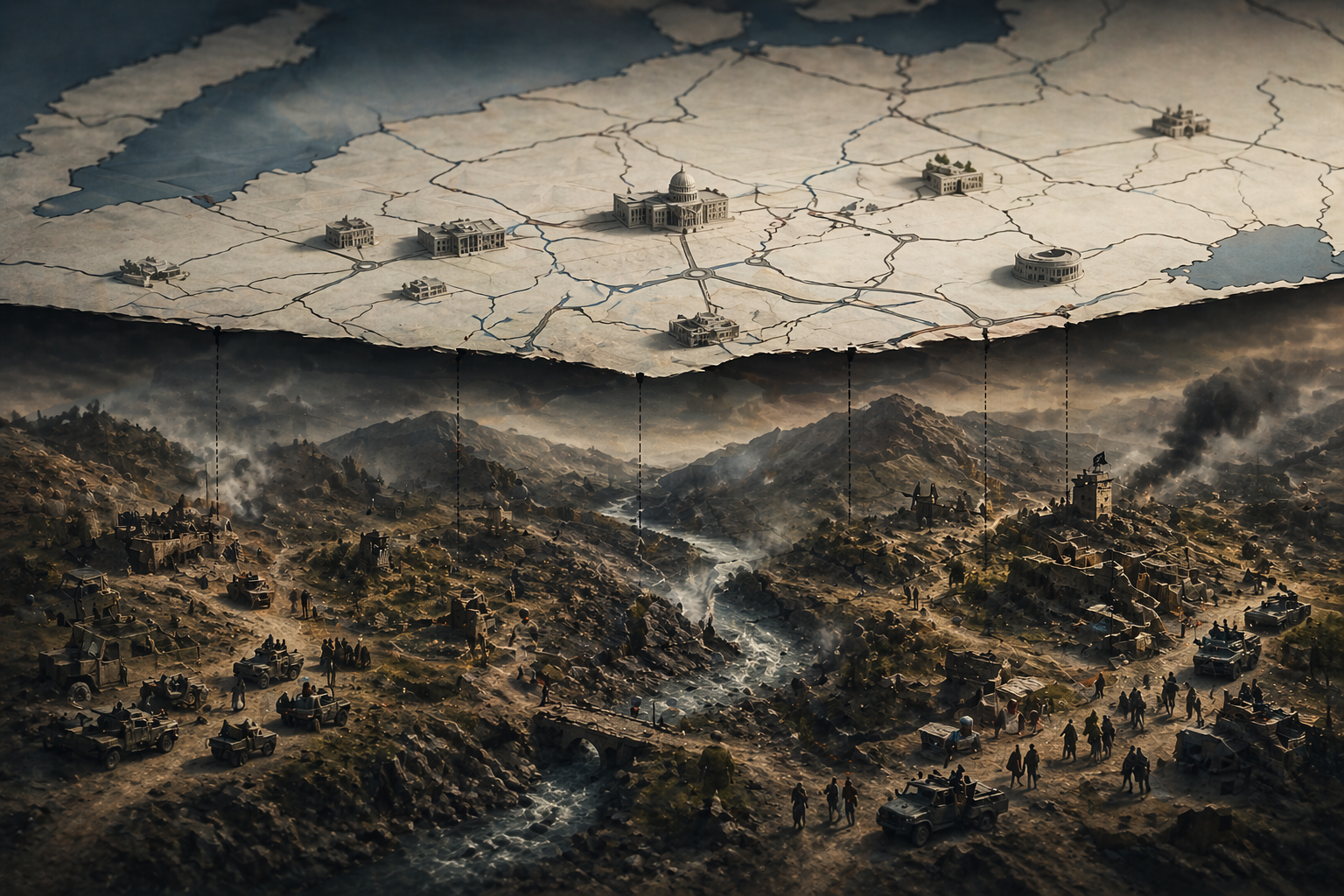
- In all manner of situations, over any timeline, external powers have struggled to even know the political, social, and institutional structures of fragile states.
- External interventions are often based on assumptions about centralised authority, coherent institutions, and a linear track to stability that do not fit realities on the ground in areas of fragmented governance and contested legitimacy.
- You cannot fabricate stability from the outside: it has to come from the inside, be conditioned by local politics and local forms of legitimacy.
There are few patterns in world politics as consistent as the inability of external powers within fragile states. Great powers have repeatedly intervened from Afghanistan through Iraq to Libya with specific strategic aims, including stability and state building, counter-terrorism, and others, yet they have always encountered outcomes that include extended periods of instability and lack of political control. Such failures have often been linked to implementation problems, inadequate planning, or shifts in political priorities at home. But such accounts may miss a more fundamental and enduring problem. In all manner of situations, over any timeline, external powers have struggled to even know the political, social, and institutional structures of fragile states.
This recurring pattern indicates that the problem lies not merely in policymaking, but in a structural misperception of how fragile states operate. External interventions are often based on assumptions about centralised authority, coherent institutions, and a linear track to stability that do not fit realities on the ground in areas of fragmented governance and contested legitimacy. Consequently, the result of the attempts to bring order from outside ends up being a reproduction of the chaos that they are meant to end. This article contends that external powers have long misunderstood fragile states, not because of insufficient resources but because of unrealistic expectations of what governance, legitimacy, and external influence can achieve.
What are Fragile States?
Fragile states are generally defined as having weak institutions, poor administrative capacity, and divided political power. According to the World Bank, such states are also said to have difficulties in establishing a monopoly over violence or providing rudimentary public goods. Yet fragility is not just institutional weakness; it also indicates the disaggregation of authority among local actors and informal networks. This diffusion of power runs counter to the assumption that governance can be centralised and imposed from the outside and thus complicates the application of traditional means of intervention.
In such cases, the state does not appear as a monolithic actor but rather as one among many sources of competing authority, and is often limited and fragmented. As a result, external interventions that are designed around formal institutions frequently fail to engage with the actors who exercise actual control on the ground. This generates a disconnect between policy design and political realities, as externally promoted structures have difficulty taking root in anything beyond narrow administrative enclaves. In addition, the lack of a clearly identifiable legitimate authority makes prolonged stability difficult to achieve, since the governance in question is provisional and contested. Failed states, then, reveal not just the limitations of institutional capacity, but the shape of the power itself, the way it resists simple mapping onto formal structures, or externally conceived schemas of order.
The Illusion of State Capacity
A central miscalculation in external interventions is the tendency to view weak states as unified political entities with working institutions. There is often an assumption on the part of external actors that a central authority exists that can formulate policy decisions effectively and enforce them throughout the territory. However, in practice, the authority of the state in weak states remains relatively insignificant and fragmented. Governance becomes highly localised, with regional players, militia groups, and informal networks playing an important role. As such, any attempt to impose centralised forms of governance or state-building fails to account for the distribution of power and makes unrealistic policy prescriptions.
Misreading Political Legitimacy
A second, and equally significant, misconception pertains to the perception of the legitimacy of the political order from the perspective of an external actor intervening in weak settings. Such interventions are usually premised on the idea that political legitimacy is something that can be achieved through procedural mechanisms, such as elections, constitution-making, or institutional building. However, legitimacy rarely depends on such mechanisms in fragile settings. Instead, legitimacy is contingent upon historical conflicts and identities, as well as on informal authorities that extend beyond state structures. As such, externally boosted governments can have institutional recognition but not social acceptance. This divergence produces governance that seems solid on paper but is highly contested in practice. Therefore, outside meddling tends to perpetuate institutions in the land, exaggerating rather than bridging the distance between formal authority and the political realities that people experience.
The result of such a misunderstanding is particularly obvious in the instability of externally supported political systems. States that emerge or are formed as a result of foreign interference find it hard to establish control outside urban areas, where they will have to depend on either coercion or outside help in order to rule. Not only does this compromise their chances for survival, but it also creates room for other players to legitimise themselves, such as insurgents or local potentates. It is true that in such settings, the gap between formal structures of governance and local centres of power, apart from weakening the state, actually fosters instability. External interventions, in other words, may end up intensifying the very situation they desired to change.
The Limits of External Instruments
Another misleading assumption lies in the idea that economic and military tools can be used to create stability in weak states. External players, such as a foreign government or coalition, frequently depend upon financial aid, developmental assistance, or military intervention as their main stabilisation tools, anticipating that resources can be converted into political order. But such measures often ignore the intricate social and political structures that contribute to instability. The United States’ long intervention in Afghanistan is a case in point, and marks that expenditures ran into the trillions of dollars, yet this dramatic exercise in using material superiority to establish sustainable governance ended in failure.
Conclusion
In the end, the repeated failures of foreign powers in weak states reflect not just mistakes of strategy, but rather conceptual constraints in the very frameworks for these environments. Interventions remain driven by assumptions about centralised authority, institutional coherence, and the utility of external instruments and thus continue to reproduce known configurations of instability. Fragile states, in this way, expose us to the edge of international politics where power is limited, not because external actors are helpless, but because they misperceive the conditions of power’s operation. You cannot fabricate stability from the outside: it has to come from the inside, be conditioned by local politics and local forms of legitimacy. External engagement with fragile states will continue to be characterised by high ambition, intervention, and disenchantment until this basic distinction is understood.
References:
- World Bank. (2023). Classification of fragile and conflict-affected situations. World Bank Group.
- Organisation for Economic Co-operation and Development (OECD). (2022). States of fragility 2022: The path to resilience. OECD Publishing.
- Stockholm International Peace Research Institute (SIPRI). (2023). SIPRI military expenditure database.
- Costs of War Project. (2021). Costs of the war in Afghanistan. Brown University Watson Institute for International and Public Affairs.
- Migdal, J. S. (1988). Strong societies and weak states: State-society relations and state capabilities in the Third World. Princeton University Press.

Archita Gaur is a postgraduate student at the School of International Studies, JNU. She specialises in the World Economy and has a strong interest in public policy, economic research, and governance. The views expressed are the author’s own.
 Kumar Satish
  Anjali Singh
  Aayush Pal