
- The agreement, which was signed in 2025 and goes into effect in January 2026, permits both nations to post up to 3,000 soldiers, along with warships and aircraft, on each other’s territory.
- India’s willingness to strengthen ties with Moscow in spite of Western pressure and sanctions regimes like CAATSA is demonstrated by RELOS, which permits troop deployments while maintaining defence cooperation with the United States under LEMOA.
- It demonstrates how both Russia and India are adjusting to a multipolar world order by utilising collaboration to maximise their security and geopolitical objectives without forming strict alliances.
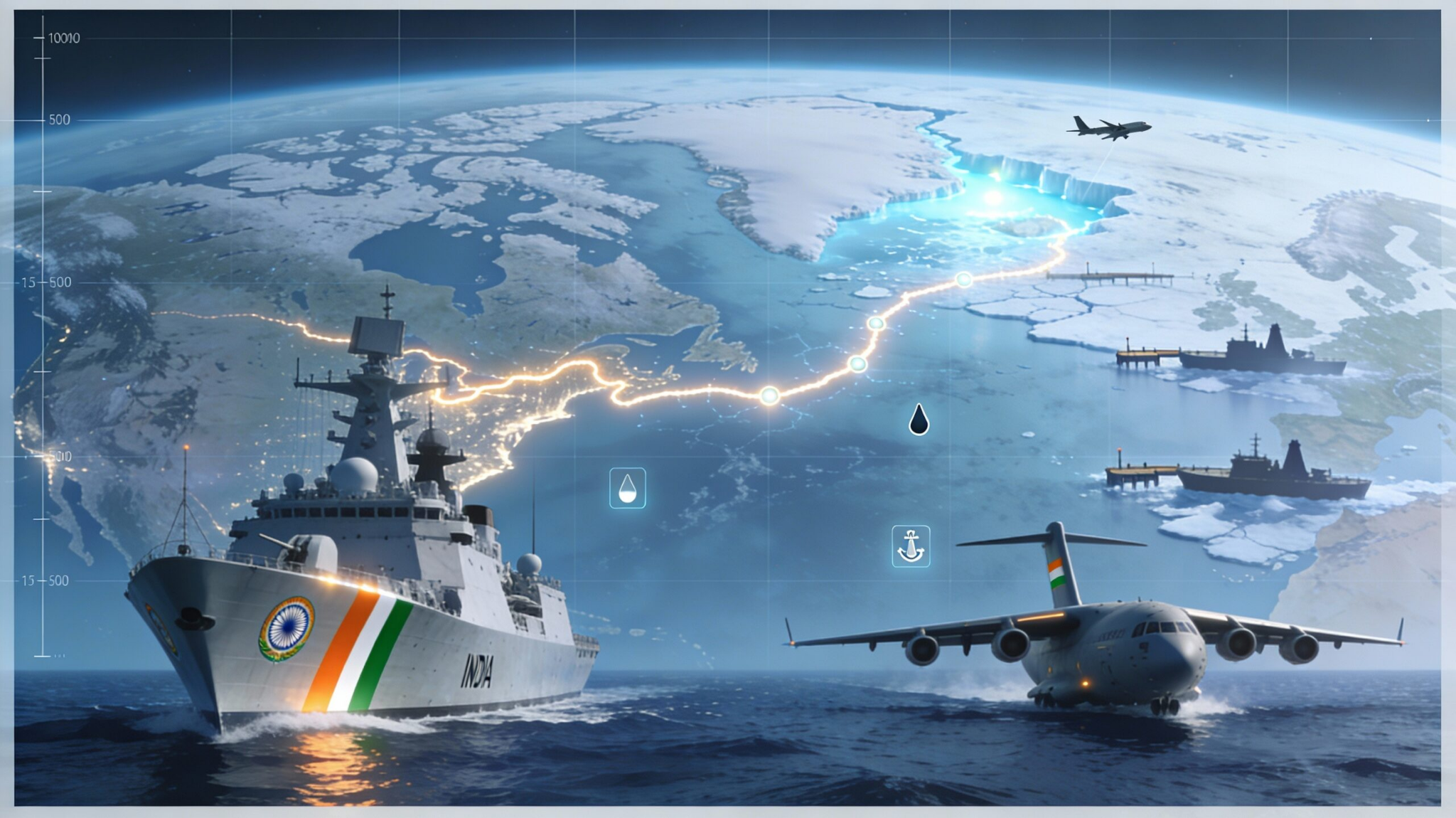
With the operationalisation of the Reciprocal Exchange of Logistics Support (RELOS) pact, India and Russia have significantly advanced their long-standing defence cooperation and reflected broader changes in the balance of power in the world. The agreement, which was signed in 2025 and goes into effect in January 2026, permits both nations to post up to 3,000 soldiers, along with warships and aircraft, on each other’s territory. This is an unparalleled degree of military cooperation for India.
From a perspective of international relations, the RELOS pact is a prime example of realism theory, in which states give priority to security, power, and strategic autonomy. India expands its operational reach and energy security interests, particularly in obtaining LNG resources via northern routes, by gaining access to Russian bases, especially in the Arctic region. Concurrently, Russia establishes a logistical base in the Indian Ocean region, bolstering its marine presence in warmer waters—a crucial geopolitical goal.
India’s multi-alignment strategy, which is based on neorealism and strategic autonomy and involves New Delhi balancing relations with several major nations, is also reflected in the pact. India’s willingness to strengthen ties with Moscow in spite of Western pressure and sanctions regimes like CAATSA is demonstrated by RELOS, which permits troop deployments while maintaining defence cooperation with the United States under LEMOA. This demonstrates India’s reluctance to rely on alliances and its preference for adaptable alliances based on national interests.
In addition, the agreement can be seen through the prism of liberal institutionalism since it formalises defence cooperation through joint drills, logistics sharing, and humanitarian missions. RELOS increases efficiency in both peacetime and conflict situations by lowering transaction costs and enhancing coordination, strengthening consistent patterns of cooperation between the two states.
Geopolitically, the agreement’s timing is also important. India seems to be hedging its strategic bets as the Trump administration is thought to be recalibrating its South Asia policy and interacting more closely with Pakistan. This is consistent with the balance of power theory, which holds that governments should fortify alternative relationships in order to counteract changes in alliances. As a result, the RELOS agreement acts as a counterweight, guaranteeing that India maintains influence in the face of shifting US priorities.
RELOS maintains Russia’s defence connections with one of its biggest arms clients while providing vital strategic depth in the face of Western isolation during the Ukraine crisis. Given that a sizable component of India’s arsenal is Russian-made, it guarantees ongoing access to Russian military equipment and maintenance assistance.
All things considered, the operationalisation of RELOS is a “win-win” strategic arrangement that reflects changing global alignments and strengthens bilateral defence ties. It demonstrates how both Russia and India are adjusting to a multipolar world order by utilising collaboration to maximise their security and geopolitical objectives without forming strict alliances.

Anjali Singh is a postgraduate student of Political Science and International Relations, a Social Media Analyst, and a former Research Intern at the Indian Council of World Affairs. Views expressed are the author’s own.
 Kumar Satish