Analysing whether groupings like BRICS+ and SCO represent true alternatives to Western-led institutions or just symbolic balancing acts
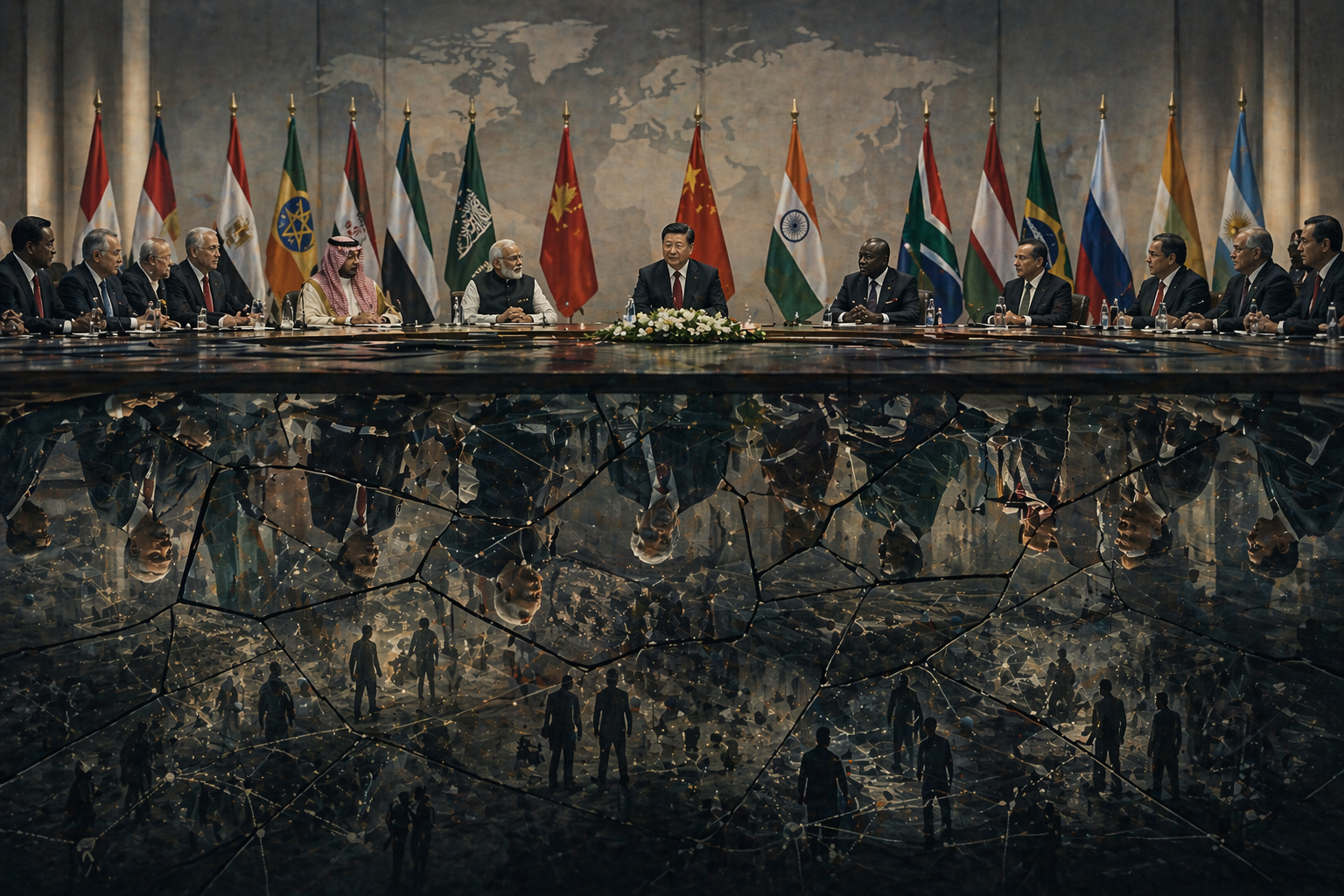
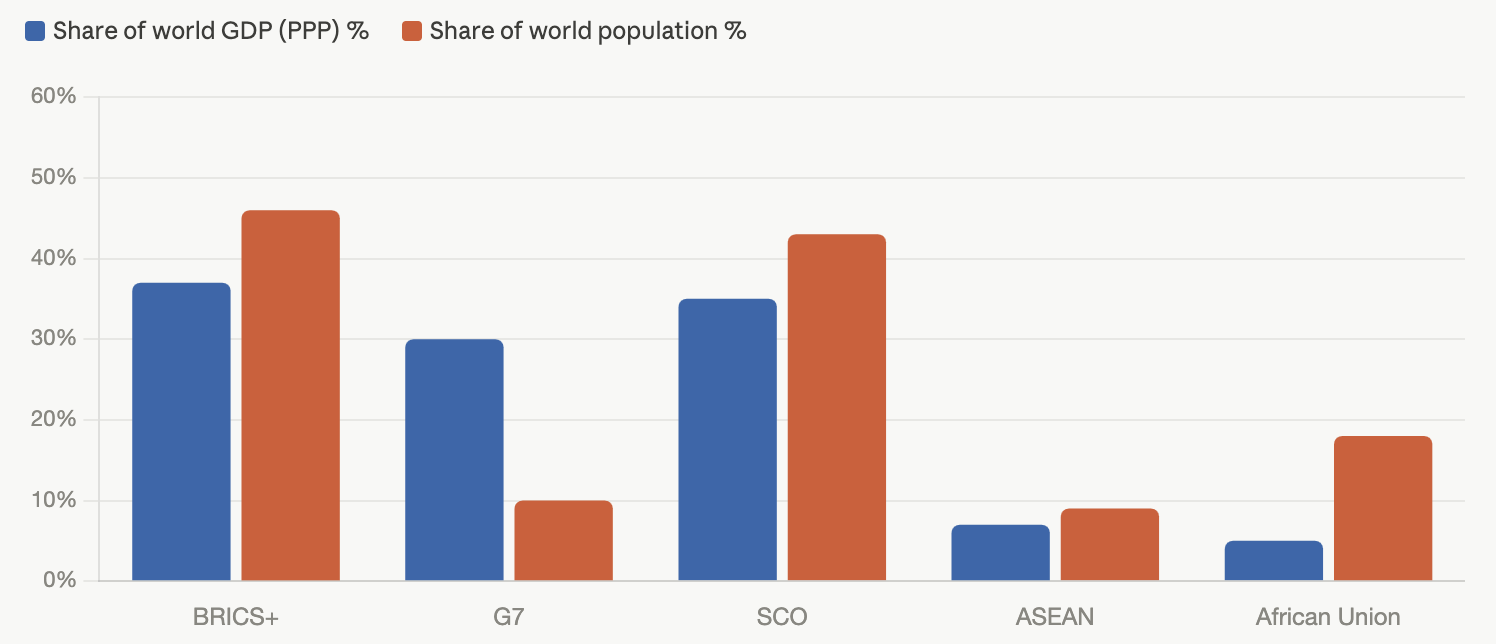
- With the inclusion of countries such as Saudi Arabia, the UAE, Ethiopia, Egypt, and Iran, the bloc now accounts for a larger share of global GDP than the G7, and represents roughly 46% of the world’s population.
- Since its founding in 2001, SCO has focused on security cooperation, including joint military exercises and a regional counterterrorism mechanism (RATS), supported by permanent secretariats in Beijing and Tashkent.
- A viable reserve currency requires deep and liquid financial markets, credible legal protections, open capital flows, and sustained institutional trust.
- BRICS+ and the SCO are neither mere theatre nor credible replacements for Western-led institutions. They occupy an intermediate space, mechanisms for coordination, signalling, and limited influence rather than systemic alternatives.
October’s Kazan Summit, where Russia convened an expanded BRICS-plus gathering stretching from Beijing to Brasília and Riyadh to Tehran, was hailed by some as a turning point in global politics. Vladimir Putin described it as evidence of a “new multipolar world order,” while Western analysts dismissed it as little more than a photo opportunity. As is often the case in international affairs, the reality lies somewhere in between.
The questions raised at Kazan are not new, but they have grown sharper: do formations like BRICS+, the Shanghai Cooperation Organisation (SCO), and the New Development Bank (NDB) constitute credible alternatives to institutions such as the IMF, World Bank, and G7? Or are they primarily diplomatic instruments, useful for signalling resistance to Western dominance but structurally incapable of replacing it?
The weight of numbers and their limits
On paper, BRICS+ appears formidable. With the inclusion of countries such as Saudi Arabia, the UAE, Ethiopia, Egypt, and Iran, the bloc now accounts for a larger share of global GDP (in purchasing power parity terms) than the G7, and represents roughly 46% of the world’s population. The SCO, spanning China, Russia, India, Pakistan, Iran, and Central Asia, is similarly expansive in both demographic and geographic terms.
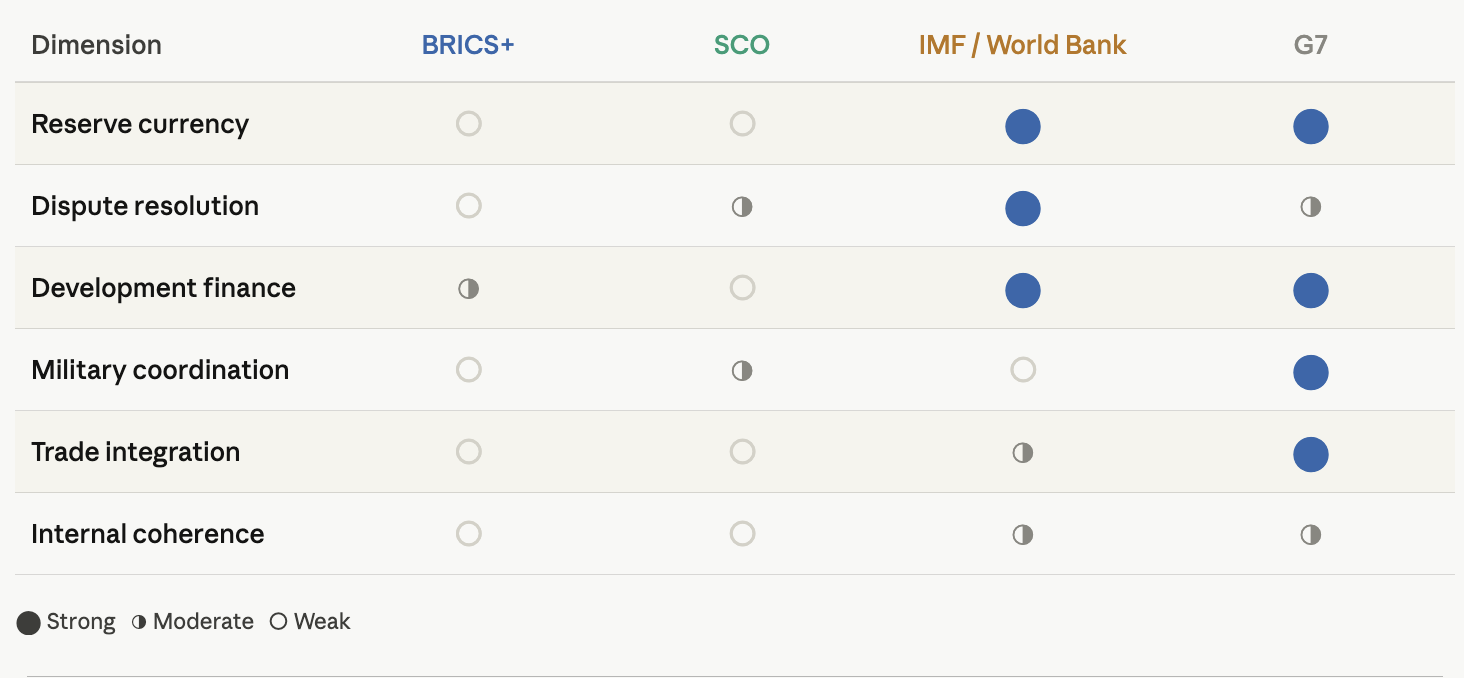
Yet scale does not automatically translate into influence. Institutions like the IMF derive power from decades of institutional development: legal frameworks, dollar backing, quota systems, and a long—if contested—history of crisis management. BRICS+ lacks comparable depth. Its New Development Bank has issued only a fraction of the loans extended annually by the World Bank, while proposals for a common BRICS currency repeatedly surface only to stall. Even at Kazan, consensus extended no further than continued exploration of a cross-border payments system—far from a viable alternative to Bretton Woods structures.
The SCO presents a related paradox. Since its founding in 2001, it has focused on security cooperation, including joint military exercises and a regional counterterrorism mechanism (RATS), supported by permanent secretariats in Beijing and Tashkent. However, its internal divisions constrain effectiveness. India and Pakistan’s rivalry, alongside persistent India–China tensions along their disputed border, frequently limit substantive coordination. The organisation’s breadth is also its constraint.
The coherence problem
A recurring challenge for Global South coalitions is internal divergence. Larger memberships expand representation but dilute consensus. The G7, despite declining relative influence, retains cohesion because its members broadly share political systems, economic models, and strategic priorities.
BRICS+ operates without such alignment. It encompasses democracies and authoritarian systems, US partners and US rivals, as well as states with conflicting regional ambitions. India maintains security ties with Washington, China positions itself as its principal competitor, Saudi Arabia and Iran remain strategic rivals, and Russia operates under extensive Western sanctions. Brazil’s engagement, meanwhile, is driven more by Global South positioning than deep strategic convergence with other members.
This diversity creates structural limitations. Effective institutions require enforceable norms and agreed leadership frameworks. BRICS+ relies on consensus, which often produces lowest-common-denominator outcomes. Ambitions such as an alternative payments system, a stronger development bank, or a reserve currency repeatedly encounter the same obstacle: disagreement over governance and burden-sharing. China’s economic dominance positions it as a natural leader, but that very asymmetry generates resistance from India, Brazil, and South Africa, none of which seek to exchange Western dominance for Chinese centrality.
The dollar problem and the de-dollarisation mirage
Reducing dependence on the US dollar remains one of BRICS+’s most discussed objectives. The motivation is clear: dollar dominance grants Washington significant leverage, as illustrated by sanctions on Iran and the freezing of Russian central bank reserves. However, translating this ambition into reality is far more complex.
A viable reserve currency requires deep and liquid financial markets, credible legal protections, open capital flows, and sustained institutional trust. China’s renminbi meets these conditions only partially, constrained by capital controls and limited market openness. The Indian rupee is even further from reserve status. Meanwhile, the NDB—intended as a vehicle for non-dollar financing—continues to rely heavily on dollar-denominated instruments, reflecting the entrenched structure of global capital markets.
Dollar dominance is not simply a political construct; it is embedded in decades of financial infrastructure and market behaviour. Displacing it requires systemic transformation, not periodic summit declarations.
What these blocs actually do well
Dismissing BRICS+ and the SCO as purely symbolic would be analytically incomplete. Their significance lies in functions that differ from their stated ambitions.
First, they provide multilateral cover for bilateral engagement. Energy cooperation between China and Russia, security coordination in Central Asia, and Gulf states’ strategic balancing all benefit from being framed within institutional settings that diffuse external scrutiny. The SCO, in particular, offers a platform for sustained India–China engagement even during periods of tension.
Second, they reshape negotiation dynamics within existing institutions. Even limited coordination among BRICS members has contributed to pressure for reforms in IMF voting structures, reserve asset composition, and WTO mechanisms. The presence of alternative forums—however limited—alters bargaining power within established systems.
Third, membership carries symbolic and domestic value. For countries such as Ethiopia or Egypt, participation signals strategic autonomy and non-alignment. Inclusion in a grouping that excludes the United States, while encompassing major powers like China and India, reinforces narratives of sovereign agency, regardless of tangible institutional outcomes.
The fragmentation verdict
BRICS+ and the SCO are neither mere theatre nor credible replacements for Western-led institutions. They occupy an intermediate space—mechanisms for coordination, signalling, and limited influence rather than systemic alternatives.
The Kazan Summit reflects a broader shift: not the rise of a unified counter-order, but the gradual erosion of Western institutional dominance. This change is driven less by the strength of emerging blocs than by declining confidence in existing structures.
What is emerging instead is fragmentation. The Global South is not consolidating around a single framework but dispersing into overlapping, sometimes competing networks. These formations reflect a multipolar environment characterised as much by mutual caution as by cooperation.
A wholesale displacement of Bretton Woods institutions remains unlikely. The more plausible trajectory is a complex ecosystem of partial alignments, parallel mechanisms, and issue-specific coalitions—flexible, inconsistent, and often temporary. This represents a meaningful shift in global governance, but not the systemic transformation that either its advocates or critics often anticipate.
Kazan may have produced a compelling image. The institutional reality behind it, however, remains underdeveloped.
References
- IMF World Economic Outlook (2024) — GDP (PPP) data https://www.imf.org/en/Publications/WEO
- UN Population Division — World Population Prospects 2024 https://population.un.org/wpp/
- New Development Bank — Annual Report & Project Portfolio https://www.ndb.int/projects/
- BRICS 2024 Kazan Summit — Joint Declaration https://brics-russia2024.ru/en/
- Shanghai Cooperation Organisation — Official Charter & Structure https://eng.sectsco.org/
- Council on Foreign Relations — BRICS and the Attempt to Reshape Global Order https://www.cfr.org/backgrounder/brics
- Carnegie Endowment for International Peace — Can BRICS De-dollarise? https://carnegieendowment.org/research/2024/06/can-brics-de-dollarize
- Brookings Institution — The SCO at 20: Lost in Translation https://www.brookings.edu/articles/the-shanghai-cooperation-organisation
- Financial Times — BRICS Expansion and the Limits of Multipolarity (2024) https://www.ft.com/content/brics-expansion
- The Economist — Why BRICS Still Isn’t a Bloc (2024) https://www.economist.com/international/2024
- SWIFT — RMB Tracker: Monthly Reporting on Renminbi Progress https://www.swift.com/our-solutions/compliance-and-shared-services/business-intelligence/renminbi/rmb-tracker
- World Bank — International Development Association Lending Data https://www.worldbank.org/en/projects-operations/lending

Daljeet Singh holds a BTech in Computer Science and is currently pursuing an MA in Political Science. His interests range across geopolitics, international relations, and technology. An avid reader and writer, he is passionate about exploring the intersections of these fields. Views expressed are the author’s own.
 Kumar Satish
  Anjali Singh
  Aayush Pal