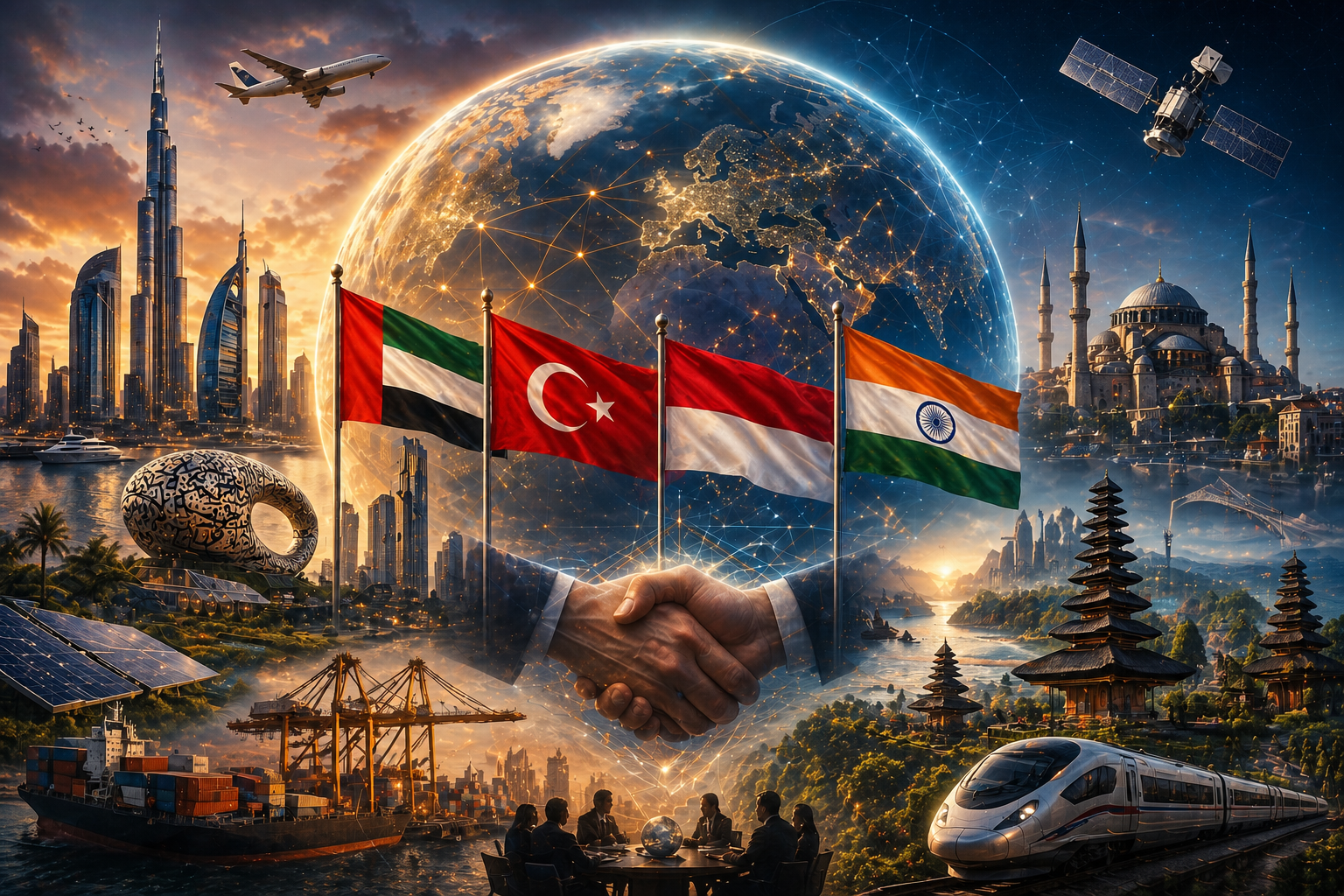
- Countries like the UAE, Turkey, and Indonesia are no longer just “ in the middle”; rather, they are becoming major players in business, banking, logistics, and culture.
- The number of intermediate powers has roughly doubled since 1991, and together they now have more material power than the great powers.
- This is a structural change, not a temporary change, and it shows that the system is moving toward a more scattered, multipolar one.
- India’s geopolitical strategy is way more adaptable. It is still a major player in BRICS and the G20, and it is expanding its role in the Quad.
The traditional view of world politics says two or three superpowers made all the choices. Institutional power is considered limited. Rather, a more critical and dynamic order is emerging, owing to middle orders. These are countries that, while not superpowers, made all choices and, with less government, are large, active, wild, and have considerable power in their respective regions. The UAE, Turkey, Indonesia, and India are all examples of this change. The first three act as typical middle powers, while India is emerging as one. They demonstrate how economic growth, good location, and efficient diplomacy are making the world more diverse and unpredictable.
The Growth of Middle-Power Power
The United States, Russia, China, and a few European economies were in charge of world politics for decades. Today, this kind of dominance is fading: the share of global economic output and overall influence of these old major powers has either levelled off or gone down. The number of intermediate powers has roughly doubled since 1991, and together they now have more material power than the great powers. This is a structural change, not a temporary change, and it shows that the system is moving toward a more scattered, multipolar one.
Countries like the UAE, Turkey, and Indonesia are no longer just “ in the middle”; rather, they are becoming major players in business, banking, logistics, and culture. They are in close contact with both Washington and Beijing, while avoiding any strict alliance agreement with either of the two. Instead, they form “variable geometry” coalitions, which are different partnerships for different crises. In this way, they don’t replace great powers; instead, they actively shape the world’s order by filling in the gaps left by superpower exhaustion and fragmentation.
The UAE is the finance and logistics hub
How middle powers can pivot is clearly reflected by the actions of the United Arab Emirates, which has changed from a small, resource-dependent country to a global centre. The UAE has changed from a Gulf state with a lot of oil to a modern city with a lot of money and logistics, with a sovereign wealth fund worth more than $1.1 trillion. It’s now the biggest hub of foreign investment in Sub-Saharan Africa and links African markets to supply chains in Asia and Europe.
This economic power turns into political power. The UAE helps different groups in the Middle East and Africa to get along, hosts important meetings, and maintains good relations with both the US and China. It avoids strict ideological alignment by making deals on energy, security, and trade with a wide range of partners. In this form, it becomes a perfect example of a “hedging state”: it is linked to many groups but still has its own power and influence around the world.
Turkey, a link between two worlds
Turkey is in a unique strategic position, as it is situated at the crossroads of Europe, the Middle East, and the Caucasus. In the last ten years, it has changed from being a NATO alliance of the West to a more powerful regional power that mediates in conflicts and balances relationships with Russia and increases its influence in the Eastern Mediterranean and Central Asia.
In the current broken order, Turkey is not just between; it uses the position to negotiate and diversify. It buys S‑400 missile systems from Russia while remaining in NATO, and it negotiates with European powers on energy, migration, and security. At the same time, it has deepened economic and defense ties with Asian partners, including countries like India and Pakistan. This “multiple‑door” policy allows Türkiye to survive and even flourish in an age of great‑power rivalry, turning its geography into political capital.
Indonesia: An Asian Power on the Rise
Indonesia’s diplomatic power comes from a strong economy, a young population, and a strategic location along major shipping routes between the Indian and Pacific Oceans. Indonesia is an important part of ASEAN, as it sets the rules of trade and security in the region. The US and China are paying close attention to Indonesia’s role in the Indo-Pacific corridor. “Strategic autonomy” is a key part of Indonesia’s foreign policy. It disagrees with permanently aligning with any one state but rather wants to have balanced alliances. It works with China and other Asian allies while also supporting Western-led projects like the Indo-Pacific Economic Framework. Because of this dual engagement, Indonesia holds the power to push for stability in the region, cooperation on climate change, and fairer trade policies. This makes the country an important voice in the Global South nations.
India: From a Rising Power to a shaper of order
It’s not easy to call India a middle power. Rather, India is looking to be a great power that will shape the future. It has one of the fastest-growing economies, is densely populated, and has a growing military and technological base. This differs from the UAE, Turkey, and Indonesia. Its role in trade, security, and diplomacy is growing, while the share of global output from other major countries stays the same or goes down. India’s geopolitical strategy is way more adaptable. It is still a major player in BRICS and the G20, and it is expanding its role in the Quad. It is also importing more Russian energy and weapons while strengthening its trade and defense ties with the US and Europe. The country is making new deals, like a big liquefied natural gas deal with the UAE and a broad free-trade and security agreement with the European Union. These show how India is spreading out its alliances so it doesn’t have to rely on just one supplier or group. These show how India is spreading out its alliances so it doesn’t have to rely on just one supplier or group.
Conclusion
At present, the United States, China, and Europe are no longer controlling the world order. The UAE, Turkey, and Indonesia are all middle powers with strong economies and geopolitical positions. They can act as brokers, mediators, and agenda setters in a world that is not very stable. India is on its way to becoming a great power, using its size, economy, and diverse partnerships to influence trade, security, and climate politics. These four countries show that the future of international relations will be less about strict groups and more about networks that overlap, alliances that can change, and states that don’t want to be seen as just pieces on the board.

Anusreeta Dutta is a columnist and climate researcher with experience in political analysis, ESG research, and energy policy. Views expressed are the author’s own.
 Hridbina Chatterjee
  Divyanka Tandon
  Kumar Satish