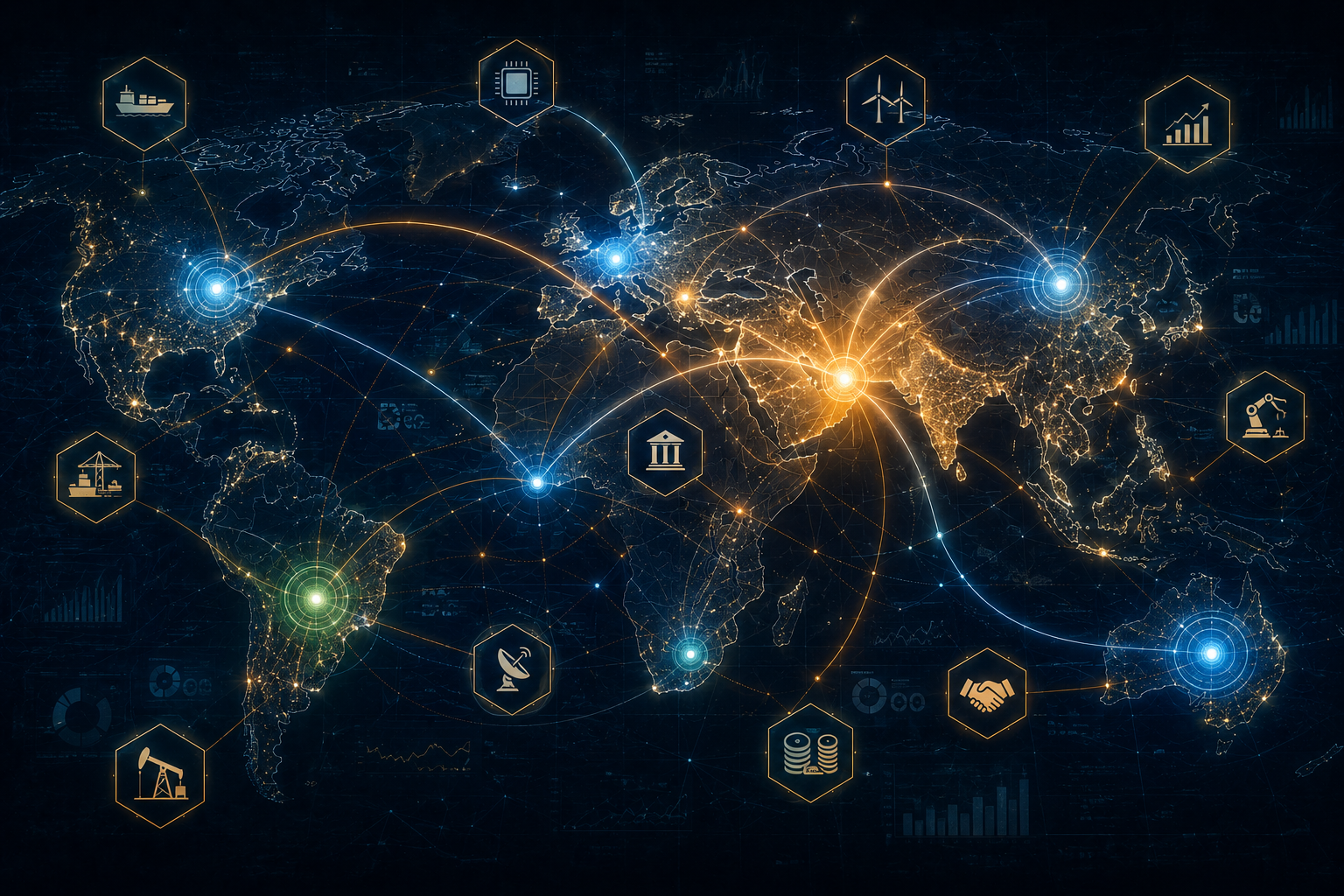
- The role of these nations shows that the nature of geopolitics in the global world has changed dramatically – now it can be argued that middle powers are not just secondary actors who react to the actions of superpowers.
- A new geopolitical reality of multi-alignment emerges, signifying a more complex multipolar world of economic interdependence.
- Strategic hedging is where states concurrently develop cooperative ties with rival powers, and they try to avoid overdependence on a single actor.
- Powers like India, Saudi Arabia, Türkiye, and Indonesia are not passive players acting within frameworks established solely by major powers but active participants in defining modern geopolitics through selective engagements and strategic balancing.
The increasing competition between the US and China has been seen by many experts as one of the central features of modern geopolitics and a possible sign that the world might see the establishment of a new bipolarity soon. However, despite some similarities to the Cold War period, today’s situation is characterised by a lack of blocs and the development of flexible relations. Many countries prefer to use the approach of strategic flexibility, diversification, and selective alignment to be able to increase their influence and protect themselves. For example, India, Saudi Arabia, Türkiye, Indonesia, and Brazil actively interact with multiple rival powers and are not forced to align their policies with one side. The increasing role of these nations shows that the nature of geopolitics in the global world has changed dramatically – now it can be argued that middle powers are not just secondary actors who react to the actions of superpowers; they play a crucial role in shaping the future of global politics.
The appearance of geoeconomics has only increased the significance of middle powers. Due to the fact that modern geopolitical competition is waged through trade, infrastructure, technology, finance, and energy cooperation, the position of those nations which occupy vital geopolitical positions and are at the centre of the economy has greatly strengthened. In such conditions, many countries prefer to remain neutral, opting instead to interact with adversaries in various ways in order to maintain their bargaining leverage. Consequently, a new geopolitical reality of multi-alignment emerges, signifying a more complex multipolar world of economic interdependence.
The Rise of Strategic Hedging
The modern-day international system has come to be strongly characterised by “strategic hedging” in middle power diplomacy. In contrast to the Cold War’s inflexible alliance systems in which states were frequently forced to fall decisively into line with either the American or Soviet bloc, states in today’s century can enjoy a much greater degree of flexibility in their external engagements. Strategic hedging is where states concurrently develop cooperative ties with rival powers, and they try to avoid overdependence on a single actor. Instead of siding with competing blocs, states look to hedge across economic ties, security arrangements and diplomatic relations in a bid to maintain strategic autonomy and pursue national interest. In a more uncertain and fragmented world, hedging has apparently become a pragmatic response to the mounting great-power competition.
The ascendancy of geoeconomics has also meant that the logic of strategic hedging has been reaffirmed. As trade, investment, technology, energy networks and infrastructure projects become means of geopolitical influence, middle powers have found new ways to leverage their geographical and economic importance. States take in more revenue from countries that sit at the centre of global supply chains, maritime routes, energy markets and regional connectivity initiatives, which are increasingly able to cash in on a handful of competing great powers. This has allowed countries such as India, Saudi Arabia, Türkiye, and Indonesia to expand their economic ties with China while also keeping strategic partnerships with the United States and other Western powers. Here again, hedging is not simply a defensive strategy that seeks to avoid risk but an active statecraft directed at enhancing bargaining power within an emergent multipolar system.
India is arguably the best example of strategic hedging in current world politics. It has expanded security ties with the United States through mechanisms such as the Quad even as it has sought to maintain its traditional defence and energy links with Russia, especially in the wake of the Russia–Ukraine conflagration. In a similar vein, India still goes to bodies like BRICS and the Shanghai Cooperation Organisation while growing its economic and technological engagements with the West and Gulf economies. This dispersion of contacts is emblematic of a broader evolution in Indian foreign policy from traditional non- alignment to a new and more flexible form of ‘multi-alignment’ that seeks to develop strategic partnerships, though selectively, in different domains. India’s approach is illustrative of how middle powers are increasingly managing direct geopolitical contestation not by ideological allegiance, but through tailored, issue-specific engagements designed to maximise strategic flexibility.
Geoeconomics and the Expanding Leverage of Middle Powers
The growing importance of middle powers within the international system is closely linked to the rise of geoeconomics as a central instrument of statecraft. In contrast to earlier periods where military capabilities primarily determined global influence, contemporary geopolitical competition increasingly unfolds through trade networks, technological ecosystems, energy dependencies, infrastructure investment, and financial systems. Edward Luttwak famously described this transition as the shift from geopolitics to “geo-economics,” where the logic of conflict is pursued through the grammar of commerce. In this evolving environment, states occupying strategically significant economic or geographic positions have acquired new forms of leverage within the global order. As great powers compete for market access, supply chain resilience, connectivity corridors, and technological dominance, middle powers are increasingly able to negotiate, balance, and extract benefits from multiple competing actors simultaneously.
Economic interdependence has bolstered the strategic importance of these states. Among the nodes in global energy markets, trade corridors, global manufacturing, and investment networks, India, Saudi Arabia, Türkiye, Indonesia and the United Arab Emirates have grown in importance. They are important not simply because of their military power, but because, as nodes, they link rival geopolitical and economic systems. India’s involvement in both the Quad and BRICS, Saudi Arabia’s growing ties with both Washington and Beijing, and Indonesia’s resource diplomacy in the global EV supply chain are just a few examples of how middle powers are using geoeconomic weight to boost their strategic autonomy. As such, the new international order is increasingly being shaped not only by great-power rivalry but also by the ability of middle powers to navigate and shape competing global interdependence networks.
India and the Politics of Multi-Alignment
India stands out among the most prominent cases of middle powers responding to the changing realities of the global geoeconomy through practices of multi-alignment. Once known for its commitment to the principles of non-alignment in the context of the Cold War, India has slowly but steadily developed into a state whose foreign policy is focused on maintaining an interest-based strategy of involvement with several centres of influence at the same time. By diversifying its relations in the spheres of security, trade, science and technology, and energy resources, India has managed to maintain strategic partnerships both with the United States, in the context of the Quad alliance, and other states, including Russia in the defense sector, countries of the Gulf Cooperation Council in terms of economy, as well as membership in organizations such as BRICS and SCO.
The conflict between Russia and Ukraine brought into prominence India’s strategic multi-alignment. While coming under immense pressure from the West, India still proceeded with the purchase of cheap Russian oil and enhanced its strategic relations with the U.S. and Europe in the spheres of semiconductors, technology, and Indo-Pacific region security issues. Moreover, India’s participation in ventures such as the India-Middle East-Europe Economic Corridor (IMEC) demonstrates its growing interest in becoming a part of the core of the connectivity system. In turn, the present-day Indian foreign policy is evidence of the realisation of the fact that contemporary power is defined not only by military potential, but also by proficiency in functioning within different competing systems.
The Emerging Multipolar Order
The approach taken by the middle powers, in aggregate, suggests an increasing fragmentation and flexibility in the international system. While both the bipolar system during the Cold War and the unipolar system that came after it are characterised by the prevalence of fixed alliances, the present-day international system is defined by multiple partnership relationships, ad hoc issue-based coalitions, and geoeconomic rivalry. States no longer interact with their great power counterparts only within the confines of alliances; they now do so selectively in sectors based on national interests. The rise of middle powers indicates that not only is military might crucial in the international system, but also strategic flexibility, especially when it comes to manoeuvring through the global economy.
Conclusion
The emergence of strategic hedging and multi-alignment is indicative of a larger shift in the very character of international politics. With geoeconomics becoming a key component in the dynamics of global rivalry, middle powers are gaining more agency in the changing international order by exploiting their economic importance, geographic location, and political manoeuvrability. Powers like India, Saudi Arabia, Türkiye, and Indonesia are not passive players acting within frameworks established solely by major powers but active participants in defining modern geopolitics through selective engagements and strategic balancing. The international order that will emerge in the future will definitely not be limited by bipolarity alone.
References:
- Acharya, A. (2017). After liberal hegemony: The advent of a multiplex world order. Ethics & International Affairs, 31(3), 271–285.
- Blackwill, R. D., & Harris, J. M. (2016). War by other means: Geoeconomics and statecraft. Harvard University Press.
- Goh, E. (2007). Great powers and hierarchical order in Southeast Asia: Analysing regional security strategies. International Security, 32(3), 113–157.
- Kuik, C. C. (2008). The essence of hedging: Malaysia and Singapore’s response to a rising China. Contemporary Southeast Asia, 30(2), 159–185.

Archita Gaur is a postgraduate student at the School of International Studies, JNU. She specialises in the World Economy and has a strong interest in public policy, economic research, and governance. The views expressed are the author’s own.
 Anjali Singh
  Divyanka Tandon