
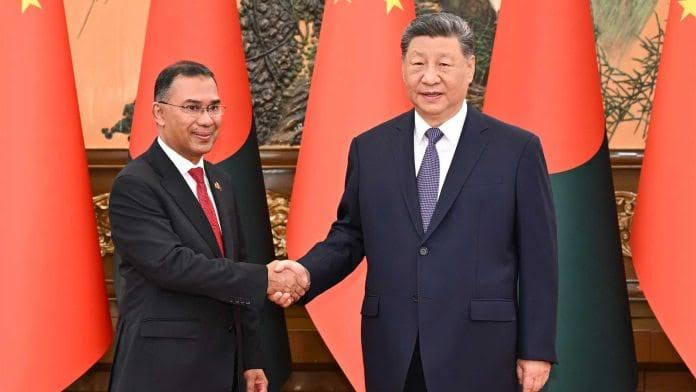
- Bangladeshi Prime Minister Tarique Rahman’s first official visit to China is a turning point in the geopolitics of South Asia, reflecting a revision in Bangladesh’s foreign policy approach and posing serious implications for India.
- The involvement of Bangladesh with China through the balance of power theory may be viewed as the attempt of the country to align itself with one of the balancing powers.
- According to this theory, the neighbour of a country tends to be an opponent, while the neighbour’s neighbour might be a partner.
- The visit to China by Tarique Rahman reveals a strategic move by Bangladesh in balancing different competing regional powers.
Bangladeshi Prime Minister Tarique Rahman’s first official visit to China is a turning point in the geopolitics of South Asia, reflecting a revision in Bangladesh’s foreign policy approach and posing serious implications for India. The visit, along with the signing of 13 MoUs, reflects growing cooperation between China and Bangladesh in terms of defence, business, connectivity, and infrastructure development. In international politics, this new alignment of interests can be explained using the concepts of the Balance of Power Theory and the Mandala theory of Kautilya.
Strategic Re-Alignment in South Asia
By making China the destination of choice for his first foreign tour after assuming office, while deliberately skipping India from his itinerary in the first instance, Rahman has made a clear statement regarding a realignment of Bangladeshi foreign policy vis-à-vis that of India. This is because Bangladesh has traditionally had close links with India in the past, owing to historical, cultural, and economic factors.
The increasing association of Bangladesh with China in order to have a diversified range of strategic choices is reflected through the defence arrangements being made between the two countries regarding the procurement of fighter aircraft of the J-10CE type, as well as various agreements involving river management (Teesta River). The influence of China continues to grow in the region of the Bay of Bengal through investments made in various projects, including those related to the development of infrastructure at Mongla port and Chattogram.
The involvement of Bangladesh with China through the balance of power theory may be viewed as the attempt of the country to align itself with one of the balancing powers and thus reduce its dependence on India through the involvement of another state. It is typical for small states to choose such a strategy historically.
From the theoretical framework of the Balance of Power theory, the diplomatic relations of Bangladesh with China may be seen as a way of reducing the dependency of Bangladesh on one big country (India) through forming alliances with other power-balancing countries (China). This kind of strategy will often be used by small countries in order to gain more autonomy in that region.
Through its engagement with China, Bangladesh is able to obtain benefits from Chinese investments, military technologies and infrastructure projects. In addition, by demonstrating that there are alternative partners available, it increases its leverage in negotiating bilateral issues with India, such as water-sharing, trade imbalance, and migration.
There is a risk, however, to the aforementioned balance. With China becoming more influential in South Asia, particularly through the BRI initiative, there have been multiple fears related to debt dependence and vulnerabilities. As far as India is concerned, China-Bangladesh cooperation adds one more variable to the country’s regional security equation.
Kautilya’s Mandala Theory: The Neighbour’s Neighbour as a Partner
One can also apply the ancient Mandala theory developed by Kautilya. According to this theory, the neighbour of a country tends to be an opponent, while the neighbour’s neighbour might be a partner. Within the discussed framework, the cooperation of Bangladesh with China, India’s primary geopolitical rival, is a perfect example of the Mandala theory.
Such proactive diplomacy on the part of China in Bangladesh through engagement at a party level and strategic dialogue is an indication of China’s long game in gaining influence in the neighbourhood of India.
Bangladesh stands to gain from such a diplomatic relationship economically as well as militarily. But for China, this is a move that helps the country gain prominence in the region and also counter Indian influence. However, for India, this relationship between the two countries is one of concern because of the possibility of encirclement and weakening of India’s traditional sphere of influence.
Implications for India’s Strategic Calculus
India is facing the situation of reacting to the changing dynamics of the region now. The strengthening relationship between China and Bangladesh through maritime cooperation and development of infrastructure projects in the proximity of India’s eastern border has some implications in strategic terms.
In addition, the reinforcement of the One China policy and military cooperation between Bangladesh and China signify an alignment that might not necessarily coincide with the interests of India.
In order to compensate for this tilt in favour of Bangladesh, India would have to pursue a more active and realistic policy. This involves increasing economic cooperation between both countries, resolving pending bilateral disputes like the Teesta River controversy and fostering people-to-people connections. As stated by Kautilya, forming strong relations with adjacent states entails constant engagement and mutual advantage.
Conclusion
The visit to China by Tarique Rahman reveals a strategic move by Bangladesh in balancing different competing regional powers. This is the clear lesson for India: history by itself will not be enough in the coming days. For India to continue playing its role as a significant partner to its neighbours in the changing world, it needs to rethink its regional policy. What is happening in terms of China and Bangladesh’s evolving relationship is far more than that.

Anjali Singh is a postgraduate student of Political Science and International Relations, a Social Media Analyst, and a former Research Intern at the Indian Council of World Affairs. Views expressed are the author’s own.
 Kumar Satish