

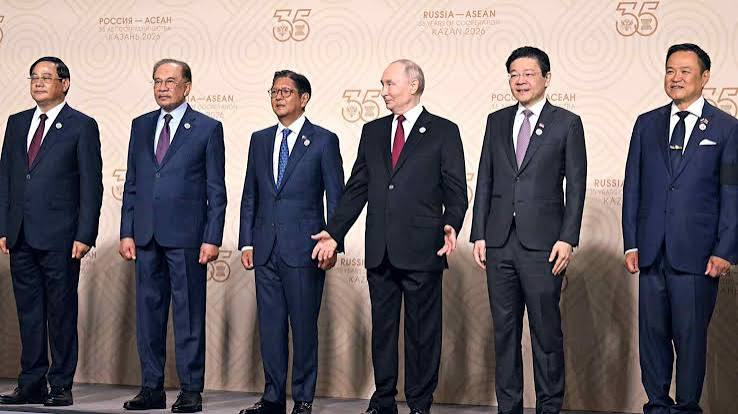
- The gathering comes at a time when Russia has been increasingly focused on strengthening its engagement with the Global South, particularly in the years following the conflict in Ukraine.
- Russia has emerged as an active partner in Southeast Asia, particularly in the energy sector.
- Today, however, Russia—the largest successor state of the Soviet Union—is actively pursuing closer ties with the very region that once viewed Moscow with caution.”
- Many of these countries are pursuing diversified foreign policies and seek to maintain productive relations with multiple major powers.
Russia Deepens Outreach to Southeast Asia
Russia is hosting an important meeting with leaders of the 10-member Association of Southeast Asian Nations (ASEAN) as both sides mark 35 years of Russia–ASEAN relations. The summit, scheduled in the city of Kazan, is expected to witness the participation of leaders from across the regional bloc.
The gathering comes at a time when Russia has been increasingly focused on strengthening its engagement with the Global South, particularly in the years following the conflict in Ukraine. During the two-day meeting, Russia and ASEAN leaders agreed to expand bilateral cooperation, deepen economic engagement, and diversify areas of partnership.
Energy and Economic Cooperation at the Core
Russia has emerged as an active partner in Southeast Asia, particularly in the energy sector. Several countries in the region rely on Russian energy exports, while cooperation in nuclear energy has also gained momentum. Recently, Vietnam permitted Rosatom to contribute to the development of its nuclear infrastructure.
Moscow sees significant economic opportunities in Southeast Asia. The region’s growing economies, expanding consumer markets, and industrial capabilities offer prospects for greater trade and investment. Russia believes that stronger commercial ties can create long-term benefits for both sides while reducing dependence on traditional economic partners.
From Cold War Rivalry to Strategic Partnership
One of the more interesting aspects of this relationship is its historical evolution. ASEAN was originally established during the Cold War period, partly out of concerns among Southeast Asian nations regarding the influence and expansion of the Soviet Union. By working collectively, member states hoped to preserve regional stability and safeguard their interests.
Today, however, Russia—the largest successor state of the Soviet Union—is actively pursuing closer ties with the very region that once viewed Moscow with caution. This transformation highlights the changing geopolitical realities of the 21st century and the growing importance of pragmatic diplomacy.
The Geopolitical Dimension
Russia’s growing engagement with Southeast Asia is also driven by strategic considerations. The Asia-Pacific has become one of the most important centres of global politics and economic activity. By strengthening its presence in the region, Russia hopes to expand its influence in an area that is increasingly shaping international affairs.
The timing is particularly noteworthy as the United States continues to enhance its presence in Southeast Asia through closer cooperation with countries such as the Philippines and Singapore. Russia, meanwhile, is seeking to benefit from its close relationship with China and the influence Beijing maintains across parts of the region.
Several mainland Southeast Asian nations, including Vietnam, Cambodia, and Laos, share close political and economic links with China. Russia appears keen to leverage these regional dynamics as part of its broader Asia-Pacific strategy. There also appears to be a convergence of interests between Moscow and Beijing in expanding their influence in the region while balancing the presence of the United States and its allies.
For ASEAN member states, closer engagement with Russia serves a different purpose. Many of these countries are pursuing diversified foreign policies and seek to maintain productive relations with multiple major powers. In that context, stronger ties with Russia offer another avenue through which Southeast Asian nations can broaden their diplomatic and economic options while preserving strategic autonomy.

Kumar Satish is a postgraduate in International Relations with a keen interest in reading and writing on geopolitical affairs.
 Anjali Singh