- Many member states genuinely feel that the UN Charter does not reflect the realities of the 21st-century world.
- It has been clear that the veto instrument was not inserted into the UN Charter ‘in a fit of absent-mindedness’.
- That would inevitably open the door to the third category – permanent UNSC membership without a veto.
- A repurposed UNTC, with a new mandate for the environment and the global commons, would serve as the principal instrumentality for the said trusteeship of the planet.
Introduction
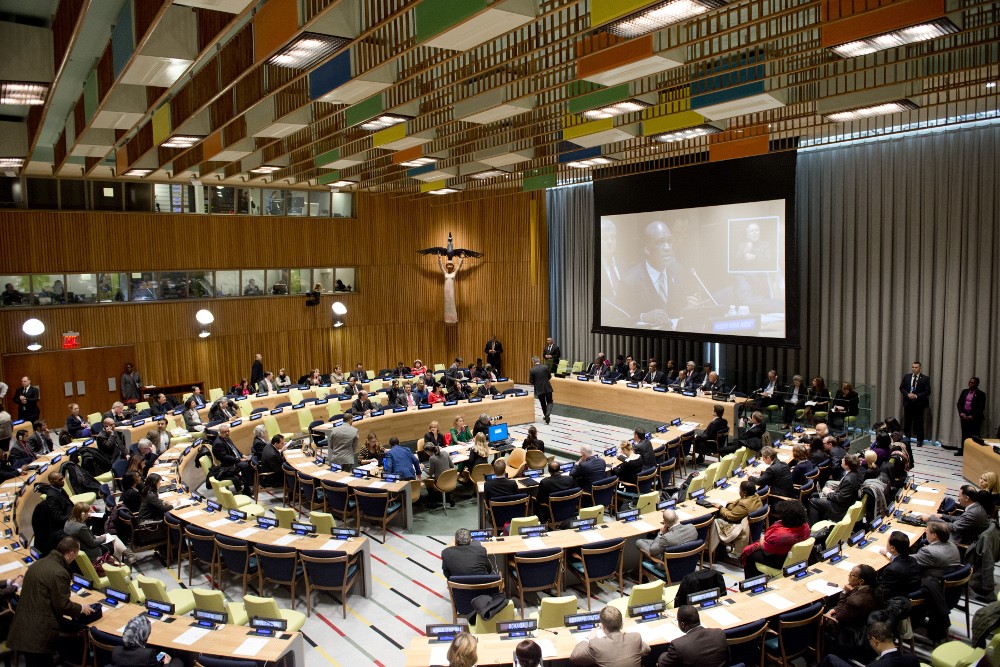
The United Nations General Assembly [UNGA] mandated [Decision 62/557; Sep 15, 2008] Inter-Governmental Negotiations (IGN) to provide the Co-Chair’s revised elements paper “on the question of equitable representation on and increase in the membership of the Security Council”. This report of the Co-Chair [June 10, 2026] encapsulates their assessment of the current state of discussions across the five key clusters and their interlinkages. The final meeting of the IGN for the 80th session took place on June 15-16, 2026 in the proverbial UN Trusteeship Council [UNTC] Chamber.
The issue of the Security Council (SC) reform and expansion within the larger quest for comprehensive UN reforms has been recognised by the UN member states. At the annual UN General Assembly high-level segments, calls have been made ritually by the heads of government on the premise that “We cannot fight today’s challenges with outdated structures” (here). There is a growing recognition among Member States that the UN’s enforcement organ needs to be made to work to resolve contemporary global challenges. The 9th UNSG Antonio Guterres has been most vocal [May 20, 2026] in calling for this “most important reform”. The matter has attained heightened understanding upon the UN Charter reaching the 81-year milestone [June 26, 2026] and the election process for the 10th UNSG actively underway after the UNSC scheduling consideration of the candidates [July 24-30, 2026]. This article seeks to examine the IGN’s “elements paper” in the context of the quest for making the UN “fit for purpose” after 80 years [Oct. 24, 2025] to meet expectations of the members for a representative UNSC, making it work in the “UN-centred International System” [Open Debate: June 26, 2026] at a time of perplexity, prospects for enhancing permanent membership and how to overcome the riddle of ‘veto’.
Iniquitous Veto: UN Charter’s ‘Soft Belly’
The UN Charter’s opening dedicatory preambular line has been emphatic: “to save the succeeding generations from the scourge of war.” At the closure of 1945 UNCIO at San Francisco [June 26, 1945], the US President Harry Truman prophesied that “If we had had this Charter a few years ago- and above all, the will to use it–millions now dead would be alive. If we should falter in the future in our will to use it, millions now living will surely die”. Yet the workability of the UNSC, as the ‘enforcement’ organ, has been shadowed over the years by requirement of “concurrence” of the five permanent members [China, France, USSR, UK and USA]. In fact, the UN Charter carried the legacy of the “agreement of all the Members” [unanimity principle; Article 5] of the Council of the League of Nations by limiting decisions in substantive matters to the “concurring votes of the permanent members” [Article 27]. Popularly known as ‘veto’, the need for P5 consent has proved most contentious. Even many of the original fifty founding UN members had expressed reservations at the outset on [iniquitously] making the P5 countries more equal than the others [Article 23]. However, what was a fait accompli [take it or leave it] at UNCIO in San Francisco has continued even after the expansion of the non-permanent membership from 11 to 15 [Dec. 17, 1963]. Since then, especially after the decolonisation [UNGA reso. 1514 (XV) of Dec. 14, 1960], the world has been greatly transformed, including the near-universal (193) UN membership. The UN has been a human construct and not designed as a perfect solution to attain the cherished utopia of “outlawry of war”, as hammered by the International Law teachers. In the words of the feisty second UNSG Dag Hammarskjöld, the “United Nations was not created to bring us to heaven, but to save us from hell” [May 13, 1954].
It has been clear that the instrument of veto was not inserted in the UN Charter “in a fit of absent- mindedness”. As Inis Claude, Jr. underscored in 1961, it was a “deliberate decision to render the Security Council incapable of undertaking enforcement action against, or against the will of, any of the Big Five.” On numerous occasions, the P5 proved this prophecy correct as their invocation of veto rendered the UNSC ineffective from taking action in spite of a wide gamut of competence available under Chapter VI or VII comprising pacific means of “dialogue & diplomacy” to settle disputes since the “future lies not in war”, restraining the warring nations for “humanizing warfare” and banishing the “scourge of genocide”, bringing about ceasefires agreements and providing the mandate for the “UN peacekeeping” in many of the global conflicts that ravage some two billion people in the world.
UNSC Expansion: Ideas to Rein in Veto
The UNGA adopted the historic resolution 76/262 [26 April 26, 2022] to rein in the veto-wielding P5 countries. This provided a “standing mandate” for the UNGA debate “when a veto is cast in the Security Council”. It was a logical UNGA action [Articles 10-15], especially after the UNSC inaction following Russia’s ‘special military operation’ in Ukraine [February 24, 2022]. Yet, even after the said UNGA resolution, P5 have used vetoes at their free will. The UN data shows that since the UN’s inception [Feb 16, 1946 to April 07, 2026] vetoes have been widely used by the P5 countries [329 vetoes till April 23, 2024]. Interestingly, no veto was used by P5 during 14 out of these 81 years. A study of this ‘no-veto’ use gap could provide a clue to rein in veto. It requires innovative approaches for “blunting the edges of veto” or even allowing “rotating use of veto” on a regional basis [author’s Heidelberg University talk; Nov. 18, 2025], akin to the idea of sharing of the French nuclear umbrella. The US President JoeBiden’s UNGA address [September 21, 2022] also provided a clue wherein he suggested that the P5 need to “refrain from the use of the veto, except in rare, extraordinary situations, to ensure that the Council remains credible and effective.” Going into ways and means of “blunting the edges of veto” and “rotating use of veto” are beyond scope of this blog.
In view of the fact that the IGN on UNSC reform has been at work, the Assembly’s “standing mandate” [resolution 76/262] provides a robust way out in the interregnum, to rid opacity in the veto use, without prejudice to IGN process by: (i) convening a formal meeting of the UNGA within 10 working days of the casting of a veto by one or more UNSC P5 countries, to hold a debate on the situation as to which veto was cast; (ii) according precedence in the list of speakers to the UNSC permanent members that have cast a veto; (iii) inviting the UNSC to submit a special report on the use of veto in question to the UNGA at least 72 hours before the relevant Assembly discussion. This extraordinary step by the UNGA may help in rendering the veto use less attractive for the future UNSC expansion. That would inevitably open the doors for the third category – permanent UNSC membership without veto.
Notwithstanding the veto-wielding countries’ bottom line in the IGN process that veto is non-negotiable, every major power seeking a permanent UNSC seat cherishes the elusive ‘veto’. In the wake of the previous report of the IGC Co-Chairs [PGA: June 05, 2023], G4 countries [Brazil, Germany, India, Japan] rebuffed [here] the model presented by United for Consensus group [Argentina, Canada, Colombia, Costa Rica, Italy, Malta, Mexico, Pakistan, the Republic of Korea, San Marino, Spain, and Türkiye (with China and Indonesia as Observers) that opposes any creation of new permanent members. Various proposals by different groups before the IGN include an expansion of the UNSC from 15 to 26 members, with an apportionment in both permanent and non-permanent elected categories still a matter of divergence. As of now, however, the crucial question of ‘veto’ is not on the radar. In view of the significance and sensitivity of the issue of UNSC expansion, parleys have been taking place both in an open format (recorded) as well as in an informal and interactive closed-door format. There have been expectations for some tangible progress on the UN reforms in general and the expansion of the UNSC membership (especially the five clusters of reform).
UNGA: Conductor of a Grand Orchestra
As the plenary organ of the UN, the General Assembly has been instrumental, literally as a “conductor of a grand orchestra” [Author: IIEL Brill Nijhoff 2004, p.144], in setting in motion International Law-making and institution-building processes [through the ILC as its subsidiary organ, global conferences or other intergovernmental processes]. Hence, the UNGA decided at the 62nd Session (Sep 15, 2008), to roll out the IGN process in an ‘informal plenary’ starting with the 63rd (2009) Session. As a sequel to his April 28, 2023 letter, the UNGA President enlisted ‘elements’ in a June 05, 2023 letter to all the PR and Observers concerning “convergences and divergences” on its mandate [UNGA Decision 62/557/2008]. The UNGA has followed up on each meeting of the IGN process and sought to nudge the member states through a series of steps. The US President Joe Biden’s address [Sep. 21, 2022] at the 77th UNGA, as well as the UNGA resolution 76 (262) provide vital clues for overcoming the riddle of the veto.
Now there is growing demand for text-based negotiations for the expansion of the UNSC in both permanent and non-permanent categories. Will the P5 allow the future inductees the privilege of wielding a veto? In all probability, and as indicated by the Co-Chairs at the IGN [April 05, 2024], the question of abolishing or sharing this privilege with new members remains non-negotiable for P5. In this respect, the contours of the IGN negotiations comprise some key issues: categories of membership; the question of the veto, regional representation, size of an enlarged Security Council and working methods of the Council; and the relationship between the Council and the General Assembly. Hence, the prospective bidders for a UNSC permanent seat shall have to take a realistic position. The “standing mandate” UNGA resolution considered the UNGA decision 62/557 [September 15, 2008] that triggered the process “to commence intergovernmental negotiations in informal plenary of the General Assembly”. Other relevant resolutions in this respect include 48/26 of December 3, 1993, 53/30 of November 23, 1998 and 61/561 of September 17, 2007 (equitable representation on and an increase in the membership of the Security Council and related matters).
It is feared that the UNSC expansion would open up a Pandora’s box since different parts of the Charter [UNGA, ECOSOC, UNSC, UNTC and the ICJ] would also need to be reviewed, especially on the issue of representation due to multi-fold growth in the UN membership [from the original 50 to 193]. Many member states genuinely feel that the UN Charter does not reflect the realities of the 21st-century world. In a futuristic scenario, if consensus emerges at the IGN parleys in the near future, it will necessitate an amendment of the Charter under Article 108. It would require approval by two-thirds of the UNGA members as well as concurrence of P5 of the UNSC. As an alternative, a review conference under Article 109 can be convened by a two-thirds vote in the UNGA and a vote of any nine UNSC members. Notwithstanding this, any alteration of the Charter proposed at such a review conference would still need the P5 consent.
Repurpose of the UN Trusteeship Council
As indicated above, if the UNSC expansion comes up on the UN reform agenda, can the revival and “repurposing of the UN Trusteeship Council” [here, here, here] be far behind? The UNTC has been lying dormant since November 10, 1994. The time seems to have finally come for the UNTC to “arise, awake and listen to the boons” (उत्तिष्ठत जाग्रत प्राप्य वरान्निबोधत – Katha Upanishad, 1.3.14 chapter) after a hiatus of 28 years. The UNSG 2021 report [Our Common Agenda, p.77] has provided a fresh impetus to this author’s long-standing scholarly idea (2022; 2021; 2014; 2000) for revival and repurposing of the UNTC. This author’s idea has been the only concrete scholarly proposal on the global table for revival and repurposing of the UNTC with a new mandate for the global environment and the commons. It was originally presented on January 15, 1999 at Legal Department of the World Bank in Washington DC [Indian Jr. of International Law vol. 40 (3) 2000, pp.456-504] and contained in contained in the author’s book International Environmental Governance (Boston: Martinus Nijhoff, 2014), released at the UN General Assembly Building (UNHQ, New York; December 12, 2014). It has been published in a revised form in the global journal: Environmental Policy and Law 52 (2022) 223-235 as well as now forms part of the book curated by the author on Envisioning Our Environmental Future: Stockholm+50 and Beyond (IOS Press: Amsterdam, 2022). As suggested in this author’s original 1999 proposal, the new mandate for the UNTC could be repurposed as follows:
| Article 87: The General Assembly and, under its authority, the Trusteeship Council, in carrying out their functions, may: a. examine progress in reversing global environmental deterioration in consultation with the UN Environment or (its future upgrade into a UN specialised agency) United Nations Environment Protection Organisation (UNEPO; or known by any other nomenclature); b. consider reports submitted by the UN Environment or UNEPO as well as relevant multilateral environmental agreements (preferably climate change, biological diversity, desertification, which have universal membership and were crystallised through the UNGA-mandated law-making processes) duly sanctioned by their respective Conferences of the Parties based on relationship agreements with the Trusteeship Council; c. review the status of each of the designated global commons, keeping in view the overall interest of all the inhabitants of the planet Earth, in consultation with the decision-making organs of their respective regulatory regimes through relationship agreements and provide a mandate for further law-making processes as deemed most appropriate; d. adopt appropriate decisions and other actions, as deemed proper, from time to time, consistent with the respective international agreements, arrangements and mechanisms. |
| Article 88: The Trusteeship Council shall prepare the form and modalities for submission of periodic reports by each of the regulatory regimes of multilateral environment agreements as well as the global commons areas placed under its supervision. The decision-making organs of the respective regimes shall provide an annual report to the Trusteeship Council and, through it, to the General Assembly. |
The UNSG Guterres also called for the UNTC to be repurposed in his 2021 report [Our Common Agenda, p.77]. The repurposing of the UNTC would provide an institutional wherewithal to the UN for the future, a low-hanging fruit – at no cost. This UNTC idea holds salience for the “planetary future”[here, here, here] along with the pragmatic expansion of the UNSC membership [here, here].
In this context, the call given by the Indian Prime Minister Narendra Modi [September 2020], in an address at the UNGA’s 75th anniversary virtual meet, has been relevant for the comprehensive UN reforms since “we cannot fight today’s challenges with outdated structures”. In a similar vein, an explicit reference made by Prime Minister Modi for “trusteeship of the planet” in an address to the G-20 Riyadh virtual summit [November 2020] provides the future pathway. This provides a potent, concrete Indian idea for UN reforms as a “global solution provider” [SIS Blog: June 2024]. As a logical corollary, a repurposed UNTC, with a new mandate for the environment and the global commons, would serve as the principal instrumentality for the said trusteeship of the planet. Who shall get the credit (यश) for donning the mantle for this futuristic change of the UNTC, whose time has come? The answer lies in the womb of Time.
Road Ahead: Need for Sanity and Wisdom
Since all member states including the sceptics agree that the UN is “irreplaceable” [UNSG: June 26, 2026], an all-out effort would be desirable at the IGN process to accommodate convergences and divergences to widen room for efficacy of the UNSC and, in turn, making the UN “fit for purpose” for resolving the global problematique at least in the remaining three-quarters of the 21st century.
To fathom the mystery of “how nations behave”, as Louis Henkin prophesied decades ago, it will be prudent to tame the minds, through diplomatic patience, sanity and wisdom, of the humans who run the affairs of nations. As the 9th UNSG prepares to leave at a time when the UN is at a “crossroads” [Samvada World: Jan. 01, 2026; October 22, 2025], on the verge of “bankruptcy” [here] with its “stability at risk” [here], the role of his successor, possibly a Madam Secretary-General, upon assumption of the most difficult job in the world on January 01, 2027, would be most crucial to literally carry the organization on her/his shoulders.
As regards infatuation with the ‘permanency’, once realization downs that there is nothing permanent in this impermanent world, the penchant for a UNSC ‘permanent seat’ and quest for garnering the elusive ‘veto’ as a status symbol would possibly wither away. This implausible-sounding scholarly audacity of hope is akin to the ‘lighting of a lamp’ in these trying times to provide us vital keys for making the UNSC [and the UN] work on the bedrock of taking International Law seriously [here, here] for “We the Peoples” in whose name the UN Charter was solemnly adopted 81 years ago.
Humboldt Awardee Professor, Institute of International Law, University of Bonn; Visiting Professor, Faculty of Law, University of Cologne, Germany; formerly Chairperson and Professor of International Law at Jawaharlal Nehru University, India. Email: bharat.intlaw@gmail.com
 Anjali Singh
  Archita Gaur