- The central question is no longer who won the war militarily — Iran’s losses were severe — but what kind of Iran, and what kind of Middle East, emerges from the wreckage.
- The broader regional picture is one of diffusion rather than collapse. Israel and the United States have demonstrated unmatched military reach, including air dominance that allowed Israeli jets to down Iranian aircraft over Tehran itself.
- Going forward, Gulf capitals face a delicate balancing act. They need American security guarantees more than ever, given Iran’s demonstrated willingness to strike them directly, but they are also wary of being pulled into future US-Israeli operations against Iran without consultation.
- India’s stakes in this conflict are substantial and multidimensional. As one of the world’s largest oil importers, with a significant share of crude historically sourced from the Gulf and transiting Hormuz, India was directly exposed to the fuel-price volatility and shipping disruption the war generated.
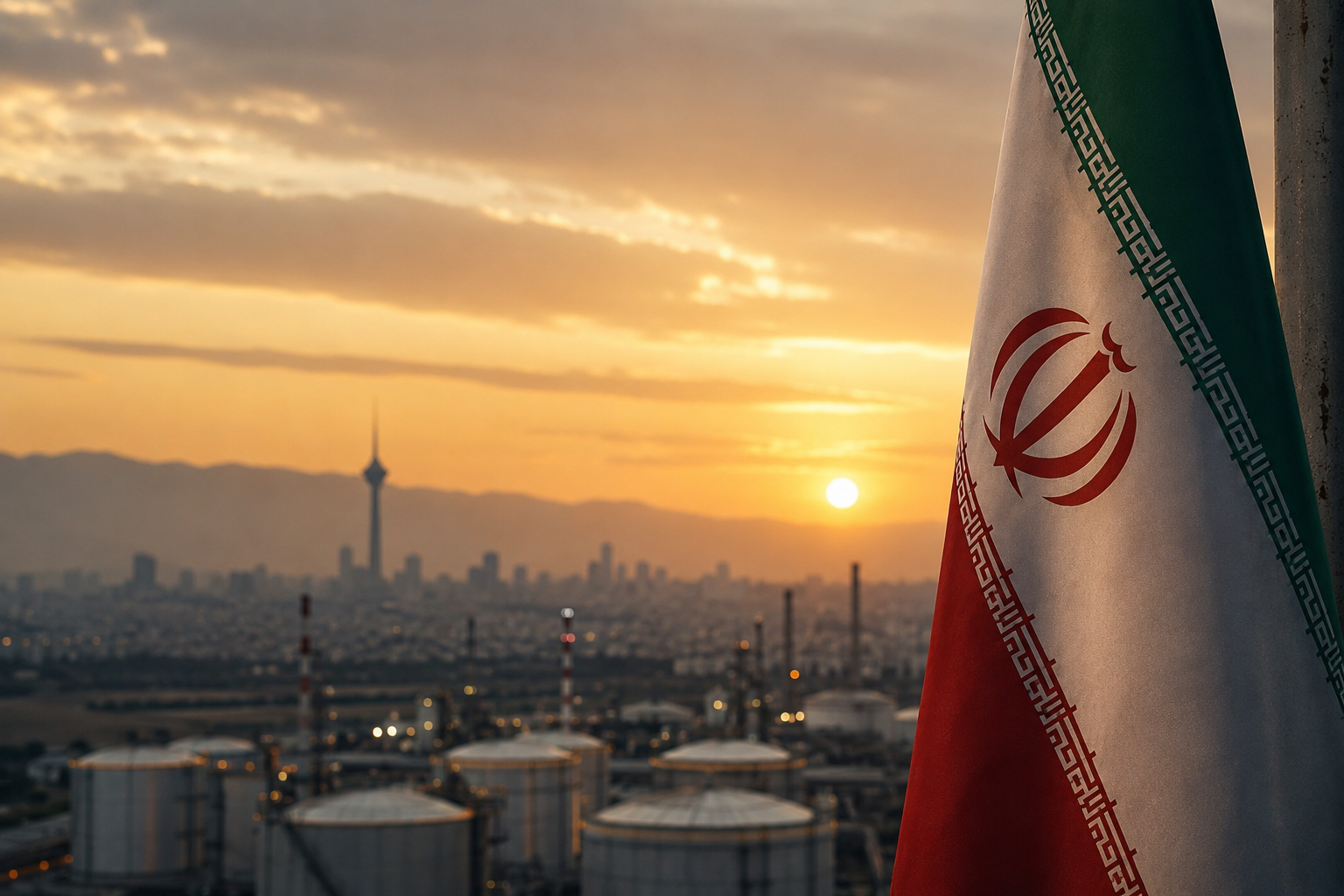
The 2026 Iran war has reshaped the Middle East in ways few predicted even a year ago. What began as a surprise US-Israeli strike on February 28, 2026 — one that killed Supreme Leader Ali Khamenei and decapitated Iran’s senior leadership — spiralled into more than three months of missile exchanges, a near-closure of the Strait of Hormuz, and a regional war that drew in Lebanon, the Gulf states, and even stray strikes on Cyprus and Turkey. With a ceasefire holding since April and a formal memorandum of understanding signed by the US and Iranian presidents on June 17, the region is now entering a fragile post-war phase. The central question is no longer who won the war militarily — Iran’s losses were severe — but what kind of Iran, and what kind of Middle East, emerges from the wreckage.
This article looks at four dimensions of that future: the regional balance of power, the position of the Gulf states, the consequences for oil markets and the global economy, and what all of this means for India.
Regional power balance: a more fragmented Middle East
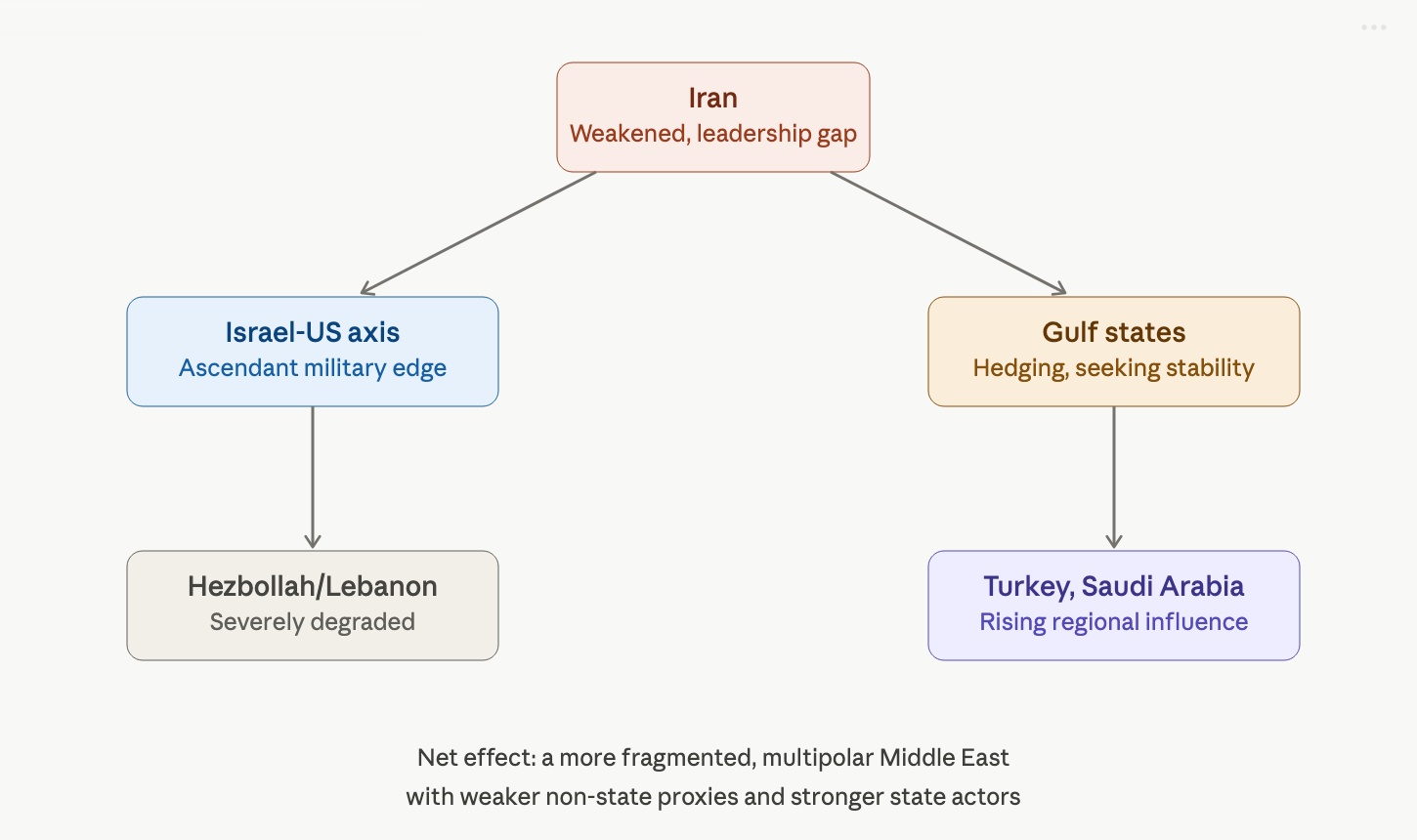
Iran emerges from this war structurally weaker than at any point since the 1980s. The killing of Khamenei left a leadership vacuum at the top of the Islamic Republic, and its most important regional asset — Hezbollah — has been devastated by the parallel 2026 Lebanon war, with more than 2,000 civilians and militants killed in Lebanon and over one-sixth of the country’s population displaced during the conflict. Iran’s missile and drone arsenal, once seen as its primary deterrent, was expended in large quantities during the retaliatory barrages of February and March without producing a decisive shift in the military balance.
At the same time, Iran has not been removed from the chessboard. Tehran retains nuclear infrastructure and enriched uranium stockpiles whose status remains disputed: international inspectors have found no evidence of active weaponisation, but analysts increasingly describe Iran’s posture as “nuclear hedging” — keeping the technical capacity to assemble a weapon on short notice while stopping short of doing so, using the program as leverage in talks over sanctions relief. The fate of that material is now a central unresolved issue in the post-war settlement, with Washington reportedly seeking a coordinated removal of buried nuclear stockpiles once the ceasefire is finalised.
The broader regional picture is one of diffusion rather than collapse. Israel and the United States have demonstrated unmatched military reach, including air dominance that allowed Israeli jets to down Iranian aircraft over Tehran itself. But the war also pulled in unexpected actors — Iranian strikes hit targets in Bahrain, Jordan, Kuwait, Oman, Qatar, Saudi Arabia, the UAE, and Iraqi Kurdistan, while stray missiles reached Turkish and Cypriot territory, prompting NATO to publicly commit to defending Turkey. That breadth of disruption has accelerated a trend already underway before the war: Gulf states, Turkey, and others are hedging their security bets rather than relying on any single patron, and non-state proxies like Hezbollah have lost ground to state actors as the primary power brokers in the region.
Impact on Gulf countries: caught in the crossfire, now recalibrating
The Gulf Arab states found themselves unwilling participants in a war they did not start. Iranian retaliation deliberately targeted US-aligned states and bases — Al Udeid Air Base in Qatar, Aramco’s Ras Tanura refining facility, and airports in Kuwait and Bahrain were all hit, with the UAE, Saudi Arabia, and Kuwait launching their own retaliatory strikes after being drawn into the fighting. For monarchies that had spent the better part of a decade pursuing detente with Tehran — exemplified by the 2023 Saudi-Iran normalisation — the war was a sharp reminder of their geographic vulnerability.
Going forward, Gulf capitals face a delicate balancing act. They need American security guarantees more than ever, given Iran’s demonstrated willingness to strike them directly, but they are also wary of being pulled into future US-Israeli operations against Iran without consultation. Expect continued, quiet diversification: deeper defence cooperation with Washington and increasingly with India and other partners, accelerated investment in indigenous air-defence and missile-interception capability, and a push to insulate energy infrastructure — ports, refineries, desalination plants — from future disruption. Saudi Arabia and the UAE are also likely to use this moment to position themselves as the indispensable stabilisers of a battered region, hosting reconstruction talks and mediating between Washington and Tehran, which strengthens their diplomatic standing even as their physical vulnerability has been exposed.
Oil markets and the global economy: a shock partially absorbed
The war’s most immediate global impact ran through the Strait of Hormuz, the chokepoint through which roughly a fifth of the world’s oil and a significant share of its liquefied natural gas pass. Iranian threats and disruptions to traffic through the strait caused fuel shortages in parts of Asia and rippled effects across the global economy during the height of the fighting, and Iran maintained de facto control over passage through the waterway even after the initial ceasefire, prompting fresh EU sanctions on individuals and entities involved in what Tehran called efforts to assert “sovereignty” over the strait.
Markets initially priced in worst-case scenarios — a sustained closure of Hormuz would have been one of the most severe energy shocks in decades, given the lack of alternative export routes for Gulf crude. In practice, outright closure never materialised for an extended period; instead, the strait saw intermittent disruption, naval brinkmanship, and a slow-motion blockade that Washington described as having been lifted following the June 17 agreement. The result was a prolonged period of elevated volatility rather than a single catastrophic spike — costly for shippers, insurers, and import-dependent economies, but short of the systemic crisis some feared in the war’s opening weeks.
The longer-term economic legacy is likely to be a re-pricing of geopolitical risk into energy markets. Insurance premiums for tankers transiting the Gulf, the cost of rerouting shipping around the Red Sea and Hormuz, and renewed urgency around energy diversification (LNG terminals outside the Gulf, strategic petroleum reserves, faster renewable buildouts) will all persist well after the guns fall silent. Inflation-sensitive economies that import the bulk of their energy — across South and Southeast Asia, Europe, and parts of Africa — absorbed the highest indirect costs, even those, like India, that were never combatants.
Implications for India: exposure, opportunity, and a careful balancing act
India’s stakes in this conflict are substantial and multidimensional. As one of the world’s largest oil importers, with a significant share of crude historically sourced from the Gulf and transiting Hormuz, India was directly exposed to the fuel-price volatility and shipping disruption the war generated. New Delhi’s response during the crisis — diversifying crude sourcing, drawing on strategic reserves, and maintaining studied neutrality rather than siding explicitly with either Israel, Iran, or the Gulf states — reflects a now well-established Indian playbook of strategic autonomy.
Several specific implications stand out. First, energy security: the war has reinforced the logic behind India’s years-long push to diversify crude imports beyond the Gulf, including expanded purchases from Russia, the US, and West Africa, and to accelerate refining and storage capacity that can absorb short-term shocks. Second, the large Indian expatriate population across the Gulf states — among the largest diaspora communities in the world — makes regional stability a direct domestic concern, both for remittance flows and for the safety of citizens who had to be evacuated or sheltered during the worst of the fighting. Third, India’s growing defence and economic partnerships with Gulf states, Israel, and the US all sit on the same chessboard reshaped by this war; New Delhi will likely deepen ties with all three simultaneously rather than choose sides, leveraging its credibility as a non-aligned power to maintain channels with Tehran even as it expands defence cooperation with Israel. Finally, connectivity projects like the India-Middle East-Europe Economic Corridor (IMEC), conceived partly as a counterweight to China’s regional infrastructure footprint, will need to be reassessed for resilience against exactly this kind of regional flashpoint, even as the disruption underscores why India and Gulf partners see value in pursuing alternative trade routes in the first place.
Looking ahead
The June 17 memorandum gives the war a notional end date — a formal settlement within 60 days — but ending hostilities is not the same as restoring stability. Iran’s internal political trajectory, the fate of its nuclear material, the pace of Lebanon’s reconstruction, and whether Gulf states feel secure enough to resume the detente-building of recent years will all shape whether this becomes a genuine inflexion point toward a less volatile Middle East, or merely an interlude before the next escalation. For India and other major energy consumers, the lesson of 2026 is unambiguous: as long as a fifth of the world’s oil passes through a single strait bordering an unresolved conflict, the costs of instability anywhere in the Gulf will be felt everywhere.
References:
- Britannica — “2026 Iran war | Deal, Explained, United States, Israel, Strait of Hormuz, Map, & Conflict”
https://www.britannica.com/event/2026-Iran-war - Wikipedia — “2026 Iran war”
https://en.wikipedia.org/wiki/2026_Iran_war - Al Jazeera — “Iran war updates: Tehran shuts Hormuz, Vance on way to Switzerland” (June 20, 2026)
https://www.aljazeera.com/news/liveblog/2026/6/20/iran-war-live-tehran-says-us-must-ensure-israel-ends-attacks-on-lebanon - Al Jazeera — “Iran war updates: Israel, Hezbollah agree ceasefire, says US official” (June 19, 2026)
https://www.aljazeera.com/news/liveblog/2026/6/19/iran-war-live-jd-vance-defends-iran-deal-as-us-says-naval-blockade-lifted - CNN — “June 7-8, 2026 — Ceasefire falters as Israel and Iran trade worst strikes in months”
https://www.cnn.com/2026/06/07/world/live-news/iran-war-trump-israel-lebanon - Al Jazeera — “Iran war updates: Netanyahu says Israeli troops will occupy south Lebanon” (June 16, 2026)
https://www.aljazeera.com/news/liveblog/2026/6/15/iran-war-live-tehran-says-peace-deal-ends-us-blockade-war-on-all-fronts - Al Jazeera — “Iran war updates: Israel continues attacks after new Lebanon ceasefire” (June 4, 2026)
https://www.aljazeera.com/news/liveblog/2026/6/4/iran-war-live-tensions-simmer-after-latest-us-iran-clashes-in-gulf - CNN — “June 2-3, 2026 — Iranian attacks on Kuwait airport, Bahrain condemned by Middle East countries”
https://www.cnn.com/2026/06/02/world/live-news/iran-trump-israel-lebanon-war-intl-hnk

Raghvendra Tripathi is an independent researcher with a background in computer applications and a keen interest in technology and geopolitics. His articles focus on how emerging technologies influence international strategy, policy, and global power dynamics. Views expressed are the author’s own.
 Anjali Singh
  Archita Gaur