- The agreement is an opportunity to redouble India’s efforts rather than walk away from the Gulf.
- The worry isn’t that the deal secures a victory in the war for Pakistan. It is that it will reduce the political time that India has for a negotiated settlement to a fighting that it can then use to settle.
- That pact is aimed at precisely that – to de-Israelize and de-Americanize the region, and that makes it a strategic defeat for Israel, even though Tehran is the declared enemy.
- The message for India is not the Saudi Arabia that’s gone hostile, but the Pakistan with a somewhat more aggressive risk-taking stance.
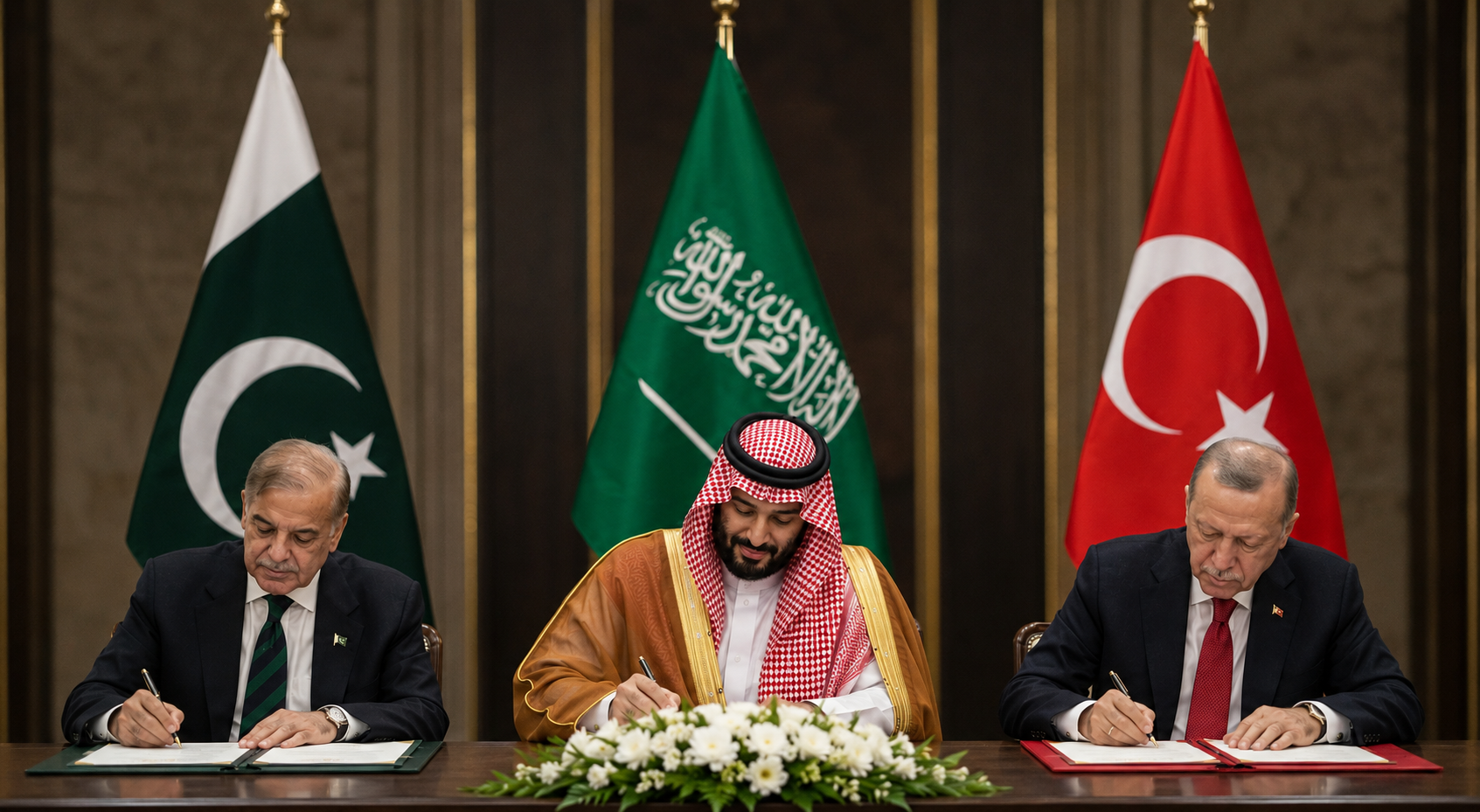
On 7 August 2026, in the holy city of Mecca, Saudi Arabia, Turkey and Pakistan signed the Mecca Joint Defence Agreement. The main clause is the most ancient of all the clauses in the Treaty book. An armed attack upon one of the three is considered to be an attack upon all of them. The accord also follows a more secretive defence industrial forum between the three states since about 2022 and the September 2025 Saudi-Pakistan Strategic Mutual Defence Agreement. So, according to the reports, several thousand Pakistani troops, aircraft and air defence systems were already deployed in the Kingdom ahead of the signing. The number of troops reported is considered that number, and it does not necessarily reflect my independent count. The automatic reaction for the Delhi and Jerusalem duo is to anticipate the emergence of an anti-bloc. The knee-jerk response for the Delhi and Jerusalem duo is to assume the formation of an anti-bloc. It is half right and half wrong, but the wrong half is the important one.
What the pact is not
It is not a NATO. That’s the message that has been repeated by analysts of all political stripes over the past several days since signing. There is no indication of the automatic and binding response mechanism which gives Article 5 teeth. The deal is not an agreement to march but collective deterrence and defence industrial coordination, according to Turkish and Pakistani officials. Pakistani officials have also claimed that the Saudi-Pakistan agreement in 2025 didn’t have the nuclear umbrella and there isn’t any valid public text that can prove that the trilateral version of the agreement changed that. I’ll leave the nuclear issue as just as much an unresolved as a settled issue. It’s also not targeted at India or Israel, certainly not on paper. The targets listed are the Houthis and Iran. The agreement was struck amid the 2026 Iran war and renewed conflict in the Arab peninsula nation of Yemen. I’m not going to say anything about it being against any country; it’s open for others to join, Erdogan said straightforwardly. Use that discount, but don’t disregard it. Not what India did, but the war on Iran and Israel’s attack on Doha in September 2025 were the trigger events. Why then, should Delhi and Jerusalem sleep if it is a modest, hedged Iran-facing arrangement? Indirect dangers are usually under-priced by planners, and, because the danger is indirect, it is the one that planners would rather avoid.
The meaning of it to India
The complacent worry is that Saudi Arabia may someday engage in a military battle with India on Pakistan’s side. Dismiss that. Riyadh will not use its partnership with India to bring Islamabad out of the war that it began. India has its own defence cooperation committee and has recently convened a security working group on counter terrorism with Saudi Arabia, and has energy trade, investment and a large Indian population in the Gulf. Saudi Arabia has good material grounds to hold India and no reason to consider it as a threat. It is not Saudi’s pivot against India.
The actual threat is one step lower and not diplomatic
The level of confidence in Pakistan is boosted. An isolated and cornered Pakistan is wary. A Pakistan which can boast of the funds of the Gulf, Pakistani drones and a defence industrial network behind it could make a future fight against India costlier than it once was. This is a point already made by Indian commentators. The worry isn’t that the deal secures a victory in the war for Pakistan. It is that it will reduce the political time that India has for a negotiated settlement to a fighting that it can then use to settle.
Pakistan becomes more industrialised. Turkey is now a serious defence exporter and Riyadh has already purchased Turkish drones, as part of the largest defence purchase deal that Ankara claims it has made. The whole supply chain to Pakistan is more important over the next ten years than any treaty clause. India’s Middle East communication gets tougher. Delhi has been working on the story that it is the non-ideological stable partner of choice in the region for two decades. That’s complicated by the presence of a visible Islamic security organisation, even a loose one. The response of the Indian people is not panic. It’s to stick with the tried and tested path of Riyadh and Abu Dhabi, continue to add fuel to the shaky thaw with Turkey and act as if Pakistan’s risk-on has gone up a level. The agreement is an opportunity to redouble India’s efforts rather than walk away from the Gulf.
What it means for Israel
In this case, the framing requires maintenance. The voice against Israel is loud and persistent in Turkey, and Pakistan does not acknowledge the state of Israel. But Turkey and Israel are not at war. As Erdogan ratchets up his rhetoric, they continue diplomatic and commercial relations. So, the three enemies of Israel are not lining up in a firing line. But the greater sin for Israel is the revelation of this pact. Gulf countries are developing a security architecture that doesn’t pass through Jerusalem, or, more and more, Washington. That’s a direct expense resulting from Israel’s actions. In September 2025, the attack on Doha demonstrated to all the capitals of the Gulf that even a rich and American-backed country could be attacked on its own soil. The sensible answer to that lesson is to get rid of reliance on Israeli or American protection. One manifestation of that instinct is the Mecca pact. That is, Israel’s regional strikes are creating the very coalition it fears. This is the beneficial, but painful, reality of Jerusalem. There’s a certain irony to be cited. Israel and this bloc have Iran as an opponent. A literal interpretation would find a more robust anti-Iran deterrence in the Gulf to be not necessarily a bad thing for Israeli security. That pact is aimed at precisely that – to de-Israelize and de-Americanize the region, and that makes it a strategic defeat for Israel, even though Tehran is the declared enemy.
In the Saudi question, what is the right tactic to play? What’s the right play in the Saudi question?
You feel that Saudi Arabia is playing a double game; trying to fend off Israel with one hand and join Israel’s enemies with the other. The facts seem to lead to a more sensible and, for Israel, more alarming place. But Riyadh is not in the process of courting normalisation at the moment. The Saudi stance has been toughened, not softened, since the Gaza war. In 2024, Crown Prince Mohammed bin Salman stated that there would be no diplomatic ties with Israel without a prior Palestinian state with East Jerusalem as its capital. Saudi officials have termed the Gaza war as genocide. The flexibility of the previous rounds of negotiations was altered to become a hard requirement under the new terms on which Israel’s current government is prepared to negotiate. It’s not Riyadh anymore that’s pushing for normalisation; it’s Washington. President Trump has linked the US-Saudi civilian nuclear deal to Saudi’s acceptance of the Abraham Accords. So the normalisation discourse you are reading is mostly American discourse and a Saudi (cold) outlook. In this light, there is no contradiction in Saudi behaviour. It’s hedging, and when a middle power doesn’t trust any single patron, that’s when they hedge.
- Riyadh maintains the normalisation option as a trump card with Washington, as it is necessary for unlocking a nuclear programme and guaranteeing security.
- Riyadh will also be constructing a Muslim security alliance to ensure its security is not reliant on Israel or the increasingly unpredictable United States of America.
- In the Islamic world, Riyadh maintains its reputation and controls opinion by not normalising in the face of Gaza’s flames.
All of these have their own specific Saudi interest. The tension you feel is a real tension, but not of a kind that means they intend to defect to another side. It’s a more challenging charge to level, as it is more difficult to respond. It is possible to detect a double game. A hedging strategy would just be a method that everyone should continue bidding.
The bottom line
It’s easy to over-rate the Mecca pact as a military tool and easy to under-rate as a signal. It will not fight wars of Pakistan or Israel’s enemies for India. What it is saying is that the Gulf is preparing an order that is not seeking the protection of Israel or the USA, and that Pakistan is now in a bigger circle of protection. The message for India is not the Saudi Arabia that’s gone hostile, but the Pakistan with a somewhat more aggressive risk-taking stance. Israel is warning that it is creating the coalition that it fears. For the Kingdom of Saudi Arabia, it’s proof that the Kingdom is interested in everyone, but not taking anything from anyone. Delhi and Jerusalem must prepare for that reality and not the more comfortable narrative of a block of foes. The easier is more pleasant. It is also wrong.

Dr. Nanda Kishor M. S. is an Associate Professor at the Department of Politics and International Studies, Pondicherry University, and former Head of Geopolitics and International Relations at Manipal University. His expertise spans India’s foreign policy, conflict resolution, international law, and national security, with several publications and fellowships from institutions including UNHCR, Brookings, and DAAD. The views expressed are the author’s own.
 Hridbina Chatterjee
  Divyanka Tandon
  Kumar Satish