
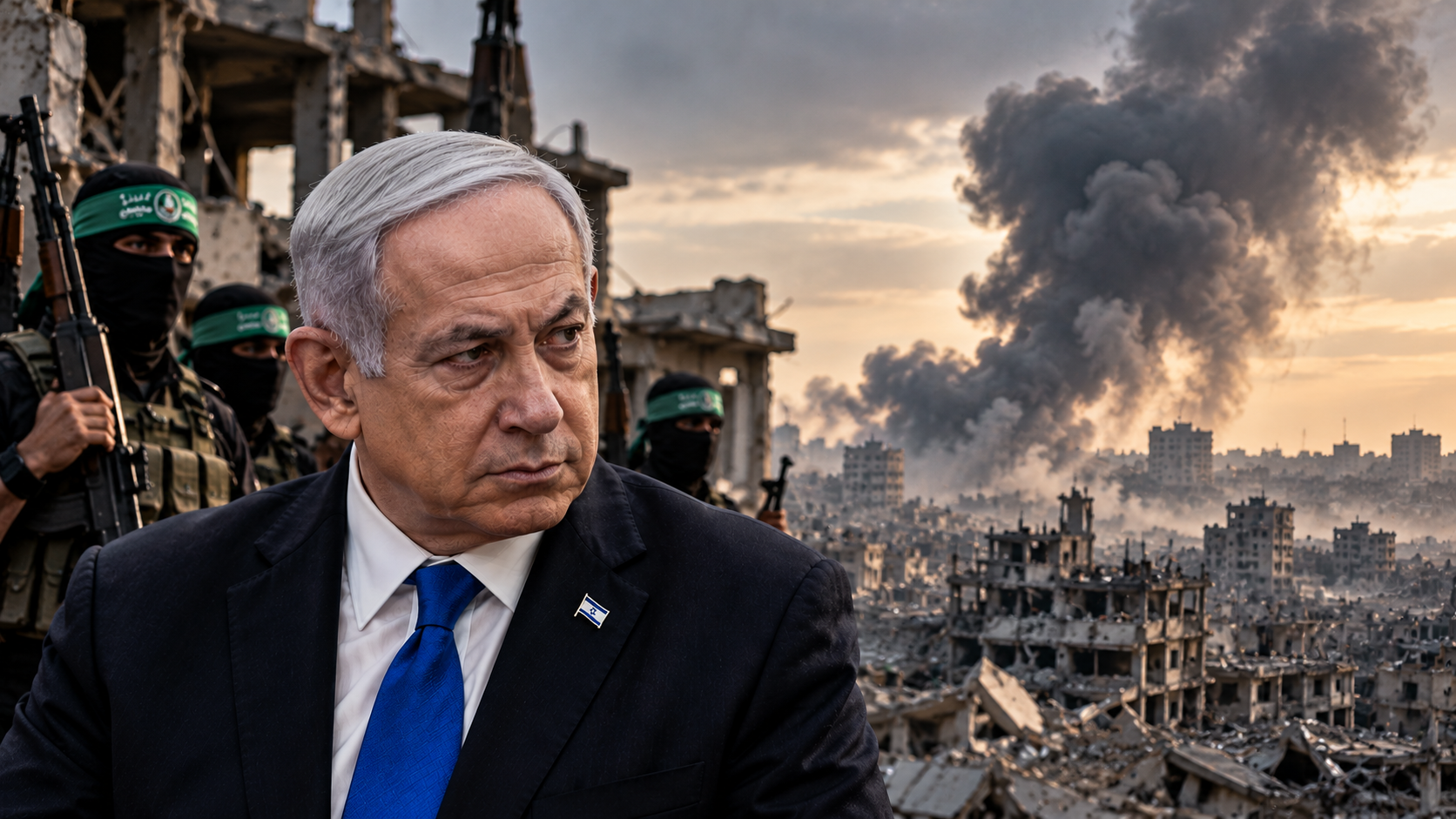
- Israel’s stated objective for entering Gaza was to demilitarise and dismantle Hamas’s military capabilities.
- October 7, 2023, has very much brought a new geopolitical change for Israel, as Israel has internationally faced greater political isolation.
- The ceasefire may have reduced the intensity of the conflict, but it has not resolved the fundamental political and security disagreements between Israel and Hamas.
- The absence of a clear post-war administration, the unresolved question of Hamas’s military capabilities, Israel’s security concerns and the wider regional confrontation involving Iran continue to make Gaza one of the most important geopolitical flashpoints in West Asia.
It was October 7, 2023, when a terrorist attack and invasion were carried out by Hamas against Israel, resulting in the loss of multiple lives. Hamas killed many Israeli citizens and detained dozens of Israeli citizens, which invited a greater retaliation from Israel. Since then, many have described October 7 as the turning point for West Asia and a defining moment in the Israel-Hamas war. Israel launched a massive military campaign against Hamas, and the scale of the operation was such that large parts of Gaza were reduced to ruins. Israel’s stated objective for entering Gaza was to demilitarise and dismantle Hamas’s military capabilities. To a significant extent, Israel has succeeded in weakening Hamas’s military infrastructure. However, the biggest difficulty in achieving the complete dismantling of Hamas lies in the decentralised nature of its operations. The nature of Hamas’s fighting structure is such that its forces operate through decentralised units, making it extremely difficult to completely dismantle the organisation and eliminate its military capabilities. As a result, both sides have remained engaged in a prolonged conflict. Iran has also been greatly involved in the broader conflict in Gaza.
Israel’s response to the October 7 terrorist attack was directed primarily against Hamas, but the wider regional dimension of the conflict has increasingly brought Iran and its network of regional allies and partners into the equation. However, the bigger question that emerged after October 7 was how the international community would respond to Israel’s military campaign in Gaza. Since October 7, and particularly in response to Israel’s military operations in Gaza, many countries have questioned Israel’s intentions. European countries, which for years had been among Israel’s strongest supporters, have increasingly questioned aspects of Israel’s conduct in Gaza. October 7, therefore, became an important turning point in how several European countries approached their relationship with Israel. Such has been the response from countries, as nations like South Africa and Turkey have taken the matter to international courts and filed legal cases against Israel, accusing it of committing genocide. The International Court of Justice (ICJ) has issued provisional measures in the case brought by South Africa, while the International Criminal Court (ICC) has issued arrest warrants for Prime Minister Benjamin Netanyahu over alleged war crimes and crimes against humanity.
October 7, 2023, has very much brought a new geopolitical change for Israel, as Israel has internationally faced greater political isolation. The much greater worry has been this growing isolation and the anti-Israel wave that has completely swept across Europe. But more importantly, and much more worryingly for Israel, this has become a greater political issue in the United States of America itself, where the Republican voter base, which has historically been considered a prime supporter of Israel, has also increasingly come out and questioned Israel’s actions in Gaza. Recent polling shows that although Republicans remain more supportive of Israel than Democrats, negative views of Israel and its government have increased among Republicans as well.
The Ceasefire and the Unresolved Future of Gaza
The biggest question now is: what is the current status of the conflict that began on October 7, 2023? As of now, since October 10, 2025, a ceasefire has been in place between Hamas and Israel. The ceasefire was agreed upon under terms that required Israel to halt its ongoing military activity inside Gaza, while Hamas would release Israeli hostages. While the ceasefire has significantly changed the nature of the conflict, the biggest question that remains is the political, security and post-war future of Gaza. Under the initiative of President Donald Trump, a Board of Peace framework was discussed during a meeting in Sharm el-Sheikh, Egypt, with the objective of establishing an arrangement that would be responsible for the future administration of Gaza. However, as of now, there has been limited political development on that front. There remain significant differences between Israel and Hamas. An agreement is in place, but Israel is not ready to completely withdraw from Gaza, while Hamas is not ready to fully demilitarise. These differences between Israel and Hamas have created a political deadlock over Gaza’s future. The Board of Peace initiative has also not necessarily materialised into concrete action. There is still no clear administration, no comprehensive policy framework and no clarity over how Gaza’s future governance will function. There is also no complete clarity regarding who will safeguard Gaza. From Israel’s perspective, there are concerns about security and the possibility of Hamas retaining its military capabilities, while at the same time there is no clear mechanism regarding how Hamas would actually be demilitarised.
The Challenge of Hamas and the Expanding Regional Conflict
The nature of Hamas’s combat structure makes this particularly difficult. Hamas operates through decentralised units and continues to retain military capabilities and an arsenal that could potentially pose a security challenge to Israel. At the same time, Israel’s focus has increasingly expanded beyond Hamas and Hezbollah towards Iran. From Israel’s perspective, if Iran’s regional influence and military capabilities can be contained, then the wider network of groups aligned with or supported by Iran—including Hamas and Hezbollah—could also be significantly weakened. This broader Israeli strategy has therefore expanded the conflict beyond Gaza. However, despite the military operations and the changing strategic calculations, there are still no clear long-term terms for the political settlement. It would therefore be correct to say that October 7, 2023, opened a Pandora’s box in West Asia. The conflict has reignited regional tensions, war has escalated across multiple fronts, the strategic balance of the region has been challenged, and the humanitarian catastrophe has only worsened.
Gaza’s Post-War Political Deadlock
Even with the ceasefire now in place, the fundamental questions remain unanswered: Who will govern Gaza? Who will provide its security? How will Hamas be demilitarised? When will Israel withdraw? Who will oversee reconstruction? And, most importantly, what will the political future of Gaza look like? Until these questions are answered, the October 7 conflict cannot truly be considered over. The fighting may have entered a different phase, but the political and security crisis that it created continues to shape West Asia. The ceasefire may have reduced the intensity of the conflict, but it has not resolved the fundamental political and security disagreements between Israel and Hamas. The absence of a clear post-war administration, the unresolved question of Hamas’s military capabilities, Israel’s security concerns and the wider regional confrontation involving Iran continue to make Gaza one of the most important geopolitical flashpoints in West Asia.

Aayush Pal is a freelance writer on contemporary geopolitical developments. The views expressed in his work are entirely his own.
 Archita Gaur
  Diksha Bharti