
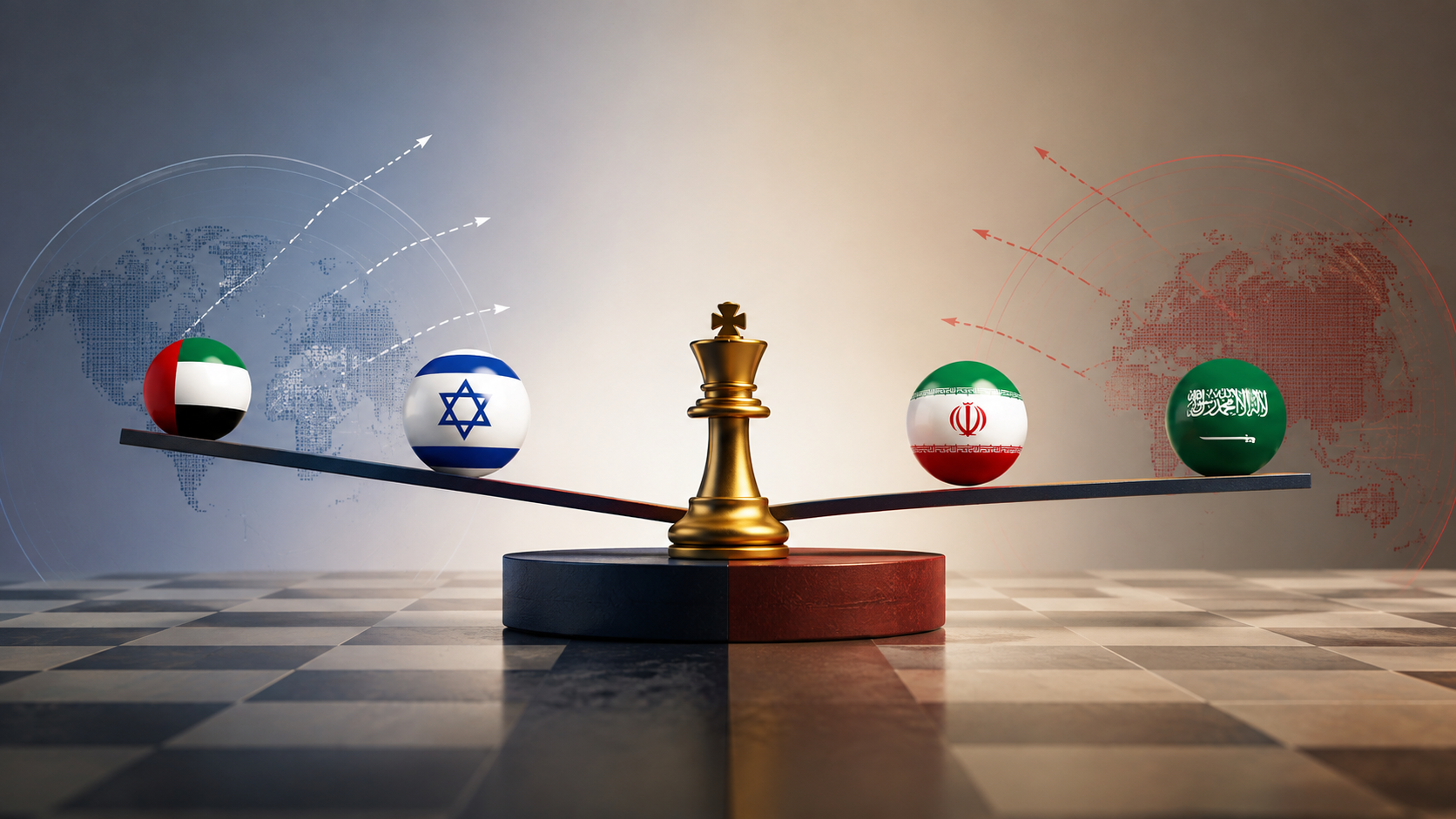
- The UAE is increasingly finding itself on the opposite side of several regional disputes from Saudi Arabia, particularly over Yemen, Sudan, oil policy, Iran, and the future balance of power in the Gulf. What was once a close partnership is increasingly becoming a managed rivalry.
- The Yemen crisis therefore demonstrates how the interests of Riyadh and Abu Dhabi, despite their continued cooperation in several areas, can directly collide when their regional priorities differ.
- For the UAE, however, southern Yemen has long been important because of its coastline, ports, maritime routes, and proximity to the Bab el-Mandeb Strait.
- The UAE is therefore attempting to maintain multiple partnerships at the same time. It wants to remain close to the United States and Israel, preserve working relations with Iran, manage its increasingly competitive relationship with Saudi Arabia, maintain its economic interests in Africa, and deepen ties with countries such as India.
The United Arab Emirates is one of the major players in West Asia, a country that stands as a testament to growth and prosperity in a region that has witnessed continuous wars, prolonged conflicts, and repeated invasions. West Asia has historically been a hub of intense geopolitical power contestation, yet the United Arab Emirates demonstrates that growth and stability are possible even in such a volatile environment. It maintains pragmatic relations with most regional countries and has built a foreign policy based on economic partnerships, strategic flexibility, and a strong presence in regional affairs. One of its longest-standing and most important relationships has been with Saudi Arabia.
However, the relationship between the two countries is now facing its most serious strain in years. The UAE is increasingly finding itself on the opposite side of several regional disputes from Saudi Arabia, particularly over Yemen, Sudan, oil policy, Iran, and the future balance of power in the Gulf. What was once a close partnership is increasingly becoming a managed rivalry. This competition is not limited to military and political influence. Both countries are competing to attract foreign investment, expand their global economic influence, and position themselves as the leading economic and strategic power in the Arab world. A major indication of this growing divide comes from the UAE’s decision to leave OPEC in May 2026, a move that gives Abu Dhabi greater freedom over its oil production and places it further apart from Saudi Arabia’s traditional role as the leading force within the organisation.
The competition between Saudi Arabia and the UAE is also visible in their economic strategies. Both countries are trying to reduce their dependence on oil by investing heavily in technology, artificial intelligence, advanced manufacturing, logistics, finance, and other high-growth sectors. Saudi Arabia is pursuing these ambitions through Vision 2030, while the UAE is attempting to strengthen Abu Dhabi and Dubai as global centres for finance, technology, trade, and investment. Both countries are therefore competing for capital from major powers such as the United States, China, India, and European economies. Whoever succeeds in building the stronger post-oil economy will have greater influence over the wider region.
The UAE’s regional strategy is also closely connected to its geographical position. The country has invested heavily in ports, logistics networks, and maritime infrastructure across the Red Sea, the Gulf of Aden, and East Africa. Control or influence over strategic ports provides the UAE with access to important trade routes connecting Asia, Africa, Europe, and the Middle East. This is why the Red Sea and the Bab el-Mandeb Strait remain central to Emirati strategy. The importance of these routes has become even clearer in 2026 as attacks by the Houthis have once again disrupted shipping in the region. On 11 August, a commercial vessel was attacked in the Bab el-Mandeb, highlighting the continuing vulnerability of one of the world’s most important maritime corridors.
The UAE’s involvement in Yemen has historically been driven by both security concerns and its interest in southern Yemen’s coastline and ports. When the Saudi-led intervention began in 2015, the UAE initially operated alongside Saudi Arabia against the Houthis. Over time, however, Abu Dhabi developed a different set of priorities and established close ties with the Southern Transitional Council, which seeks greater autonomy and independence for southern Yemen. This created a direct clash with Saudi Arabia’s objective of maintaining a unified Yemeni state that remains aligned with Saudi security interests.
The disagreement eventually escalated into an open confrontation. In late 2025 and early 2026, UAE-backed southern separatists made major territorial advances, prompting Saudi Arabia to intervene directly. Riyadh supported a counteroffensive against the Southern Transitional Council and demanded the withdrawal of remaining Emirati forces from Yemen. The UAE subsequently withdrew its remaining forces. Saudi-backed forces regained territory, while the STC leadership suffered a major setback.
This development represents one of the biggest strategic setbacks for the UAE in recent years. For Saudi Arabia, the issue is directly connected to its national security because instability or separatist control in southern Yemen could threaten its border and strategic interests. For the UAE, however, southern Yemen has long been important because of its coastline, ports, maritime routes, and proximity to the Bab el-Mandeb Strait. The Yemen crisis therefore demonstrates how the interests of Riyadh and Abu Dhabi, despite their continued cooperation in several areas, can directly collide when their regional priorities differ.
The East African Ambition
The UAE’s regional ambitions extend beyond the Arabian Peninsula and into the Horn of Africa. Ethiopia has been one of its important partners in the region, while the UAE has also developed significant economic interests around the Red Sea and the Gulf of Aden. Its involvement in Somaliland is particularly important because of the strategic location of the Berbera port.
The UAE-backed DP World has a major role in the development and operation of Berbera port, giving Abu Dhabi an important economic and logistical presence along the Gulf of Aden. Ethiopia’s earlier agreement with Somaliland to gain access to the port also adds another strategic dimension to the region’s changing geopolitical landscape. However, Somalia has strongly opposed such arrangements and, in January 2026, announced that it was cancelling agreements with the UAE, including port, defence, and security arrangements, accusing Abu Dhabi of undermining Somali sovereignty.
The situation becomes even more complicated after Israel formally recognises Somaliland in December 2025. Israel’s recognition changes the strategic calculations around the Gulf of Aden and Red Sea, particularly because Somaliland sits close to the Bab el-Mandeb Strait and Yemen. The development also creates another point of convergence between Israel and the UAE, although the two countries’ interests in the region are not necessarily identical.
The UAE’s relationship with Ethiopia is also significant because of the Grand Ethiopian Renaissance Dam. Egypt strongly opposes Ethiopia’s approach to the Nile and views the dam as a major issue for its water security. As the UAE maintains close economic and strategic relations with Ethiopia, Egypt increasingly views Abu Dhabi’s regional activities with suspicion. This has contributed to a broader alignment of interests between Egypt and Saudi Arabia on several regional issues.
Another major source of tension is Sudan. The UAE faces repeated accusations from Sudan’s army and other actors of supporting the Rapid Support Forces, or RSF, in Sudan’s civil war. Abu Dhabi strongly denies providing military support to the RSF and maintains that its role is humanitarian. However, the allegations remain a major source of tension between the UAE and Egypt, Saudi Arabia, and Sudanese authorities. The United States and UN experts have also previously described evidence of Emirati support for the RSF as credible.
Sudan has therefore become another major fault line in the Saudi-UAE relationship. Saudi Arabia has increasingly become involved in diplomatic efforts surrounding Sudan, while the UAE continues to face accusations over its alleged role in supporting the RSF. The conflict has also turned Sudan and the wider Horn of Africa into another arena where Saudi and Emirati interests compete.
The result is a growing pattern across the region. Saudi Arabia is becoming more assertive in Yemen and Sudan, while the UAE continues to maintain economic, commercial, and strategic networks across East Africa. Both countries are attempting to expand their influence without directly turning their rivalry into an open confrontation.
The Saudi-Pakistan-Türkiye Factor
Another important development affecting the UAE is Saudi Arabia’s rapidly expanding security relationship with Pakistan and Türkiye. This is considerably more significant than the earlier Saudi-Pakistan understanding that existed when the UAE’s regional position was being assessed.
On 7 August 2026, Saudi Arabia, Pakistan, and Türkiye signed the Mecca Joint Defence Agreement, creating a new security arrangement in which an armed attack against one of the three countries is treated as an attack against all. The agreement comes at a time of heightened regional tensions and growing uncertainty over the future of the Middle Eastern security order.
The agreement is particularly significant because Pakistan possesses nuclear weapons, Türkiye is a major NATO military power, and Saudi Arabia is one of the region’s largest economic and military powers. It does not automatically create a nuclear umbrella for Saudi Arabia, and claims that it is specifically designed as a nuclear deterrence framework should therefore be treated cautiously. However, Pakistan’s nuclear capability gives the arrangement an important strategic dimension.
For the UAE, this represents another shift in the regional balance. Abu Dhabi maintains close relations with Saudi Arabia, Pakistan, and Türkiye individually, but the emergence of a new security grouping gives Riyadh additional strategic options at a time when Saudi Arabia and the UAE are increasingly pursuing different regional policies. India is also closely watching the development and has said it is examining its implications for national security and regional stability.
UAE’s Balancing Act
The United Arab Emirates also has to maintain a careful balancing act between Israel and Iran. The UAE established formal diplomatic relations with Israel through the Abraham Accords in 2020 and has since developed extensive economic, technological, and security ties with Israel. At the same time, Iran remains one of the UAE’s most important geographical neighbours and a major regional power.
The UAE therefore does not want its relationship with Israel to completely destroy its working relationship with Iran. This becomes especially important during periods of direct confrontation between Iran, Israel, and the United States. In 2026, the UAE faces an even more difficult situation as the regional conflict directly affects its airspace, ports, energy infrastructure, and economy. The UAE has repeatedly stressed that its territory and airspace should not be used to launch military operations against Iran, even while maintaining close ties with the United States and Israel.
This balancing act becomes increasingly difficult as the regional conflict expands. Iran-aligned Houthis are attacking Saudi-linked interests and shipping routes in the Red Sea, while the wider conflict has also disrupted the Strait of Hormuz. The UAE therefore has to protect its economic interests while avoiding being dragged into a direct confrontation with Iran. The security of its ports, shipping routes, energy exports, and financial centres depends heavily on maintaining a degree of regional stability.
At the same time, the UAE is strengthening its relationship with India. India has become an increasingly important economic and strategic partner for Abu Dhabi, with both countries expanding cooperation in trade, energy, defence, technology, and investment. The relationship is particularly valuable for the UAE because India provides a major market, a large economy, and an important partner outside the traditional Western security framework.
The UAE is therefore attempting to maintain multiple partnerships at the same time. It wants to remain close to the United States and Israel, preserve working relations with Iran, manage its increasingly competitive relationship with Saudi Arabia, maintain its economic interests in Africa, and deepen ties with countries such as India.
The UAE’s challenge is no longer simply about expanding its influence in West Asia. It is about protecting the influence it has already built. Its rivalry with Saudi Arabia is spreading from Yemen to oil policy, Sudan, the Horn of Africa, and the wider regional order. At the same time, the UAE faces pressure from the continuing conflict involving Iran, Israel, the Houthis, and the broader disruption of regional trade routes.
For a country whose rise has been built on economic openness, trade, ports, investment, and political flexibility, the current regional environment presents a difficult test. The UAE’s ability to balance these competing relationships without becoming trapped in any one regional conflict will determine whether it can maintain its position as one of West Asia’s most influential powers.

Aayush Pal is a freelance writer on contemporary geopolitical developments. The views expressed in his work are entirely his own.
 Kumar Satish
  Anjali Singh