
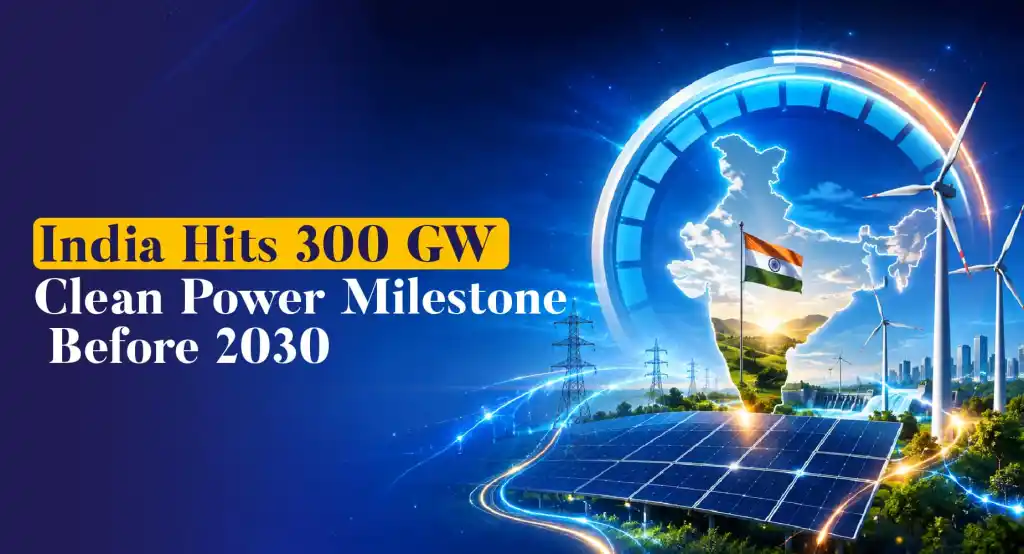
- The significance of 300 GW is more than a number. Clean energy is gaining increasing importance for India in terms of strategic autonomy, energy security, and geopolitical power.
- Ultimately, the country’s clean-energy ambitions will turn not just on how many solar panels and wind turbines it adds, but on its ability to create an ecosystem that can store, manage, and distribute clean electricity reliably.
- Therefore, energy security for India today is a mix of resource security, manufacturing security, and technology security.
- The real goal should be an energy system in which electricity is increasingly domestic, reliable, and affordable; critical technologies are manufactured in-country; mineral vulnerabilities are addressed through diversified supplies and recycling; and clean energy enhances industrial competitiveness.
India’s clean energy transition is entering a new phase. As of July 31, 2026, the installed capacity of power generation from non-fossil fuels in the country was 300 GW, or 300.50 GW. Solar contributed 164.59 GW, wind 58.14 GW, large and small hydro 57.24 GW, bio-power 11.75 GW, and nuclear 8.78 GW. The achievement puts India on a firm path to meet its 2030 target of 500 GW of non-fossil capacity. But the significance of 300 GW is more than a number.
Clean energy is gaining increasing importance for India in terms of strategic autonomy, energy security, and geopolitical power. The move could reduce reliance on imported fossil fuels, boost domestic manufacturing, enhance the competitiveness of Indian industry, and increase India’s leverage in the growing global clean-energy economy. Installed capacity, however, is insufficient to deliver strategic power. The more difficult challenge is to make renewable energy a reliable, secure, and technology-independent energy system.
From Capacity to Ability
Renewable energy in India has seen amazing growth. Solar and wind power have grown at an explosive pace, driven by cheaper technology, government incentives, and big money flowing into the sector. But capacity is not the same as electrical availability. There is no solar power at nighttime, and wind generation depends on the weather. As energy demand increases, India will face a fundamental challenge: building a system that is increasingly dependent on renewables and capable of delivering power when consumers and companies need it.
According to the International Energy Agency, industrial growth, cooling needs, agriculture, and electrification will drive India’s energy needs to grow by an average of 6.4% per year through 2030. This makes the next stage of the transition a whole lot more difficult. India is doing more than just replacing coal and other fossil fuels with renewables. It’s also building a much bigger electricity system. This implies investment in storage, transmission, forecasting, variable generation, and demand-side management.
The grid could become India’s strategic backbone.
The renewable resources are unequally distributed in India. Rajasthan and Gujarat have huge solar potential, and Tamil Nadu, Gujarat, Karnataka, and Maharashtra are important wind producers. In the meantime, the country’s largest centers of industrial and electrical consumption are widely dispersed. So we need a stronger national transmission system. India is planning to add more than 500 GW of non-fossil capacity to its transmission infrastructure by 2030. We are also enhancing inter-regional transmission capacity to enable power to flow between regions based on demand and generation conditions. This is a tactical consideration.
The high interconnection of the grid helps India to get the benefit of its geographical diversity. If solar production drops in one area, electricity can be supplied from another. Therefore, strong transmission may lower the risk from renewable intermittency. And so the Green Energy Corridor and its associated transmission investments need to be looked at as strategic national infrastructure and not just power sector infrastructure.
The next stage will be a function of storage.
If transmission is the base, energy storage will be the flexible engine of India’s green economy. Excess solar power produced during the day can be stored in batteries and shifted to the evening peak demand period. Pumped-storage hydropower can provide more long-term balancing capacity, and other technologies could eventually be part of the solution to seasonal variations. This presents an exciting industrial opportunity.
Batteries and storage devices should not be considered as imported equipment in India. Battery cells, power electronics, grid control technologies, pumped storage, and recycling capabilities can all become critical sectors in their own right. Ultimately, the country’s clean-energy ambitions will turn not just on how many solar panels and wind turbines it adds, but on its ability to create an ecosystem that can store, manage, and distribute clean electricity reliably.
The other side of energy security is domestic manufacturing.
What an irony the global energy transition is. The purpose of renewable energy is to decrease dependence on imported oil and gas. But the transformation depends on highly concentrated global supply chains for the technologies required. China remains dominant in many parts of the solar manufacturing chain, while key minerals and battery components are concentrated in a few countries. To this, India has responded with the implementation of production-linked incentive schemes, domestic manufacturing rules, and efforts to create an integrated solar manufacturing ecosystem. The next challenge is to go upstream.
Manufacturing solar modules in India will not be sufficient if the country continues to rely on imports for polysilicon, wafers, and other essential inputs. Likewise, electric vehicles cannot provide real energy security benefits if batteries continue to be heavily dependent on overseas supply chains. Hence, the clean energy industry should be treated as critical infrastructure by India.
Critical minerals could be the new oil.
The energy geopolitics of the twenty-first century will not be about oil alone. Lithium, cobalt, nickel, graphite, copper, and rare earth elements are increasingly important for batteries, electric vehicles, wind turbines, electronics, and electrical grids. The National Critical Mineral Mission, overseas mineral procurement, in-country exploration, and recycling activities have all helped in strengthening India’s critical mineral strategy. This is a vital point because mineral security could determine the timing and cost of India’s energy transition.
Recycling is going to be massively important. Materials used in batteries, solar panels, and electronic equipment can all be recovered and reused. Developing a circular economy around these resources could reduce import dependence and also create new domestic sectors. Therefore, energy security for India today is a mix of resource security, manufacturing security, and technology security.
Can clean electricity supplant the oil?
Oil remains India’s most significant fossil-fuel exposure. Still, it imports most of its crude oil needs, making its economy vulnerable to global prices, geopolitical upheavals, and interruptions in key oil-producing countries. The problem can’t be solved overnight just by switching to renewable electricity, as most of India’s oil consumption is in transport and petrochemicals. But electrification may change that equation over time. Electric automobiles, railroads, electric public transportation, and industrial electrification can replace petroleum in the regions where it is theoretically possible. As a greater proportion of that electricity is generated from domestic renewable sources, India’s exposure to global oil shocks will begin to decline. That could have implications beyond climate policy.
Less dependence on oil could improve India’s current account, reduce its vulnerability to energy-price inflation, and give it foreign policy latitude. So, electrification through domestic renewables can be a tool for strategic autonomy.
Can clean energy rescue vital industries?
The next frontier, beyond energy, is waiting. Steel, fertilisers, chemicals, and shipping all require energy-intensive fuels or industrial processes that are not always directly electrifiable. Here is where green hydrogen could become strategically important. India’s National Green Hydrogen Mission aims to make the country a major producer and exporter of green hydrogen and its derivatives, with a goal of 5 million tons of green hydrogen production annually by 2030.
If renewable electricity is cheap and reliable enough, green hydrogen could help cut emissions in steel and fertiliser and also reduce reliance on imported fossil-based feedstocks. It could also create a new export opportunity. Instead of exporting raw energy resources, India can incrementally manufacture green industrial goods using domestic renewable electricity.
Strategic power of 300 GW
Therefore, the 300 GW milestone is an important one but should not be used as an excuse to become complacent. India needs to ask three larger questions: Can renewable energy be reliable 24/7? Can it develop safe, domestic supply chains for renewable energy technology and critical minerals? Can sustainable energy reduce our dependence on oil and decarbonise key industries? It’s the responses that will determine if India’s renewable energy expansion is a real strategic advantage. In the early days of the clean-energy transition, it was all about scale. The next step has to be about robustness, reliability, and technological depth. So, India has to look beyond the 500 GW target.
The real goal should be an energy system in which electricity is increasingly domestic, reliable, and affordable; critical technologies are manufactured in-country; mineral vulnerabilities are addressed through diversified supplies and recycling; and clean energy enhances industrial competitiveness. If successful, the renewable shift will be much more than an environmental success. By 2047, it could become one of the pillars of India’s strategic autonomy, reducing its exposure to external energy shocks and raising its industrial and geopolitical profile. India’s growth is reflected in the 300 GW milestone. The challenge now is to turn that scale into strategic power.

Anusreeta Dutta is a columnist and climate researcher with experience in political analysis, ESG research, and energy policy. Views expressed are the author’s own.
 Aayush Pal
  Piyush Anand
  Parag Gilada